Results 1-19 of 19
<<< Previous 1 Next >>>
![[Life of Aesop: Aesop convicting his fellow servants of having eaten the figs.]](img-thumbnail/jpegs/48708.jpg)
[Life of Aesop: Aesop convicting his fellow servants of having eaten the figs.] [So thrive false witnesses...]
[Etched by Thomas Dudley after Francis Barlow.]
[Amsterdam: Etiènne Roger, 1714.]
Etching. Sheet 205 x 165mm (8 x 6½") Trimmed within plate, mounted on album paper.
Aesop, having beeen accused of eating his master's figs, has vomited to show he had eaten nothing, then insists his accusers do the same, proving their guilt. Plate 1 of thirty-one illustrations added to the second edition of Barlow's "Æsop's Fables, With His Life" (1687), to illustrate the translation of Planudes's Life of Aesop, which was unillustrated in the first edition of 1666. This example comes from an Amsterdam edition, 'Les Fables d'Esope', with the printing plate trimmed down. All of the plates were designed by Barlow: they were etched c.1678-9, only five by Barlow; the rest, including this one, by Thomas Dudley. Originally the plate extended down with a title verse (possibly written by Aphra Behn, who wrote new verses for the fables), but for this non-English edition the verse was trimmed off and new borders engraved. Little is known of Dudley: on one plate of this series he signed himself as a student of Wenceslaus Hollar; and in 1679 he went to Lisbon, where he is known to have made further prints, and he is not supposed to have returned to England thereafter. He etched some portraits but these prints after Barlow are his most important work. BM: 1871,0812.235, described as a proof state.
[Ref: 48708] £95.00
(£114.00 incl.VAT)
![[Life of Aesop: Aesop resolving the gardener's problem.]](img-thumbnail/jpegs/48712.jpg)
[Life of Aesop: Aesop resolving the gardener's problem.] [No more you learned fops...]
Tho: Dudley fecit [after Francis Barlow.]
[Amsterdam: Etiènne Roger, 1714.]
Proof etching. Sheet 205 x 165mm (8 x 6½") Trimmed within plate, mounted on album paper.
A gardener asks of Xanthus why his cultivated herbs did not grow as well as wild ones. Aesop replied that Mother Nature regarded them as step-children rather than her own. Plate 7 of thirty-one illustrations added to the second edition of Barlow's "Æsop's Fables, With His Life" (1687), to illustrate the translation of Planudes's Life of Aesop, which was unillustrated in the first edition of 1666. This example comes from an Amsterdam edition, 'Les Fables d'Esope', with the printing plate trimmed down. All of the plates were designed by Barlow: they were etched c.1678-9, only five by Barlow; the rest, including this one, by Thomas Dudley. Originally the plate extended down with a title verse (possibly written by Aphra Behn, who wrote new verses for the fables), but for this non-English edition the verse was trimmed off and new borders engraved. Little is known of Dudley: on one plate of this series he signed himself as a student of Wenceslaus Hollar; and in 1679 he went to Lisbon, where he is known to have made further prints, and he is not supposed to have returned to England thereafter. He etched some portraits but these prints after Barlow are his most important work. BM: 1871,0812.241, described as a proof state.
[Ref: 48712] £110.00
(£132.00 incl.VAT)
![[Life of Aesop: Aesop ordered by Xanthus to take a dish to her that loves him best.]](img-thumbnail/jpegs/48699.jpg)
[Life of Aesop: Aesop ordered by Xanthus to take a dish to her that loves him best.] [A Wife, or Dog, as certaine reasons prove...]
Tho: Dudley fecit 1678 [after Francis Barlow].
[Amsterdam: Etiènne Roger, 1714.]
Proof etching. Sheet 205 x 165mm (8 x 6½") Trimmed within plate, mounted on album paper.
Xanthus, Aesop's master, hands a dish of meat to Aesop, expecting him to give it to his wife. However Aesop gives in to a dog, seen in the background. Top right are musicians in a gallery Plate 8 of thirty-one illustrations added to the second edition of Barlow's "Æsop's Fables, With His Life", to illustrate the translation of Planudes's Life of Aesop, which was unillustrated in the first edition of 1666. This example comes from an Amsterdam edition, 'Les Fables d'Esope', with the printing plate trimmed down. All of the plates were designed by Barlow: they were etched c.1678-9, only five by Barlow; the rest, including this one, by Thomas Dudley. Originally the plate extended down with a title verse (possibly written by Aphra Behn, who wrote new verses for the fables), but for this non-English edition the verse was trimmed off and new borders engraved. Little is known of Dudley: on one plate of this series he signed himself as a student of Wenceslaus Hollar; and in 1679 he went to Lisbon, where he is known to have made further prints, and he is not supposed to have returned to England thereafter. He etched some portraits but these prints after Barlow are his most important work. BM: 1871,0812.243, described as a proof state.
[Ref: 48699] £95.00
(£114.00 incl.VAT)
![[Life of Aesop: Aesop serving tongues.]](img-thumbnail/jpegs/48715.jpg)
[Life of Aesop: Aesop serving tongues.] [The maryed men afronted at the jest...]
[Etched by Thomas Dudley after Francis Barlow.]
[Amsterdam: Etiènne Roger, 1714.]
Proof etching. Sheet 205 x 165mm (8 x 6½") Trimmed within plate, mounted on album paper.
Aesop, ordered to serve a dinner of the best, serves up tongues at every course to Xanthus and his guests. When confronted, Aesop replies ''What excels the tongue? It is the great channel of learning and philosophy''. Plate 10 of thirty-one illustrations added to the second edition of Barlow's "Æsop's Fables, With His Life" (1687), to illustrate the translation of Planudes's Life of Aesop, which was unillustrated in the first edition of 1666. This example comes from an Amsterdam edition, 'Les Fables d'Esope', with the printing plate trimmed down. All of the plates were designed by Barlow: they were etched c.1678-9, only five by Barlow; the rest, including this one, by Thomas Dudley. Originally the plate extended down with a title verse (possibly written by Aphra Behn, who wrote new verses for the fables), but for this non-English edition the verse was trimmed off and new borders engraved. Little is known of Dudley: on one plate of this series he signed himself as a student of Wenceslaus Hollar; and in 1679 he went to Lisbon, where he is known to have made further prints, and he is not supposed to have returned to England thereafter. He etched some portraits but these prints after Barlow are his most important work. BM: 1871,0812.252, described as a proof state.
[Ref: 48715] £95.00
(£114.00 incl.VAT)
![[Life of Aesop: Aesop taken to prison.]](img-thumbnail/jpegs/48710.jpg)
[Life of Aesop: Aesop taken to prison.] [How vaine are mens designes...]
Tho: Dudley fecit [after Francis Barlow.]
[Amsterdam: Etiènne Roger, 1714.]
Proof etching. Sheet 205 x 165mm (8 x 6½") Trimmed within plate, mounted on album paper.
Having found treasure for Xanthus, Xanthus still orders Aesop to be imprisoned. Aesop complains of the bad faith and is released. Plate 14 of thirty-one illustrations added to the second edition of Barlow's "Æsop's Fables, With His Life" (1687), to illustrate the translation of Planudes's Life of Aesop, which was unillustrated in the first edition of 1666. This example comes from an Amsterdam edition, 'Les Fables d'Esope', with the printing plate trimmed down. All of the plates were designed by Barlow: they were etched c.1678-9, only five by Barlow; the rest, including this one, by Thomas Dudley. Originally the plate extended down with a title verse (possibly written by Aphra Behn, who wrote new verses for the fables), but for this non-English edition the verse was trimmed off and new borders engraved. Little is known of Dudley: on one plate of this series he signed himself as a student of Wenceslaus Hollar; and in 1679 he went to Lisbon, where he is known to have made further prints, and he is not supposed to have returned to England thereafter. He etched some portraits but these prints after Barlow are his most important work. BM: 1871,0812.247, described as a proof state.
[Ref: 48710] £95.00
(£114.00 incl.VAT)
![[Life of Aesop: Beaten by Xanthus.] [Philosophers like Fortune-tellers thrive,](img-thumbnail/jpegs/48698.jpg)
[Life of Aesop: Beaten by Xanthus.] [Philosophers like Fortune-tellers thrive, / Those by false notions, these false flateries live, / And those as oft true vertue do mistake, / As these false auguries, and predictions make.]
[Etched by Thomas Dudley after Francis Barlow.]
[Amsterdam: Etiènne Roger, 1714.]
Proof etching. Sheet 200 x 165mm (8 x 6½"). Trimmed within plate, mounted on album paper.
Aesop as a slave on Samos, being beaten by his owner Xanthus for saying he had seen two crows, when only one was in sight. Plate 16 of thirty-one illustrations added to the second edition of Barlow's "Æsop's Fables, With His Life", to illustrate the translation of Planudes's Life of Aesop, which was unillustrated in the first edition of 1666. This example comes from an Amsterdam edition, 'Les Fables d'Esope', with the printing plate trimmed down. All of the plates were designed by Barlow: they were etched c.1678-9, only five by Barlow; the rest, including this one, by Thomas Dudley. Originally the plate extended down with a title verse (possibly written by Aphra Behn, who wrote new verses for the fables), but for this non-English edition the verse was trimmed off and new borders engraved. Little is known of Dudley: on one plate of this series he signed himself as a student of Wenceslaus Hollar; and in 1679 he went to Lisbon, where he is known to have made further prints, and he is not supposed to have returned to England thereafter. He etched some portraits but these prints after Barlow are his most important work. BM: 1871,0812.249, described as a proof state.
[Ref: 48698] £95.00
(£114.00 incl.VAT)
![[Life of Aesop: Aesop interpreting an inscription on a tomb, thereby discovering a treasure.]](img-thumbnail/jpegs/68293.jpg)
[Life of Aesop: Aesop interpreting an inscription on a tomb, thereby discovering a treasure.] [How poore is man whom sordid interest sways...]
Tho: Dudley fecit [after Francis Barlow.]
[Amsterdam: Etiènne Roger, 1714.]
Proof etching, text verso. Sheet 205 x 165mm (8 x 6½") Trimmed within plate, mounted on album paper.
Aesop agrees to decypher an inscription and find the treasure in return for his freedom. After he digs it up, Xanthus reneges, but Aesop tricks him into giving Aesop half the trove. Plate 19 of thirty-one illustrations added to the second edition of Barlow's "Æsop's Fables, With His Life", to illustrate the translation of Planudes's Life of Aesop, which was unillustrated in the first edition of 1666. This example comes from an Amsterdam edition, 'Les Fables d'Esope', with the printing plate trimmed down. All of the plates were designed by Barlow: they were etched c.1678-9, only five by Barlow; the rest, including this one, by Thomas Dudley. Originally the plate extended down with a title verse (possibly written by Aphra Behn, who wrote new verses for the fables), but for this non-English edition the verse was trimmed off and new borders engraved. Little is known of Dudley: on one plate of this series he signed himself as a student of Wenceslaus Hollar; and in 1679 he went to Lisbon, where he is known to have made further prints, and he is not supposed to have returned to England thereafter. He etched some portraits but these prints after Barlow are his most important work. BM: 1871,0812.250, described as a proof state.
[Ref: 68293] £95.00
(£114.00 incl.VAT)
![[Life of Aesop: Aesop interpreting to the Samians the portent of the eagle and the public ring.]](img-thumbnail/jpegs/68292.jpg)
[Life of Aesop: Aesop interpreting to the Samians the portent of the eagle and the public ring.] [In vaine the learned do their knowledge boast...]
Tho: Dudley fecit [after Francis Barlow.]
[Amsterdam: Etiènne Roger, 1714.]
Proof etching; text verso. Sheet 205 x 165mm (8 x 6½") Trimmed within plate, mounted on album paper.
Aesop agrees to decypher a portent and, in doing so, forces his master Xanthus to give him his freedom. Plate 20 of thirty-one illustrations added to the second edition of Barlow's "Æsop's Fables, With His Life" (1687), to illustrate the translation of Planudes's Life of Aesop, which was unillustrated in the first edition of 1666. This example comes from an Amsterdam edition, 'Les Fables d'Esope', with the printing plate trimmed down. All of the plates were designed by Barlow: they were etched c.1678-9, only five by Barlow; the rest, including this one, by Thomas Dudley. Originally the plate extended down with a title verse (possibly written by Aphra Behn, who wrote new verses for the fables), but for this non-English edition the verse was trimmed off and new borders engraved. Little is known of Dudley: on one plate of this series he signed himself as a student of Wenceslaus Hollar; and in 1679 he went to Lisbon, where he is known to have made further prints, and he is not supposed to have returned to England thereafter. He etched some portraits but these prints after Barlow are his most important work. BM: 1871,0812.251, described as a proof state.
[Ref: 68292] £95.00
(£114.00 incl.VAT)
![[Life of Aesop: Aesop kneeling before king Croesus.]](img-thumbnail/jpegs/48714.jpg)
[Life of Aesop: Aesop kneeling before king Croesus.] [Of all the graces, Heaven in man designd...]
[Etched by Thomas Dudley after Francis Barlow.]
[Amsterdam: Etiènne Roger, 1714.]
Proof etching. Sheet 205 x 165mm (8 x 6½") Trimmed within plate, mounted on album paper.
Aesop negotiates with Croesus to prevent war between Lydia and Samos. Plate 21 of thirty-one illustrations added to the second edition of Barlow's "Æsop's Fables, With His Life" (1687), to illustrate the translation of Planudes's Life of Aesop, which was unillustrated in the first edition of 1666. This example comes from an Amsterdam edition, 'Les Fables d'Esope', with the printing plate trimmed down. All of the plates were designed by Barlow: they were etched c.1678-9, only five by Barlow; the rest, including this one, by Thomas Dudley. Originally the plate extended down with a title verse (possibly written by Aphra Behn, who wrote new verses for the fables), but for this non-English edition the verse was trimmed off and new borders engraved. Little is known of Dudley: on one plate of this series he signed himself as a student of Wenceslaus Hollar; and in 1679 he went to Lisbon, where he is known to have made further prints, and he is not supposed to have returned to England thereafter. He etched some portraits but these prints after Barlow are his most important work. BM: 1871,0812.252, described as a proof state.
[Ref: 48714] £95.00
(£114.00 incl.VAT)
![[Life of Aesop: Aesop welcomed on his return to Samos from the court of Lydia.]](img-thumbnail/jpegs/48707.jpg)
[Life of Aesop: Aesop welcomed on his return to Samos from the court of Lydia.] [When eloquence the stubborn powers assailes...]
[Etched by Thomas Dudley after Francis Barlow.]
[Amsterdam: Etiènne Roger, 1714.]
Proof etching. Sheet 205 x 165mm (8 x 6½") Trimmed within plate, small tear, mounted on album paper.
Aesop, having negotiated peace with his former master Xanthus of Lydia, steps off a boat with an olive branch in his hand, and is welcomed by the rulers of Samos, with a band of horns and trumpets. Plate 22 of thirty-one illustrations added to the second edition of Barlow's "Æsop's Fables, With His Life", to illustrate the translation of Planudes's Life of Aesop, which was unillustrated in the first edition of 1666. This example comes from an Amsterdam edition, 'Les Fables d'Esope', with the printing plate trimmed down. All of the plates were designed by Barlow: they were etched c.1678-9, only five by Barlow; the rest, including this one, by Thomas Dudley. Originally the plate extended down with a title verse (possibly written by Aphra Behn, who wrote new verses for the fables), but for this non-English edition the verse was trimmed off and new borders engraved. Little is known of Dudley: on one plate of this series he signed himself as a student of Wenceslaus Hollar; and in 1679 he went to Lisbon, where he is known to have made further prints, and he is not supposed to have returned to England thereafter. He etched some portraits but these prints after Barlow are his most important work. BM: 1871,0812.259, described as a proof state.
[Ref: 48707] £110.00
(£132.00 incl.VAT)
![[Life of Aesop: Aesop falsely accused by Eunus, his adopted son.]](img-thumbnail/jpegs/48713.jpg)
[Life of Aesop: Aesop falsely accused by Eunus, his adopted son.] [To what vast heights had Aesop's glory run...]
Tho: Dudley fecit [after Francis Barlow.]
[Amsterdam: Etiènne Roger, 1714.]
Proof etching. Sheet 205 x 165mm (8 x 6½") Trimmed within plate, mounted on album paper.
Eunus had forged letters, apparently from Aesop offering his services to foreign kings. Aesop is condemned to death and Ennus is given Aesop's estates as a reward. Plate 23 of thirty-one illustrations added to the second edition of Barlow's "Æsop's Fables, With His Life", to illustrate the translation of Planudes's Life of Aesop, which was unillustrated in the first edition of 1666. This example comes from an Amsterdam edition, 'Les Fables d'Esope', with the printing plate trimmed down. All of the plates were designed by Barlow: they were etched c.1678-9, only five by Barlow; the rest, including this one, by Thomas Dudley. Originally the plate extended down with a title verse (possibly written by Aphra Behn, who wrote new verses for the fables), but for this non-English edition the verse was trimmed off and new borders engraved. Little is known of Dudley: on one plate of this series he signed himself as a student of Wenceslaus Hollar; and in 1679 he went to Lisbon, where he is known to have made further prints, and he is not supposed to have returned to England thereafter. He etched some portraits but these prints after Barlow are his most important work. BM: 1871,0812.241, described as a proof state.
[Ref: 48713] £95.00
(£114.00 incl.VAT)
![[Life of Aesop: Aesop in the sepulchre fed by Hermippus.]](img-thumbnail/jpegs/48701.jpg)
[Life of Aesop: Aesop in the sepulchre fed by Hermippus.] [So pitied falls the innocent accused...]
[Etched by Thomas Dudley after Francis Barlow.]
[Amsterdam: Etiènne Roger, 1714.]
Proof etching. Sheet 205 x 165mm (8 x 6½") Trimmed within plate, mounted on album paper.
Eunus, Aesop's adopted son, forged papers that inplicated Aesop in treason. King Lycerus ordered Hermippus to put Aesop to death, but instead he hid Aesop until he was reprieved. Plate 24 of thirty-one illustrations added to the second edition of Barlow's "Æsop's Fables, With His Life", to illustrate the translation of Planudes's Life of Aesop, which was unillustrated in the first edition of 1666. This example comes from an Amsterdam edition, 'Les Fables d'Esope', with the printing plate trimmed down. All of the plates were designed by Barlow: they were etched c.1678-9, only five by Barlow; the rest, including this one, by Thomas Dudley. Originally the plate extended down with a title verse (possibly written by Aphra Behn, who wrote new verses for the fables), but for this non-English edition the verse was trimmed off and new borders engraved. Little is known of Dudley: on one plate of this series he signed himself as a student of Wenceslaus Hollar; and in 1679 he went to Lisbon, where he is known to have made further prints, and he is not supposed to have returned to England thereafter. He etched some portraits but these prints after Barlow are his most important work. BM: 1871,0812.255, described as a proof state.
[Ref: 48701] £95.00
(£114.00 incl.VAT)
![[Life of Aesop: Eunus confronted by Aesop.]](img-thumbnail/jpegs/48700.jpg)
[Life of Aesop: Eunus confronted by Aesop.] [Ungrateful Eunus how could you betray...]
[Etched by Thomas Dudley after Francis Barlow.]
[Amsterdam: Etiènne Roger, 1714.]
Proof etching. Sheet 205 x 165mm (8 x 6½") Trimmed within plate, mounted on album paper.
Eunus, Aesop's adopted son, forged papers that inplicated Aesop in treason. When Aesop is vindicated, Ennus is condemned to death, but Aesop intercedes oh his behalf and re-adopts him. However, shamed, Eunus can be seen flinging himself from a cliff behind. Plate 26 of thirty-one illustrations added to the second edition of Barlow's "Æsop's Fables, With His Life", to illustrate the translation of Planudes's Life of Aesop, which was unillustrated in the first edition of 1666. This example comes from an Amsterdam edition, 'Les Fables d'Esope', with the printing plate trimmed down. All of the plates were designed by Barlow: they were etched c.1678-9, only five by Barlow; the rest, including this one, by Thomas Dudley. Originally the plate extended down with a title verse (possibly written by Aphra Behn, who wrote new verses for the fables), but for this non-English edition the verse was trimmed off and new borders engraved. Little is known of Dudley: on one plate of this series he signed himself as a student of Wenceslaus Hollar; and in 1679 he went to Lisbon, where he is known to have made further prints, and he is not supposed to have returned to England thereafter. He etched some portraits but these prints after Barlow are his most important work. BM: 1871,0812.257, described as a proof state.
[Ref: 48700] £95.00
(£114.00 incl.VAT)
![[Life of Aesop: Aesop with King Nectenabo, king of Egypt.]](img-thumbnail/jpegs/48711.jpg)
[Life of Aesop: Aesop with King Nectenabo, king of Egypt.] [How vaine are mens designes...]
Tho: Dudley fecit [after Francis Barlow.]
[Amsterdam: Etiènne Roger, 1714.]
Proof etching. Sheet 205 x 165mm (8 x 6½") Trimmed within plate, mounted on album paper.
Nectenabo challenged Xanthus to build a tower that touches neither earth nor heaven. Aesop trains eagles to carry children in baskets, travels to Egypt and tells Nectenabo they are the workmen for the tower and requests Nectenabo send the building materials to them. Nectenabo replies he has no men that can fly and admits defeat. Plate 27 of thirty-one illustrations added to the second edition of Barlow's "Æsop's Fables, With His Life", to illustrate the translation of Planudes's Life of Aesop, which was unillustrated in the first edition of 1666. This example comes from an Amsterdam edition, 'Les Fables d'Esope', with the printing plate trimmed down. All of the plates were designed by Barlow: they were etched c.1678-9, only five by Barlow; the rest, including this one, by Thomas Dudley. Originally the plate extended down with a title verse (possibly written by Aphra Behn, who wrote new verses for the fables), but for this non-English edition the verse was trimmed off and new borders engraved. Little is known of Dudley: on one plate of this series he signed himself as a student of Wenceslaus Hollar; and in 1679 he went to Lisbon, where he is known to have made further prints, and he is not supposed to have returned to England thereafter. He etched some portraits but these prints after Barlow are his most important work. BM: 1871,0812.258, described as a proof state.
[Ref: 48711] £120.00
(£144.00 incl.VAT)
![[Life of Aesop: the death of Aesop.]](img-thumbnail/jpegs/48706.jpg)
[Life of Aesop: the death of Aesop.] [Reader reflect upon this scene of woe...]
T D [Thomas Dudley] fecit [after Francis Barlow].
[Amsterdam: Etiènne Roger, 1714.]
Proof etching. Sheet 205 x 165mm (8 x 6½") Trimmed within plate, mounted on album paper.
Aesop, on a diplomatic mission to Delphi from King Croesus of Lydia, was sentenced to death on a trumped-up charge of temple theft, and is thrown from a cliff. Plate 30 of thirty-one illustrations added to the second edition of Barlow's "Æsop's Fables, With His Life", to illustrate the translation of Planudes's Life of Aesop, which was unillustrated in the first edition of 1666. This example comes from an Amsterdam edition, 'Les Fables d'Esope', with the printing plate trimmed down. All of the plates were designed by Barlow: they were etched c.1678-9, only five by Barlow; the rest, including this one, by Thomas Dudley. Originally the plate extended down with a title verse (possibly written by Aphra Behn, who wrote new verses for the fables), but for this non-English edition the verse was trimmed off and new borders engraved. Little is known of Dudley: on one plate of this series he signed himself as a student of Wenceslaus Hollar; and in 1679 he went to Lisbon, where he is known to have made further prints, and he is not supposed to have returned to England thereafter. He etched some portraits but these prints after Barlow are his most important work. BM: 1871,0812.259, described as a proof state.
[Ref: 48706] £95.00
(£114.00 incl.VAT)
![[Life of Aesop: Aesop bought by the philosopher Xanthus.]](img-thumbnail/jpegs/48702.jpg)
[Life of Aesop: Aesop bought by the philosopher Xanthus.] [How poore's the price...]
Tho: Dudley fecit [after Francis Barlow.]
[Amsterdam: Etiènne Roger, 1714.]
Proof etching. Sheet 205 x 165mm (8 x 6½") Trimmed within plate, mounted on album paper.
Aesop bought in a slave market. Plate 5 of thirty-one illustrations added to the second edition of Barlow's "Æsop's Fables, With His Life", to illustrate the translation of Planudes's Life of Aesop, which was unillustrated in the first edition of 1666. This example comes from an Amsterdam edition, 'Les Fables d'Esope', with the printing plate trimmed down. All of the plates were designed by Barlow: they were etched c.1678-9, only five by Barlow; the rest, including this one, by Thomas Dudley. Originally the plate extended down with a title verse (possibly written by Aphra Behn, who wrote new verses for the fables), but for this non-English edition the verse was trimmed off and new borders engraved. Little is known of Dudley: on one plate of this series he signed himself as a student of Wenceslaus Hollar; and in 1679 he went to Lisbon, where he is known to have made further prints, and he is not supposed to have returned to England thereafter. He etched some portraits but these prints after Barlow are his most important work. BM: 1871,0812.239, described as a proof state.
[Ref: 48702] £95.00
(£114.00 incl.VAT)
![[Life of Aesop: Aesop passing the house of the father of Xanthus's wife.]](img-thumbnail/jpegs/48703.jpg)
[Life of Aesop: Aesop passing the house of the father of Xanthus's wife.] [Insulting women while their slaves obey...]
Tho: Dudley fecit [after Francis Barlow.]
[Amsterdam: Etiènne Roger, 1714.]
Proof etching. Sheet 205 x 165mm (8 x 6½") Trimmed within plate, mounted on album paper. Letterpress overprinting.
Having caused Xanthus's wife to leave him, Aesop stands outside her father's house telling a servant that Xanthus would be celebrating his second marriage the following day, the wife listening. She soon rushed home. Plate 9 of thirty-one illustrations added to the second edition of Barlow's "Æsop's Fables, With His Life", to illustrate the translation of Planudes's Life of Aesop, which was unillustrated in the first edition of 1666. This example comes from an Amsterdam edition, 'Les Fables d'Esope', with the printing plate trimmed down. All of the plates were designed by Barlow: they were etched c.1678-9, only five by Barlow; the rest, including this one, by Thomas Dudley. Originally the plate extended down with a title verse (possibly written by Aphra Behn, who wrote new verses for the fables), but for this non-English edition the verse was trimmed off and new borders engraved. Little is known of Dudley: on one plate of this series he signed himself as a student of Wenceslaus Hollar; and in 1679 he went to Lisbon, where he is known to have made further prints, and he is not supposed to have returned to England thereafter. He etched some portraits but these prints after Barlow are his most important work. BM: 1871,0812.242, described as a proof state.
[Ref: 48703] £95.00
(£114.00 incl.VAT)
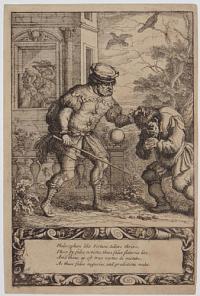
Philosophers like Fortune-tellers thrive, / Those by false notions, these false flateries live, / And those as oft true vertue do mistake, / As these false auguries, and predictions make.
[Etched by Thomas Dudley after Francis Barlow.]
[London, 1687.]
Etching. Sheet 250 x 170mm (9¾ x 6¾"). Trimmed within plate on three sides, paper toned.
Aesop being beaten by Xanthus for saying he had seen two crows, when only one was in sight. One of thirty-two illustrations to the 2nd edition of 1687 of Barlow's Aesop, showing scenes from his life. Aesop began life as a slave in Samos, owned by Xanthus.
[Ref: 40312] £160.00
(£192.00 incl.VAT)
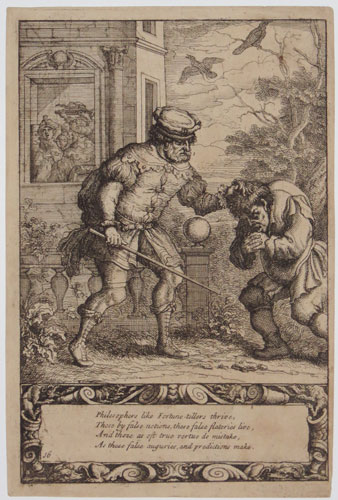
![[Aesop welcomed on his return to Samos]](img-thumbnail/jpegs/47305.jpg)
[Aesop welcomed on his return to Samos] When Eloquence the stuborne powers assailes, / It oft beyond dull brutall force prevailes [...]
[Thomas Dudley after Francis Barlow, 1678/9]
Etching, platemark approx. 240 x 165mm (9½ x 6½").
One of thirty-two illustrations to the second (1687) edition of Francis Barlow's Aesop, showing scenes from the life of the Greek storyteller. All of the plates were designed by Barlow but only five were etched by him. The rest, including this one, were etched by Thomas Dudley (1678-9, fl.). Little is known of Dudley- he signed himself as a student of Wenceslaus Hollar in one print and while he etched some portraits, his prints after Barlow are his most important work. In 1679 he went to Lisbon, where he is known to have made further prints, and he is not supposed to have returned to England thereafter.
[Ref: 47305] £70.00
(£84.00 incl.VAT)
<<< Previous 1 Next >>>
![[Life of Aesop: Aesop convicting his fellow servants of having eaten the figs.]](jpegs/48708.jpg)
![[Life of Aesop: Aesop resolving the gardener's problem.]](jpegs/48712.jpg)
![[Life of Aesop: Aesop ordered by Xanthus to take a dish to her that loves him best.]](jpegs/48699.jpg)
![[Life of Aesop: Aesop serving tongues.]](jpegs/48715.jpg)
![[Life of Aesop: Aesop taken to prison.]](jpegs/48710.jpg)
![[Life of Aesop: Beaten by Xanthus.] [Philosophers like Fortune-tellers thrive,](jpegs/48698.jpg)
![[Life of Aesop: Aesop interpreting an inscription on a tomb, thereby discovering a treasure.]](jpegs/68293.jpg)
![[Life of Aesop: Aesop interpreting to the Samians the portent of the eagle and the public ring.]](jpegs/68292.jpg)
![[Life of Aesop: Aesop kneeling before king Croesus.]](jpegs/48714.jpg)
![[Life of Aesop: Aesop welcomed on his return to Samos from the court of Lydia.]](jpegs/48707.jpg)
![[Life of Aesop: Aesop falsely accused by Eunus, his adopted son.]](jpegs/48713.jpg)
![[Life of Aesop: Aesop in the sepulchre fed by Hermippus.]](jpegs/48701.jpg)
![[Life of Aesop: Eunus confronted by Aesop.]](jpegs/48700.jpg)
![[Life of Aesop: Aesop with King Nectenabo, king of Egypt.]](jpegs/48711.jpg)
![[Life of Aesop: the death of Aesop.]](jpegs/48706.jpg)
![[Life of Aesop: Aesop bought by the philosopher Xanthus.]](jpegs/48702.jpg)
![[Life of Aesop: Aesop passing the house of the father of Xanthus's wife.]](jpegs/48703.jpg)
![[Aesop welcomed on his return to Samos]](jpegs/47305.jpg)