Results 1-37 of 37
<<< Previous 1 Next >>>
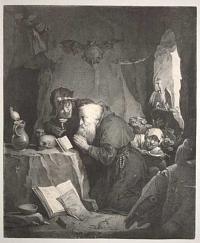
[The Temptation of St. Anthony]
[after David Teniers the younger.]
[n.d., c.1830.]
Scarce lithograph. Sheet 360 x 295mm (18 x 11¾"). Trimmed into image, losing all inscriptions. Repaired tears. Slight marks on saint's head.
St Anthony praying in a cave while a demon is trying to tempt him with a glass of wine, monstrous creatures all around. An adapted copy of the engaving by Jacques Philippe Le Bas (BM 1850,0713.32).
[Ref: 70018] £160.00
(£192.00 incl.VAT)

Burns's Address to the Deil. illustrated by Landseer. (Sheet 1.) [&] (Sheet 2.)
[Engraved by Samuel Machin Slater, Charles Milton Gorway, Ebenezer Landells et al after Thomas Landseer] G.H. Davidson, Printer and Stereotyper, Tudor Street, Blackfriars.
London: - Published by G. Berger, Holywell Street, Strand; O. Hodgson, 10, Cloth Fair, West Smithfield; sold also at the Office of the Ladies' Penny Gazette, King Edward Street, New Bridge Street; and to be had, on order, of all Dealers of Periodicals.
Two sheets, with wood-engravings and letterpress. Sheets 275 x 380mm (10¾ x 15"). Both sheets with stains, '2' laid on album paper.
Two sheets with all 21 verses of Robert Burns' 'Addess to the Deil', illustrated with 10 fantastical wood engravings after Thomas Landseer, including a title and the Devil on horseback. The blocks were also used in book format. See BM 1867,1214.448 for sheet 1, with references for book issues.
[Ref: 61155] £190.00
(£228.00 incl.VAT)
view all images for this item
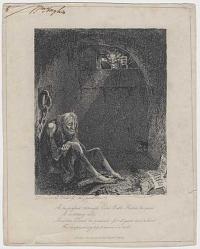
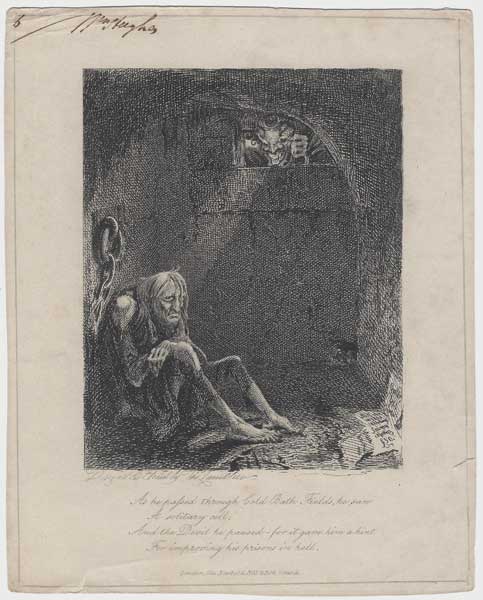
As he passed through Cold Bath Fields, he saw / A solitary cell; / And the Devil he paused - for it have him a hint / For impoving his prisons in hell.
Design'd & Etched by Tho.s Landseer.
London, Geo. Newbold, 303 & 304, Strand. [n.d., c.1831.]
Etching. Sheet 250 x 190mm (9¾ x 7½"). Small tear, old ink mss. Hughes ? in top border, pencil frame.
The Devil peers into a dirty cell, in which an emaciated man is chained to a wall. An illustration to 'The Devil's Walk', a satirical poem by Samuel Taylor Coleridge and Robert Southey, 1799. Coldbath Fields Prison, the 'Middlesex House of Correction' and debtor's prison in Clerkenwell, famed for housing Radicals and other political prisoners. It was notorious for a strict regime of silence and its use of the treadmill.
[Ref: 70177] £60.00
(£72.00 incl.VAT)
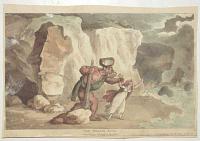
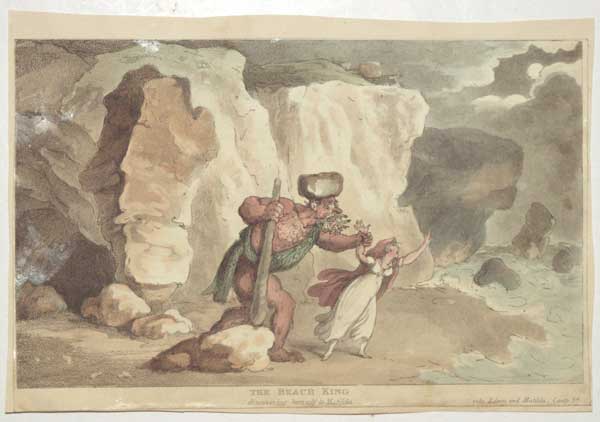
The Beach King discovering himself to Matilda. vide. Edwin and Matilda Canto 3.d. [Plate 7, Vo,l. 2.]
[after Thomas Rowlandson.]
[Nº 9. of the Poetical Magazine. Pub. Jan. 1. 1810, at R. Ackermann's Repository of Arts, 101, Strand.]
Coloured aquatint. Sheet 130 x 210mm (5¼ x 8¼"). Trimmed within plate and laid on album paper.
The giant Beach King, a sea monster type creature, leaning on a club of coral, grabs Matilda's wrist to stop her fleeing.
[Ref: 70085] £60.00
(£72.00 incl.VAT)

[Flora in her Chariot.]
[Engraved c.1730s, but later.]
Mezzotint. Proof before all letters. Plate 165 x 209mm. 6½ x 8¼".
Flora, in Roman mythology, the goddess of flowers and the season of spring. Seen here relining naked in her chariot, which is supported by a cloud; three small winged cherubs fly around, two holding a garland of roses and flowers, the third with a basket of flowers, fruit and greenery. Attributed to John Smith. Ex Collection: Hon. Christopher Lennox-Boyd.
[Ref: 20247] £160.00
(£192.00 incl.VAT)

[Hades.] Quid non mortalia pectora cogis, Auri sacra sames. Virg. Æn III, v.56. From the Original Picture of the same size, in the Collection of Sir Joshua Reynolds.
Teniers pinxit. Ric.d Earlom Sculpsit. John & Josiah Boydell Excudit 1786.
Published Jany. 2d 1786 by John & Josiah Boydell, Cheapside, London.
Mezzotint. 495 x 680mm. A few small tears to edges, some surface marks.
A woman passing Cerberus on the way to Hades, with malformed demons, in the tradition of Hieronymus Bosch, shying away from her sword. Painted by David Teniers the younger.
[Ref: 8211] £550.00

The Infant Hercules.
Painted by Sir Joshua Reynolds K.t. Engraved by William Ward Jnr.
London, Published March 1st 1819 by W.Cribb, 13 Tavistock Street, Covent Garden.
Mezzotint. 480 x 380mm. Slight surface soiling.
After Reynolds' painting 'The Infant Hercules Strangling the Serpents', 1786, now in the Hermitage Museum, St Petersburg. The engraver is William James Ward (1800-40), son of William Ward, nephew of James Ward and nephew by marriage of George Morland.
[Ref: 4857] £650.00

[Jerusalem Delivered] A Moon Light Scene of a Forest where Ismen the Magician is sacrificing to Demons and invoking them to rise. [&] The Magicians marching off after the success of their Incantations. [&] A Turkish Mosque lighted after the Mahometan Manner where Aladine the Emperor is seated on a Throne Surrounded by his Divan. [&] The Forest as Enchanted, where Alcast General of Swiss is stopp'd by a firy Castle, defended by Daemons. [&] The Christian Army under the Command of Godfrey of Bulloigne encamped before the Walls of Jerusalem. [&] A Morning Scene of the Forest with Rinaldo, on the Bank of the Enchanted River.
[Various engravers, including Edward Rooker and Paul Sandby after John Collins.]
[Published by Elizabeth Jane Collins, n.d., c.1763.]
Complete set of six etchings, each c.460 x 540mm (18 x 21¼"), stitched. With two end papers in disbound contemporary marbled boards, with large folio, 575 x 480mm. (22½ x 19"). Boards scuffed and rubbed, with chips and tears to extremities. Some spotting to plates, some cut very close to or along lower platemark.
A fine set of prints based on John Collins' stage sets for a performance of Torquato Tasso's 'Jerusalem Delivered' at the Royal Theatre in the Tuileries in Paris in 1754. Tasso's epic poem, first published 1581, tells the story of the First Crusade mixed with heroic myth featuring magic and monsters, based on the styles of Homer and Virgil. John Collins (c.1725-58/9) was a London-born set designer who had studied in Italy. This series was published by his widow.
[Ref: 9494] £1,800.00
view all images for this item

[Jerusalem Delivered] A Moon Light Scene of a Forest where Ismen the Magician is sacrificing to Demons and invoking them to rise. Plate 1st. Page 393. To the right honourable Lord Visc.t Charlemont this plate is inscribed by his Lordship's most obliged humble Servant. Eliz.th Jane Collins.
J. Collins Pinx.t from Tasso's Jerusalem deliver'd. J. Wood Sculp.t.
[Published by Elizabeth Jane Collins, first published c.1763 but later.]
Etching. Sheet 460 x 540mm (18 x 21¼"). Trimmed to plate, a few nicks, small stains, dedication weakly inked on left. Slight staining.
The Muslim sorcerer Ismen casts a spell to protect the forest with enchantments to stop the Crusaders cutting wood for engines for the siege of Jerusalem. It is the first of a set of six prints based on John Collins' stage sets for a performance of Torquato Tasso's 'Jerusalem Delivered' at the Royal Theatre in the Tuileries in Paris in 1754. Tasso's epic poem, first published 1581, tells the story of the First Crusade mixed with heroic myth featuring magic and monsters, based on the styles of Homer and Virgil. John Collins (c.1725-58/9) was a London-born set designer who had studied in Italy. This series was published by his widow. See Ref: 9494 for complete set.
[Ref: 53228] £280.00
(£336.00 incl.VAT)

[Jerusalem Delivered] The Forest as Enchanted, where Alcast General of Swiss is stopp'd by a firy Castle, defended by Daemons. Plate 4. Page 400. To the most Noble Peregrine Bertie, Duke of Ancaster & Kesteven, Lord Lord great Chamberlain of England &c, &c., This Plate is most humbly Inscrib'd by his Grace's most Devoted and Obedient Serv.t Eliz.th Jane Collins.
J. Collins Pinx.t from Tasso's Jerusalem deliver'd. P. Sandby & E. Rooker sculp.
[Published by Elizabeth Jane Collins, c.1763.]
Etching. Sheet 460 x 545mm (18 x 21¾"). Trimmed to plate, a few nicks, small stains, dedication weakly inked on left.
A knight walks through a forest during the siege of Jerusalem and is confronted by a castle surrounded by fire-breathing demons and dragons. From a set of six prints based on John Collins' stage sets for a performance of Torquato Tasso's 'Jerusalem Delivered' at the Royal Theatre in the Tuileries in Paris in 1754. Tasso's epic poem, first published 1581, tells the story of the First Crusade mixed with heroic myth featuring magic and monsters, based on the styles of Homer and Virgil. John Collins (c.1725-58/9) was a London-born set designer who had studied in Italy. This series was published by his widow. See Ref: 9494 for complete set.
[Ref: 53229] £380.00
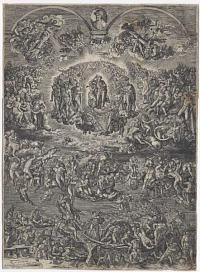
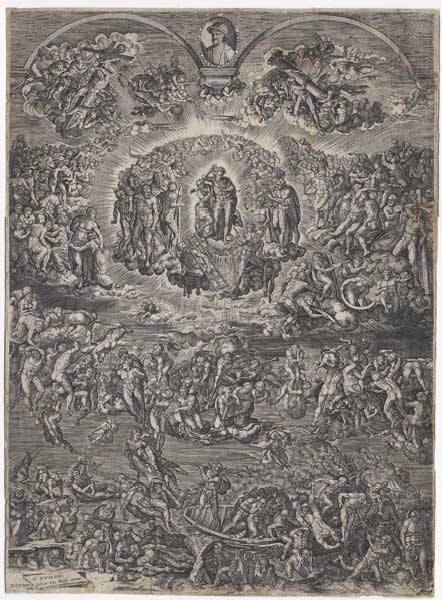
[The Last Judgement]
H. Wirix scul [after Michelangelo].
Johan van Weely excud [n.d., c.1600].
Engraving, sheet 310 x 230mm (12¼ x 9"). Collector's ink stamp of Heinrich Kaspar Lempert on verso. Trimmed to plate, tears with old repairs. Damaged, some loss in margins.
The Last Judgement, with Christ in the centre, people below being forced from a boat into hell. After Michelangelo's fresco in the Sistine Chapel of the Vatican. First published by Aper van der Hoeven c.1573. Hieronymus Wierix (1553–1619) was a Flemish engraver, draughtsman and publisher, best known for his reproductive engravings after works by prominent artists. Alongside other members of the Wierix family of engravers, he played an important role in promoting Netherlandish art abroad. Regarded as a child prodigy, Hieronymus began engraving in 1565, aged eleven, and produced accomplished copies after Dürer the following year. L.1337.
[Ref: 70243] £580.00

Eurydice Hurried Back to the Infernal Regions.
Painted by H Thomson Esq.r R.A. Engraved by W. Ward A.R.A. Engraver to their R.H. the Prince Regent & the Duke of York
[Published June 16, 1815, by the Engraver, 24 Buckingham Place Fitzroy Square.]
Mezzotint. Sheet 555 x 620mm (21¾ x 24½"). Trimmed within plate, laid on card, mark top right. Repaired tear top centre.
Three spirits of the Underworld carry Eurydice away from Orpheus, who watches in horror, hands clasped, his lyre by his side. Below left is Virgil's verse; on the right is Dryden's translation. Frankau 108. Ex: collection of The Hon. Christopher Lennox-Boyd.
[Ref: 67817] £850.00

Book 1, Line 192. Proof. [Satan on the Burning Lake.]
Designed & Engraved by J. Martin Esq.r. Printed by Chatfield & co.
Published by Septimus Prowett, 62 Paternoster Row. 1825.
Fine mezzotint, rare proof impression. 255 x 350mm (10 x 13¾"), with large margins.
Satan on the Burning Lake; a fantastic image depicting Satan, with a helmet and spear, supporting himself on his shield, rolling on the fiery waves of a burning lake flowing among the rocks in a dark cavern, looking towards Beelzebub who flounders beside him. Fully lettered proof impression. From a series of prints illustrating John Milton's (1608-1674) 'Paradise Lost', first published in 1667, consisting of ten books with over ten thousand lines of verse. The poem concerns the Biblical story of the Fall of Man, the temptation of Adam and Eve by the fallen angel Satan and their expulsion from the Garden of Eden. Begun by early 1824, this series of engravings was the result of a comission from a little known American publisher Septimus Prowett, who approached Martin to produce mezzotint illustrations to accompany an issue of Milton's text. Prowett's publication was released in four different proof forms; this print is from the 'Imperial Folio Edition' but not bound up at publication time. Balston 94. (a) 4. CW: 27
[Ref: 36905] £1,500.00

Book 1, Line 314. Proof. [Satan arousing the fallen Angels.]
Designed & Engraved by J. Martin Esq.r. Printed by Chatfield & Coleman.
London Published by Septimus Prowett, 23 Old Bond Street. [1825.]
Fine mezzotint, rare proof impression. 255 x 350mm (10 x 13¾"), with large margins,
Satan arousing the fallen Angels; Satan on the right, is seen holding his spear with his arms raised, standing on a cliff overhanging the burning lake in a cavern of hell, rousing the fallen angels below, one of Martin's finest mezzotints. Fully lettered proof impression. From a series of prints illustrating John Milton's (1608-1674) 'Paradise Lost', first published in 1667, consisting of ten books with over ten thousand lines of verse. The poem concerns the Biblical story of the Fall of Man, the temptation of Adam and Eve by the fallen angel Satan and their expulsion from the Garden of Eden. Begun by early 1824, this series of engravings was the result of a comission from a little known American publisher Septimus Prowett, who approached Martin to produce mezzotint illustrations to accompany an issue of Milton's text. Prowett's publication was released in four different proof forms; this print is from the 'Imperial Folio Edition' but not bound up at publication time. Balston 94. (a) 4. CW: 28
[Ref: 36907] £1,500.00

Book 3, line 301 [Satan viewing the ascent to Heaven].
J. Martin 1824 [inside image]. Designed & Engraved by J. Martin Esq.r.
London Published by Septimus Prowett, 23, Old Bond Street, 1825. Printed by Chatfield & C.o.
Fine mezzotint with etching, plate 270 x 195mm (10½ x 7¾"), with very large margins.
Satan crouching on dark rocks (or clouds) on the left, holds his spear in his left hand and leans on his right hand and knee, looking back over his shoulder towards a broad staircase rising towards the shining gates of Heaven, where angels ascend. llustration to John Milton's 'Paradise Lost'. Line 301 is given to this image rather than 501 from which it is taken, likely to be a mistake made by a letter engraver rather than Martin himself. From the Imperial Folio Edition. CW 57. Balston 9a4(C).
[Ref: 58897] £480.00

Book 4 line 453 [Eve at the Fountain].
Designed & Engraved by J. Martin Esq.r
London Published by Septimus Prowett, 23, Old Bond Street, 1825.
Mezzotint with etching, plate 195 x 270mm (7¾x 10½"), with very large margins.
Eve stands at the edge of a pool, dipping one toe in the water, raising her hand to her head in surprise at her reflection, in a verdant landscape with banks of wild, overhanging trees, of all varieties. llustration to John Milton's 'Paradise Lost'. From the Imperial Folio. Issued in Part IV of Prowett's smaller format edditions of Paradise Lost in the Summer of 1825. CW 58. Balston 9a4(C).
[Ref: 58901] £480.00

Book 4, Line 502. Proof. [Satan contemplating Adam and Eve in Paradise]
Designed & Engraved by J. Martin Esq.r. Printed by Chatfield & Co.
London Published by Septimus Prowett, 23 Old Bond Street. 1825.
Fine mezzotint, rare proof impression. 255 x 350mm (10 x 13¾"), with large margins. Foxing.
Satan contemplating Adam and Eve in Paradise; Adam and Eve sitting together on the left, watched by Satan who hides behind a tall tree in the right foreground, in a landscape with banks of trees on either side and a valley in the centre. Fully lettered proof impression. From a series of prints illustrating John Milton's (1608-1674) 'Paradise Lost', first published in 1667, consisting of ten books with over ten thousand lines of verse. The poem concerns the Biblical story of the Fall of Man, the temptation of Adam and Eve by the fallen angel Satan and their expulsion from the Garden of Eden. Begun by early 1824, this series of engravings was the result of a comission from a little known American publisher Septimus Prowett, who approached Martin to produce mezzotint illustrations to accompany an issue of Milton's text. Prowett's publication was released in four different proof forms; this print is from the 'Imperial Folio Edition' but not bound up at publication time. Balston 94. (a) 4. CW: 35
[Ref: 36914] £750.00

Book 4 line 502 [Satan Contemplating].
Designed & Engraved by J. Martin Esq.r
London Published by Septimus Prowett, 23, Old Bond Street, 1826. Printed by J. Lahee.
Fine mezzotint with etching, plate 195 x 270mm (7¾x 10½"), with very large margins.
Adam and Eve sit together in a gentle embrace on the left while Satan watches from behind a tall, gnarled tree. Behind them a lovely landscape that recedes into light. llustration to John Milton's 'Paradise Lost'. From the Imperial Folio. CW 59. Balston 9a4(C).
[Ref: 58906] £520.00

Book 4, Line 866. Proof. [The Angels guarding Paradise at night.]
Designed & Engraved by J. Martin Esq.r. Printed by J. Lahee.
London Published by Septimus Prowett, 23 Old Bond Street. 1826.
Fine mezzotint, rare proof impression. 255 x 350mm (10 x 13¾"), with large margins. Light foxing in margins.
The Angels guarding Paradise at night; an angel with a helmet and spear standing on a clifftop, shining with light in the darkness, with several smaller spirits around it, keeping watch, with Paradise below, the moon and stars above and a small patch of light among the trees where other angels keep watch on land, to the lower left. Fully lettered proof impression. From a series of prints illustrating John Milton's (1608-1674) 'Paradise Lost', first published in 1667, consisting of ten books with over ten thousand lines of verse. The poem concerns the Biblical story of the Fall of Man, the temptation of Adam and Eve by the fallen angel Satan and their expulsion from the Garden of Eden. Begun by early 1824, this series of engravings was the result of a comission from a little known American publisher Septimus Prowett, who approached Martin to produce mezzotint illustrations to accompany an issue of Milton's text. Prowett's publication was released in four different proof forms; this print is from the 'Imperial Folio Edition' but not bound up at publication time. Balston 94. (a) 4. CW: 37.
[Ref: 36916] £750.00

Book 5, Line 136. Proof. [Paradise - Adam and Eve - The Morning Hymn]
Designed & Engraved by J. Martin Esq.r. Printed by J. Lahee.
Published 1825 by Septimus Prowett, 23 Old Bond Street.
Fine mezzotint, rare proof impression. 255 x 350mm (10 x 13¾"), T. Dupuy watermark. Large margins. Light foxing.
Paradise - Adam and Eve - The Morning Hymn; a view of Paradise, with a lake in the centre, trees on the opposite bank, surrounded by woods behind. Swans are seen on the water, preparing to fly, with Adam and Eve to the left, bowing in prayer, as sunlight breaks across the horizon. Fully lettered proof impression. From a series of prints illustrating John Milton's (1608-1674) 'Paradise Lost', first published in 1667, consisting of ten books with over ten thousand lines of verse. The poem concerns the Biblical story of the Fall of Man, the temptation of Adam and Eve by the fallen angel Satan and their expulsion from the Garden of Eden. Begun by early 1824, this series of engravings was the result of a comission from a little known American publisher Septimus Prowett, who approached Martin to produce mezzotint illustrations to accompany an issue of Milton's text. Prowett's publication was released in four different proof forms; this print is from the 'Imperial Folio Edition' but not bound up at publication time. Balston 94. (a) 4. CW: 38
[Ref: 36917] £900.00

Book 5, Line 308. Proof. [Paradise - with the Approach of the Archangel Raphael]
Designed & Engraved by J. Martin Esq.r. Printed by J. Lahee.
Published 1825 by Septimus Prowett, 23 Old Bond Street.
Fine mezzotint, rare proof impression. 255 x 350mm (10 x 13¾"), with large margins. Light foxing in margins.
Paradise - with the Approach of the Archangel Raphael; a scene in the Garden of Eden, with Adam and Eve pointing towards the Archangel visible amongst the trees in the distance. Fully lettered proof impression. From a series of prints illustrating John Milton's (1608-1674) 'Paradise Lost', first published in 1667, consisting of ten books with over ten thousand lines of verse. The poem concerns the Biblical story of the Fall of Man, the temptation of Adam and Eve by the fallen angel Satan and their expulsion from the Garden of Eden. Begun by early 1824, this series of engravings was the result of a comission from a little known American publisher Septimus Prowett, who approached Martin to produce mezzotint illustrations to accompany an issue of Milton's text. Prowett's publication was released in four different proof forms; this print is from the 'Imperial Folio Edition' but not bound up at publication time. Balston 94. (a) 4. CW: 39.
[Ref: 36918] £750.00

Book 5, Line 519. Proof. [Raphael conversing with Adam and Eve]
Designed & Engraved by J. Martin Esq.r.
London Published by Septimus Prowett, 23 Old Bond Street. 1826.
Fine mezzotint, rare proof impression. 255 x 350mm (10 x 13¾"), with large margins. Very slight cockling in centre.
Raphael conversing with Adam and Eve; the Archangel Raphael sitting with Adam and Eve, gesturing as he talks to them, at the mouth of a mossy cave in lower left, with tall trees on the higher ground above. It appears that no 'formal' lettered proofs were issued of this mezzotint and only a very few impressions with the scratched 'proof', such as this example, seem to have been pulled. Fully lettered proof impression. From a series of prints illustrating John Milton's (1608-1674) 'Paradise Lost', first published in 1667, consisting of ten books with over ten thousand lines of verse. The poem concerns the Biblical story of the Fall of Man, the temptation of Adam and Eve by the fallen angel Satan and their expulsion from the Garden of Eden. Begun by early 1824, this series of engravings was the result of a comission from a little known American publisher Septimus Prowett, who approached Martin to produce mezzotint illustrations to accompany an issue of Milton's text. Prowett's publication was released in four different proof forms; this print is from the 'Imperial Folio Edition' but not bound up at publication time. Balston 94. (a) 4. CW: 40
[Ref: 36921] £1,500.00

Book 7, Line 339. Proof. [Creation of Light]
Designed & Engraved by J. Martin Esq.r. Printed by Charfield & Coleman.
London Published by Septimus Prowett, 23 Old Bond Street. 1825.
Fine mezzotint, rare proof impression. 255 x 350mm (10 x 13¾"), with large margins. Foxing.
The Creation of Light; a dramatic image of God dividing night and day, his image seen in the sky above the sea. Martin exhibited a large oil painting of this subject entitled 'The Creation' at the Society of Britsh Artists in 1825. Fully lettered proof impression. From a series of prints illustrating John Milton's (1608-1674) 'Paradise Lost', first published in 1667, consisting of ten books with over ten thousand lines of verse. The poem concerns the Biblical story of the Fall of Man, the temptation of Adam and Eve by the fallen angel Satan and their expulsion from the Garden of Eden. Begun by early 1824, this series of engravings was the result of a comission from a little known American publisher Septimus Prowett, who approached Martin to produce mezzotint illustrations to accompany an issue of Milton's text. Prowett's publication was released in four different proof forms; this print is from the 'Imperial Folio Edition' but not bound up at publication time. Balston 94. (a) 4. CW: 41.
[Ref: 36919] £1,500.00

Book 7 line 339 [Creation of Light].
Designed & Engraved by J. Martin Esq.r
London Published by Septimus Prowett, 23, Old Bond Street, 1825. Printed by Chatfield & Coleman.
Fine mezzotint with etching, plate 195 x 270mm (7¾x 10½"), with very large margins.
God dividing night and day, his ghostly image can be seen in the sky above the sea. llustration to John Milton's 'Paradise Lost'. From the Imperial Folio Edition. CW 65. Balston 9a4(C).
[Ref: 58900] £420.00

Book 9 Line 780. [Satan tempting Eve]
Designed & Engraved by J. Martin Esq.r. Printed by Chatfield & Co.
London Published by Septimus Prowett, 23 Old Bond Street. 1826.
Fine mezzotint with etching. Fully lettered proof. Plate 255 x 350mm (10 x 13¾"), with very large margins.
Satan tempting Eve; Eve standing under a tree at the edge of a pool, reaching up with one hand to hold a bough, around which Satan, disguised as a serpent, is entwined, holding an apple in the other, listening to the snake. From a series of large size issue illustrating John Milton's (1608-1674) 'Paradise Lost', first published in 1667, consisting of ten books with over ten thousand lines of verse. The poem concerns the Biblical story of the Fall of Man, the temptation of Adam and Eve by the fallen angel Satan and their expulsion from the Garden of Eden. Begun by early 1824, this series of engravings was the result of a commission from a little known American publisher Septimus Prowett, who approached Martin to produce mezzotint illustrations to accompany an issue of Milton's text. Prowett's publication was released in four different proof forms. CW 42. Balston 9a4(A).
[Ref: 58911] £650.00

Book 9, Line 780. Proof. [Satan tempting Eve]
Designed & Engraved by J. Martin Esq.r.
London Published by Septimus Prowett, 23 Old Bond Street. 1826.
Fine mezzotint, rare proof impression. 255 x 350mm (10 x 13¾"), with large margins. Remainder of Printer's name in right of title area very faint.
Satan tempting Eve; Eve standing under a tree at the edge of a pool, reaching up with one hand to hold a bough, around which Satan, disguised as a serpent, is entwined, holding an apple in the other, listening to the snake. An early proof impressions such as this example, is considered amongst the most beautiful and atmospheric of Martin's 'Paradise Lost' mezzotints. It appears that no 'formal' lettered proofs were issued of this mezzotint and only a very few impressions with the scratched 'proof', such as this example, seem to have been pulled. Fully lettered proof impression. From a series of prints illustrating John Milton's (1608-1674) 'Paradise Lost', first published in 1667, consisting of ten books with over ten thousand lines of verse. The poem concerns the Biblical story of the Fall of Man, the temptation of Adam and Eve by the fallen angel Satan and their expulsion from the Garden of Eden. Begun by early 1824, this series of engravings was the result of a comission from a little known American publisher Septimus Prowett, who approached Martin to produce mezzotint illustrations to accompany an issue of Milton's text. Prowett's publication was released in four different proof forms; this print is from the 'Imperial Folio Edition' but not bound up at publication time. Balston 94. (a) 4. CW: 42.
[Ref: 36920] £1,500.00

Book 1 Line 710. [Pandemonium]
J. Martin .1824 [within image]. Designed & Engraved by J. Martin Esq.r.
London Published by Septimus Prowett, 23 Old Bond Street. 1825.
Mezzotint with etching, on 19th century watermarked paper, plate 255 x 350mm (10 x 13¾"), with very large margins. Repaired tear bottom right margin.
Satan stands on a cliff in the foreground, holding his spear, inciting hordes of angels assembled on the rocks below him to rebel, gesturing with his right hand towards the city of pandemonium, with a dome looming in the darkness behind thick, fortified walls. From a series of large size issue illustrating John Milton's (1608-1674) 'Paradise Lost', first published in 1667, consisting of ten books with over ten thousand lines of verse. The poem concerns the Biblical story of the Fall of Man, the temptation of Adam and Eve by the fallen angel Satan and their expulsion from the Garden of Eden. Begun by early 1824, this series of engravings was the result of a comission from a little known American publisher Septimus Prowett, who approached Martin to produce mezzotint illustrations to accompany an issue of Milton's text. Prowett's publication was released in four different proof forms. CW 29. Balston 9a4(A).
[Ref: 58912] £650.00

Book 10, Line 312 & 347. Proof. [Bridge over Chaos]
Designed & Engraved by J. Martin Esq.r. Printed by Chatfield & co.
Published by Septimus Prowett, 62 Paternoster Row. 1826.
Fine mezzotint, rare proof impression. 255 x 350mm (10 x 13¾"), with large margins. Light foxing in margins.
Bridge over Chaos; a powerful and mysterious image depicting the underworld, considered Martin's finest mezzotint. A bridge is suspended over the bottomless abyss of Chaos, with the figures of Satan, Sin and Death looking in awe of this new creation. Fully lettered proof impression. From a series of prints illustrating John Milton's (1608-1674) 'Paradise Lost', first published in 1667, consisting of ten books with over ten thousand lines of verse. The poem concerns the Biblical story of the Fall of Man, the temptation of Adam and Eve by the fallen angel Satan and their expulsion from the Garden of Eden. Begun by early 1824, this series of engravings was the result of a comission from a little known American publisher Septimus Prowett, who approached Martin to produce mezzotint illustrations to accompany an issue of Milton's text. Prowett's publication was released in four different proof forms; this print is from the 'Imperial Folio Edition' but not bound up at publication time. Balston 94. (a) 4. CW: 45
[Ref: 36902] £1,500.00

Book 10, Line 863. Proof. [Adam reproving Eve]
Designed & Engraved by J. Martin Esq.r. Printed by J. Lahee.
Published by Septimus Prowett, 62 Paternoster Row. 1826.
Fine mezzotint, rare proof impression. 255 x 350mm (10 x 13¾"); sheet size: 318 x 426mm (12½ x 16 ¾"). Large margins. Light foxing.
Adam reproving Eve; Adam standing on the left, clothed in animal skins, is seen raising his left arm as he reproves Eve, who kneels in front of him, covering her face with her hands and hair. Fully lettered proof impression. From a series of prints illustrating John Milton's (1608-1674) 'Paradise Lost', first published in 1667, consisting of ten books with over ten thousand lines of verse. The poem concerns the Biblical story of the Fall of Man, the temptation of Adam and Eve by the fallen angel Satan and their expulsion from the Garden of Eden. Begun by early 1824, this series of engravings was the result of a comission from a little known American publisher Septimus Prowett, who approached Martin to produce mezzotint illustrations to accompany an issue of Milton's text. Prowett's publication was released in four different proof forms; this print is from the 'Imperial Folio Edition' but not bound up at publication time. Balston 94. (a) 4. CW: 46
[Ref: 36901] £550.00

Book 10, Line 863. [Adam reproving Eve]
Designed & Engraved by J. Martin Esq.r. Printed by J. Lahee.
Published by Septimus Prowett, 62 Paternoster Row. 1826.
Fine mezzotint, with etching. Platemark: 255 x 350mm (10 x 13¾"), with very large margins. Repaired tears in margins.
Adam reproving Eve; Adam standing on the left, clothed in animal skins, is seen raising his left arm as he reproves Eve, who kneels in front of him, covering her face with her hands and hair. From a series of large size issue illustrating John Milton's (1608-1674) 'Paradise Lost', first published in 1667, consisting of ten books with over ten thousand lines of verse. The poem concerns the Biblical story of the Fall of Man, the temptation of Adam and Eve by the fallen angel Satan and their expulsion from the Garden of Eden. Begun by early 1824, this series of engravings was the result of a comission from a little known American publisher Septimus Prowett, who approached Martin to produce mezzotint illustrations to accompany an issue of Milton's text. Prowett's publication was released in four different proof forms; this print is from the 'Imperial Folio Edition' but not bound up at publication time. CW 46. Balston 9a4(A).
[Ref: 58913] £650.00

Book 11, Line 78. Proof. [Heaven, The Rivers of Bliss]
Designed & Engraved by J. Martin Esq.r. Printed by Chatfield & co.
Published by Septimus Prowett, 62 Paternoster Row. 1825.
Fine mezzotint, rare proof impression. 255 x 350mm (10 x 14"), with large margins. Light foxing.
Heaven, The Rivers of Bliss; A trumpet has been sounded in Heaven to call the angels to witness a proclamation from God. Two angels, one playing a harp, the other, a trumpet, are seen on a rock in the foreground, with a lake surrounded by trees and hills behind, wiith groups of angels on the banks. An opposing illustration to Pandemonium (CW: 29) Ref: 36908. Fully lettered proof impression. From a series of prints illustrating John Milton's (1608-1674) 'Paradise Lost', first published in 1667, consisting of ten books with over ten thousand lines of verse. The poem concerns the Biblical story of the Fall of Man, the temptation of Adam and Eve by the fallen angel Satan and their expulsion from the Garden of Eden. Begun by early 1824, this series of engravings was the result of a comission from a little known American publisher Septimus Prowett, who approached Martin to produce mezzotint illustrations to accompany an issue of Milton's text. Prowett's publication was released in four different proof forms; this print is from the 'Imperial Folio Edition' but not bound up at publication time. Balston 94. (a) 4. CW: 47.
[Ref: 36900] £1,150.00

Book 11, Line 226. Proof. [The approach of the Archangel Michael]
Designed & Engraved by J. Martin Esq.r. Printed by Chatfield & co.
Published by Septimus Prowett, 62 Paternoster Row. 1826.
Fine mezzotint, rare proof impression. 255 x 350mm (10 x 13¾"); sheet size: 318 x 426mm (12½ x 16¾"). Large margins. Light foxing.
The approach of the Archangel Michael; Adam and Eve, clothed in animal skins, are seen standing in Paradise. Adam holds Eve by the arm as they look towards a light breaking behind a tree covered mountain in the distance to the right, heralding the approach of the archangel. Fully lettered proof impression. From a series of prints illustrating John Milton's (1608-1674) 'Paradise Lost', first published in 1667, consisting of ten books with over ten thousand lines of verse. The poem concerns the Biblical story of the Fall of Man, the temptation of Adam and Eve by the fallen angel Satan and their expulsion from the Garden of Eden. Begun by early 1824, this series of engravings was the result of a comission from a little known American publisher Septimus Prowett, who approached Martin to produce mezzotint illustrations to accompany an issue of Milton's text. Prowett's publication was released in four different proof forms; this print is from the 'Imperial Folio Edition' but not bound up at publication time. Balston 94. (a) 4. CW: 48.
[Ref: 36899] £480.00
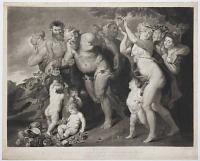
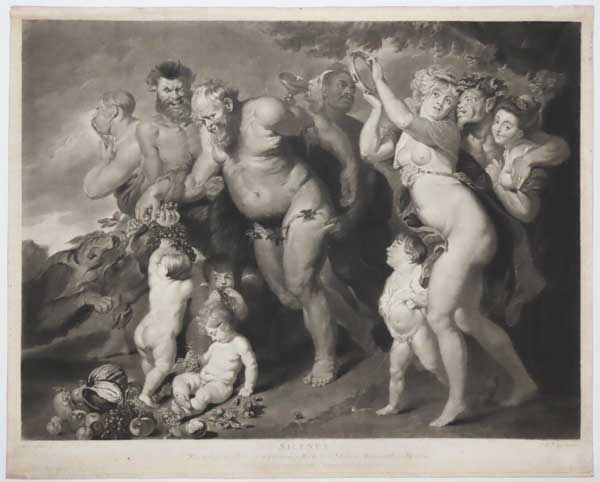
Silenus.
Rubens pinxit. C.H. Hodges Sculpsit.
Publish'd Aug.st 1.st 1789, by John & Josiah Boydell, Cheapside, & at the Shakespeare Gallery, Pall Mall London.
Mezzotint. 485 x 610mm (19 x 24"). Trimmed to plate on right, narrow margins elsewhere, spotting and creasing.
The drunken Silenus, supported by satyrs, picks at a bunch of grapes which a tiger is also leaping towards. Bacchants surround him, making music, eating, drinking and (in one case) urinating. Rubens' painting is in the Alte Pinakothek, Munich, although the composition of the painting has been altered considerably in this print.
[Ref: 70161] £480.00

To Sir John Fleming Leicester Bar.t This Plate of the Sleeping Nymph From the original Picture in his possession is by permission respectfully dedicated by his very obliged & obedient Serv.t W.m Ward.
Painted by John Hoppner Esq.r R.A. Engraved by Will.m Ward Engraver to H.R.H. the Duke of York.
Published Jan.y 20, 1808 by the Engraver. No 24 Buckingham Place, Fitzroy Square.
Mezzotint. 530 x 630mm.
Said to be Georgina Maria Cottin (1794-1859), who married the painting's owner in 1810. Frankau: 264. Ex: Collection of The Hon. C. Lennox-Boyd.
[Ref: 3292] £960.00

Tam O' Shanter.
Painted by Abraham Cooper. Engraved by Henry Meyer.
[London: S. Knight, 1814.]
A rare mezzotint. Sheet 515 x 585mm (20½ x 23"). Trimmed within plate on three sides, into title at bottom, losing publication line and half of crest.
Illustration to the narrative poem 'Tam O' Shanter' written by Robert Burns in 1790, which describes a disturbing vision experienced by Tam on his way home from an inn: riding his horse Meg, he stumbles across some witches and demons in Alloway Kirk (seen burning in the background), who give chase. He escapes across a bridge over the River Doon (witches will not cross running water) but not before one catches Meg's tail and pulls it off. Ex: the Collection of the Hon. C. Lennox-Boyd.
[Ref: 47702] £360.00
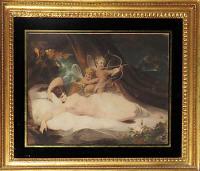
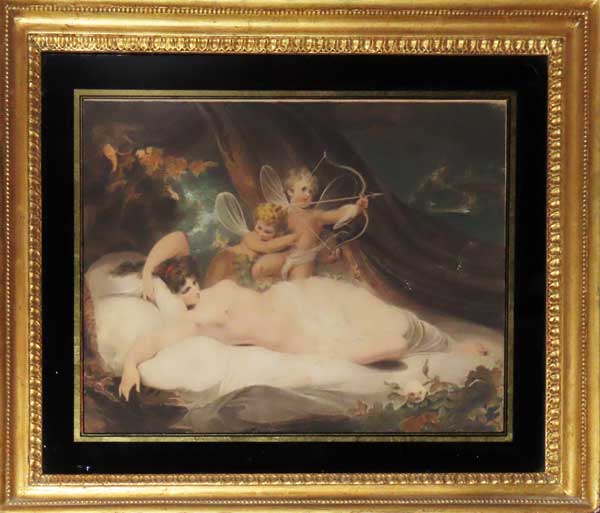
[Venus and Cupids. From the original drawing in the possession of John Julius Angerstein Esq.r.]
[Drawn by R. Westall, R.A. Engraved by R. M. Meadows.]
[n.d., c.1800.]
Fine stipple engraving, printed in colours, in decorative gilt frame, sight size 300 x 385mm (11¾ x 15¼"). Mounted over image on left, bottom and lower right, possibly trimmed. Unexamined out of frame.
Venus, half-naked, reclining in a bower with two butterfly-winged cherubs, one of whom draws a bow.
[Ref: 70241] £450.00

[The Wheel of Fortune.]
Sold by T. Bakewell in Cornhill. [n.d., c.1745.]
Engraving Sheet: 185 x 255mm (7¼ x 10"). Trimmed within plate. Laid on album sheet.
A mythological scene in which a withered, snake-haired woman spins a figure wretched figure around a large wheel while a fire blazes near them and two further crones look on. The three old women are reminiscent of the Fates from ancient mythology, though with their snakes for hair they also resemble the hideous gorgons. The Wheel of Fortune was a medieval and ancient concept demonstrating the capricious nature of Fate, the wheel being spun at random by the goddess Fortuna affecting the lives of those attached. The Wheel of Fortune was also a medieval form of torture, the victim would be tied to a large wheel while a large fire would be set close enough to burn anyone tied to the wheel. The wheel would then be turned like a spit slowly cooking the captive.
[Ref: 40328] £130.00
(£156.00 incl.VAT)
<<< Previous 1 Next >>>