Results 1-30 of 30
<<< Previous 1 Next >>>
![[Coldbath Fields Prison.] The House of Correction, Cold Bath Fields.](img-thumbnail/jpegs/68764.jpg)
[Coldbath Fields Prison.] The House of Correction, Cold Bath Fields. The View taken near Grays Inn Road.
J.King del. J.Mills sculp.
[n.d., c.1800.]
Engraving. 180 x 115mm (7 x 4½"). Trimmed.
A view of Coldbath Fields Prison formerly known as the Middlesex House of Correction and Clerkenwell Gaol. a prison in the Mount Pleasant area of Clerkenwell, London. Founded in the reign of James I (1603 - 1625) it was completely rebuilt in 1794 and extended in 1850. It housed prisoners on short sentences of up to two years. Blocks emerged to segregate felons, misdemeanants and vagrants. The prison closed in 1885.
[Ref: 68764] £60.00
(£72.00 incl.VAT)
![[Hammersmith.]](img-thumbnail/jpegs/68813.jpg)
[Hammersmith.] To Baptist May Esq.r. This View of his House at Hamersmith and Union Yatch under sail is Dedicated by his most obedient Humb.le Serv.t. T.Major.
J.Fayram Pinx.t. Major sculp.t.
Publish'd accord.g to Act [of Parl.t. Nov.r. 22nd 1751.]
Rare engraving. Sheet 295 x 250mm (11¾ x 10"). Trimmed.
A view of the Thames at Hammersmith. In the foreground the Union Yacht sailing and in the left background Baptist May Esq.r.'s house. Baptist May Esq..r (1628 - 1698) was a Royal courtier during the reign of Charles II of England.
[Ref: 68813] £360.00
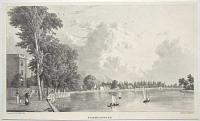
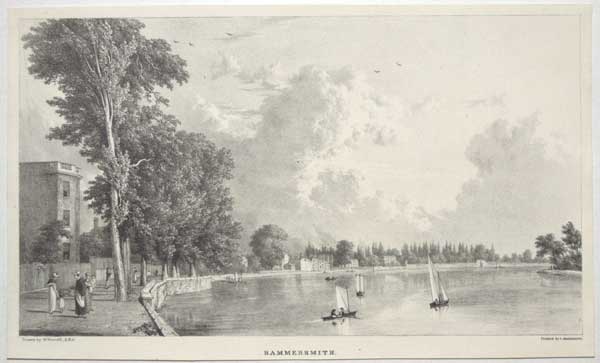
Hammersmith.
Drawn by W.Westall, A.R.A. Printed by C.Hullmandel.
[n.d., c.1820. Published by Rodwell & Martin.]
Lithograph. Sheet 330 x 200mm (13 x 8"). Trimmed.
A view of the river Thames at Hammersmith. On the left of the image women and children stroll along the bank and on the right, people sit in small sail boats.
[Ref: 68812] £260.00
(£312.00 incl.VAT)

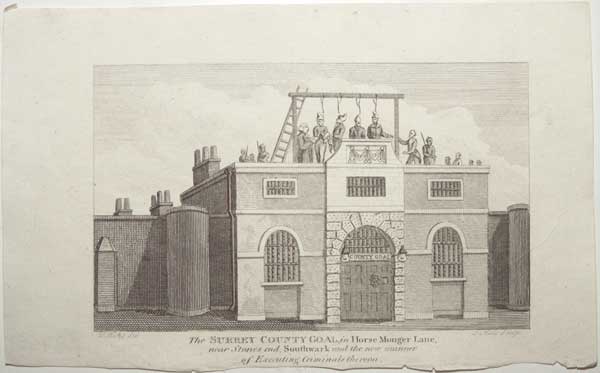
The Surrey County Goal, in Horse Monger Lane. Near Stones end Southwark and the new manner of Executing Criminals thereon.
J.King del. J.Mills sculp.
[n.d, c.1800.]
Engraving. 210 x 130mm (8¼ x 5"). Damaged, right centre border.
A view of Horsemonger Lane Gaol, a prison close to present-day Newington Causeway in Southwark, south London. Built at the end of the 18th century, it was in use until 1878.
[Ref: 68766] £60.00
(£72.00 incl.VAT)
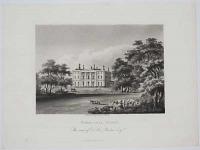
West-Hill Surry. The Seat of D.H Rucker.
Drawn & Engraved by J. Hassell.
Lodnon Pub.d by J. Hassell 1 Sep.t 1804.
Aquatint, sheet 205 x 275mm (8¼ x 11"). Trimmed losing platemark at top.
A view of the manor house Melrose Hall, in West Hill, Surrey, the country estate of Daniel Henry Rucker (1766–1843), a wealthy London and West Indies merchant. The house was designed by the architect Jesse Gibson (1748–1828) comissioned by by Daniel's uncle, John Anthony Rucker (1719-1825). In 1863, Melrose Hall was sold to a charity and became The Royal Hospital for Incurables, now the Royal Hospital for Neuro-disability.
[Ref: 69491] £50.00
(£60.00 incl.VAT)
![[An Old Building at Putney, Sept 12 1826.] [and another watercolour by Emslie]](img-thumbnail/jpegs/69314.jpg)
[An Old Building at Putney, Sept 12 1826.] [and another watercolour by Emslie]
[by George Shepherd.]
[1826]
A preparatory pencil sketch and the completed watercolour. 165 x 215mm (6½ x 8½") & 170 x 225mm (7 x 9"). Laid on card together.
A ramshackle house with a willow. From the Peter Jackson Collection & Gardiner Collection.
[Ref: 69314] £350.00

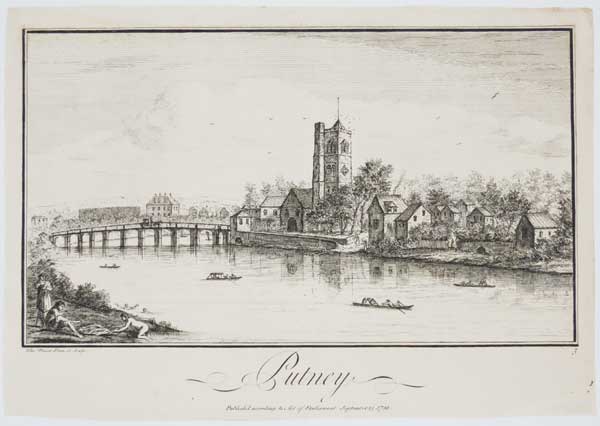
Putney.
Tho. Preist Pinx, et Sculp.
Publish' according to Act of Parliament September 25. 1738. [T. Cadell, Jun. and W. Davies]
Very rare engraving, 18th century watermark, sheet 260 x 375mm (10¼ x 14¾"). Trimmed on three sides with thread margin at top. Light foxing.
View on the Thames at Putney, with people boating and bathing in the foreground and Putney Bridge in the background.
[Ref: 69495] £220.00
(£264.00 incl.VAT)

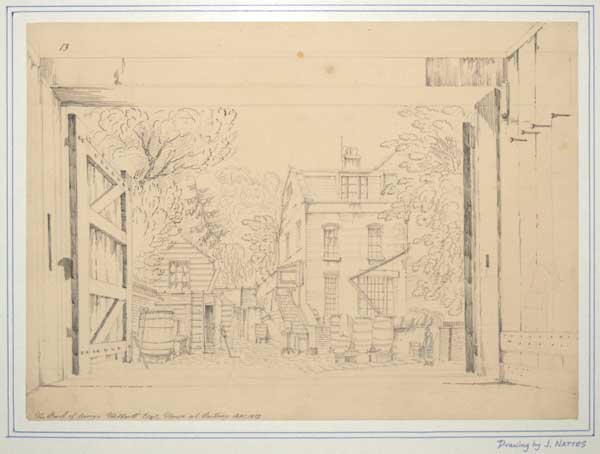
The Back of George Hibberts Esqr House at Putney Sepr 12th 1812.
[Drawing by John Claude Nattes.]
[n.d., c.1812.]
Fine ink and graphite sketch. Sheet 235 x 330mm (9¼ x 13"). Laid on card at sides.
The back of a large house, seen through massive double gates, to a yard with several water barrels. John Claude Nattes (c.1765–1839) was a watercolourist and topographical draughtsman of either French or English origin. In 1789, Joseph Banks commissioned Nattes to record the architecture of Lincolnshire, resulting in more than 700 drawings and watercolours produced between 1789 and 1797. This remarkable body of work remains an important record of pre-Victorian topography. He later accompanied John Stoddart on tours of Scotland, providing illustrations for Remarks on Local Scenery and Manners in Scotland (1801). Nattes was among the earliest practitioners of watercolour painting in Britain and was associated with the founding of the Society of Painters in Water Colours in 1804. Although expelled two years later, for exhibiting other people's work as his own, he continued to exhibit at the Royal Academy until 1814. From the Gardiner Collection.
[Ref: 69312] £480.00
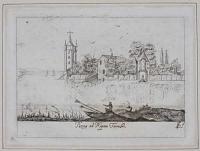
Putney ad Ripam Tamesis.
E.f [monogram of John Evelyn]
[n.d. c.1649] [But later]
Very rare etching, 105 x 150mm (4¼ x 5¾"). Small margins. Tipped into album sheet.
In his famous Diary, Evelyn documents taking a barge up the Thames in April 1649 to visit young ladies' schools in Putney, where he mentions sketching the landscape. An impression of this exact print was corrected in pencil by Evelyn himself to read Battersea . John Evelyn (1620–1706) was a diarist, virtuoso, and amateur etcher. Nearly all of his own etchings were produced in 1649. His treatise Sculptura was published in 1662, although his interest in printmaking diminished in later life.
[Ref: 69493] £180.00
(£216.00 incl.VAT)
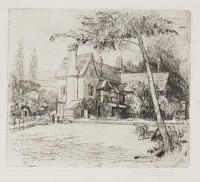
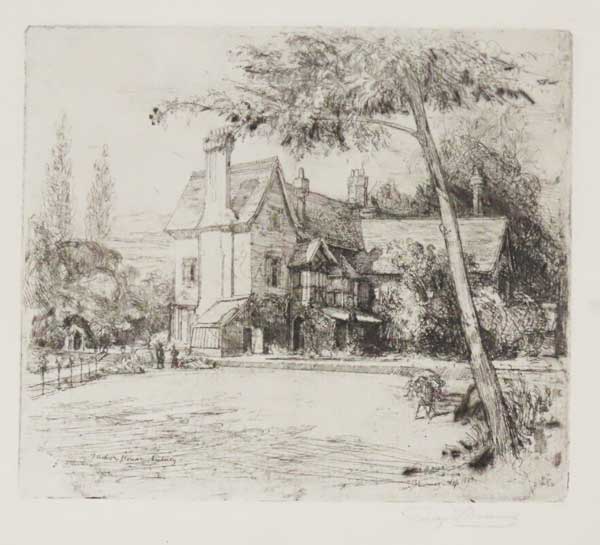
Tudor House Putney.
Percy Thomas, Sept 1895.
Rare etching signed by the artist, 135 x 160mm (5½ x 6¼"), with very large margins
Percy Thomas R.E. (c.1846 - 1922) was a painter and etcher of landscapes, genre scenes and portraits. He was born in London in 1846 and studied at the Royal Academy Schools as well as under James Abbott McNeill Whistler as his first pupil. Whistler taught him to etch, and in 1874 he etched a portrait of his master for inclusion in Ralph Thomas's Catalogue of Whistler's Etchings. Percy Thomas exhibited at the Royal Academy from 1867 and was elected a member of the Royal Society of Painter-Etchers and Engravers in 1881. He lived in London and later in Hove, Sussex.
[Ref: 69490] £95.00
(£114.00 incl.VAT)
![[Five views of Putney Bridge.]](img-thumbnail/jpegs/69315.jpg)
[Five views of Putney Bridge.]
[1779-1842]
Two copper engravings, two on steel, one wood-engraving. Largest 180 x 290mm (7 x 11½"). Trimmed and laid on card & 3 small engravings of the bridge.
The largest is from 'The Modern Universal British Traveller". From the Gardiner Collection.
[Ref: 69315] £160.00
(£192.00 incl.VAT)
![[Sir Joseph Bazalgette's Putney Bridge.]](img-thumbnail/jpegs/69316.jpg)
[Sir Joseph Bazalgette's Putney Bridge.]
[c.1886.]
Two wood-engraved views and four wood-engraved contract drawings. Largest 185 x 285mm (7¼ x 11¼"). Trimmed and laid on card.
Two scenes of the Prince & Princess of Wales at the opening of the new Putney Bridge and four architectural plans. From the Gardiner Collection.
[Ref: 69316] £80.00
(£96.00 incl.VAT)
![[Three views of Putney Bridge.]](img-thumbnail/jpegs/69319.jpg)
[Three views of Putney Bridge.]
[1779-1842]
Sepia aquatint & two etchings. Aquatint 145 x 205mm (5¾ x 8"). Trimmed and laid on card.
Three views of the first Putney Bridge, all with the Church of St. Mary the Virgin. From the Gardiner Collection.
[Ref: 69319] £120.00
(£144.00 incl.VAT)

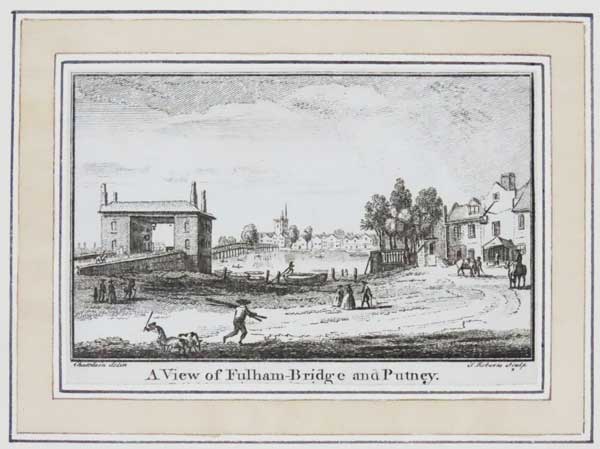
A View of Fulham-Bridge and Putney.
Chatelain delin. J. Roberts Sculp.
[n.d. c.1750]
Engraving, sheet 80 x 120mm (3¼ x 4¾"). Trimmed within plate and laid on album paper.
View of the entrance to the bridge, looking across the river towards Putney, with figures passing through the foreground. The bridge was the second bridge built over the Thames in London (after London Bridge). It was constructed of wood and opened in 1729.
[Ref: 69492] £85.00
(£102.00 incl.VAT)
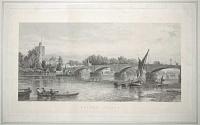
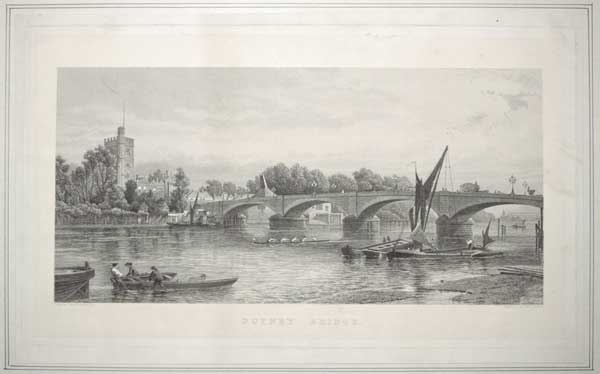
Putney Bridge.
Drawn by John O'Connor R.I. Engraved by John Saddler.
[n.d., c.1880.]
Engraving on steel, printed on chine collé. 265 x 455mm (10½ x 18"). Laid on card at corners, small margins.
A view of Putney Bridge from the Putney shoreline, with All Saints Church, Fulham, on the opposite bank. From the Peter Jackson Collection & Gardiner Collection.
[Ref: 69303] £260.00
(£312.00 incl.VAT)

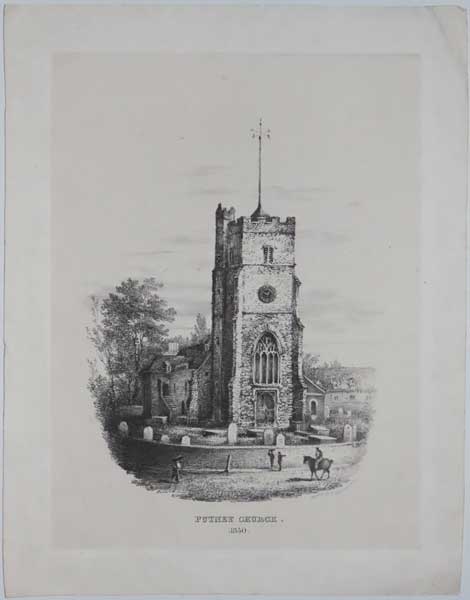
Putney Church, 1830.
Paint'd & M.Jones. Printed by C. Hullmandel.
[n.d. c.1830]
Uncommon & rare lithograph on india. Sheet 275 x 205mm (10¾ x 8"), large margins.
A view of the Church of St. Mary the Virgin, Putney, predating the substantial reconstruction of 1836 to the designs of Edward Lapidge and, of course, the fire of 1973. .
[Ref: 69494] £130.00
(£156.00 incl.VAT)

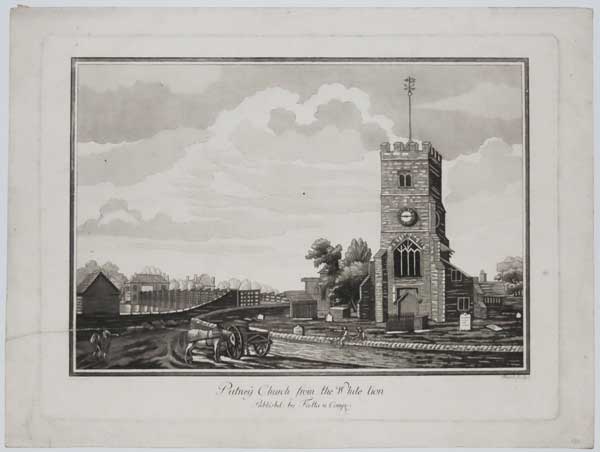
Putney Church from the White lion.
Dillon pinx. Knoell Sculps.
Publishd: by Fietta & Comp: [n.d. c.1800]
Very scarce aquatint, 240 x 325mm (9½ x 12¾"), with very large margins. Printer's crease on left.
View of a brick church with a square battlemented tower, set within a walled churchyard on the right. A carter sits on the churchyard wall, conversing with another man and gesturing towards his horse and cart on the road to the left. In the background, a bridge spans the river, while two figures walk at the far left. The composition is enclosed within a rectangular border. Seems to be an Italian copy of one engraved by Robert Laurie and published in 1783 by John Harris, Sweetings Alley, Cornhill, London.
[Ref: 69496] £320.00
![[Five views of the Church of St. Mary the Virgin, Putney]](img-thumbnail/jpegs/69313.jpg)
[Five views of the Church of St. Mary the Virgin, Putney]
[Various dates, c.1780-1880.]
An ink & wash sketch, two engravings on copper, a steel plate engraving (1832) and a postcard. Largest sheet 170 x 210mm (6¾ x 8¼). Laid on card together.
Five views of the Church of St. Mary the Virgin, Putney, predating the substantial reconstruction of 1836 to the designs of Edward Lapidge and, of course, the fire of 1973. From the Peter Jackson Collection & Gardiner Collection.
[Ref: 69313] £150.00
(£180.00 incl.VAT)
![[Church of St. Mary the Virgin] Putney Church, S.W.](img-thumbnail/jpegs/69302.jpg)
[Church of St. Mary the Virgin] Putney Church, S.W.
C. Burton del.t. Printed by P. Simonau.
Pub: by C.T. Craicklow, Surveyor, 1 Crane Court Fleet Street.
Fine coloured lithograph. Sheet 275 x 200mm (10¾ x 8"). Laid on card at edges with a page of text about the church.
A view of the Church of St. Mary the Virgin, Putney, predating the substantial reconstruction of 1836 to the designs of Edward Lapidge and, of course, the fire of 1973. From the Peter Jackson Collection & Gardiner Collection.
[Ref: 69302] £160.00
(£192.00 incl.VAT)
![[''Bull & Star'' High Street, Putney.]](img-thumbnail/jpegs/69318.jpg)
[''Bull & Star'' High Street, Putney.]
J.P. Emslie 1887. [signed]
Sketch, ink and watercolour. 155 x 235mm (6 x 9¼"). Mounted on card.
A historic public house, demolished 1971, now under TK Max. John Philipps Emslie (1839–1913) was a British topographical artist and folklorist. The son of the engraver John Emslie, he studied at the Working Men's College under Dante Gabriel Rossetti from 1854. Emslie became known for his topographical drawings, illustrating The Illustrated Topical Record of London (1900) and writing and illustrating New Canterbury Tales (c. 1887). An original member and later council member of the Folklore Society, he also documented local folklore throughout England, combining written observations with topographical sketches. Ex Peter Jackson Collection & Gardiner Collection.
[Ref: 69318] £280.00
(£336.00 incl.VAT)
![[Chatfield House. Old Mansion, opposite Fairfax House, No High St Putney 1887]](img-thumbnail/jpegs/69305.jpg)
[Chatfield House. Old Mansion, opposite Fairfax House, No High St Putney 1887] [&] [Old Jacobean Residences Nos 72 & 74 High Street Putney]
J.P. Emslie 1887.[signed]
Two watercolours, titled in a later hand on the mount. Each c. 160 x 240mm (6¼ x 9½"). Mounted on card at corners
Two buildings in Putney High Street, now the site of the Putney Exchange. John Philipps Emslie (1839–1913) was a British topographical artist and folklorist. The son of the engraver John Emslie, he studied at the Working Men's College under Dante Gabriel Rossetti from 1854. Emslie became known for his topographical drawings, illustrating The Illustrated Topical Record of London (1900) and writing and illustrating New Canterbury Tales (c. 1887). An original member and later council member of the Folklore Society, he also documented local folklore throughout England, combining written observations with topographical sketches. Ex Peter Jackson Collection & Gardiner Collection.
[Ref: 69305] £240.00
(£288.00 incl.VAT)
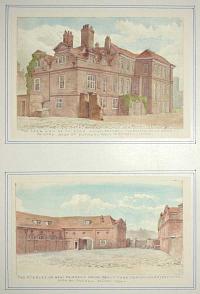
The Rear View of Fairfax House, Formerly the Residence of Genl Fairfax. High Street, Putney - 1887. To be Demolished. [&] The Stables of Genl Fairfax's House (About to be Demolished) Situate , High St Putney. Sketched 1887.
J.P. Emslie 1887. [Signed]
Two sketches, ink and watercolour. 150 x 240mm (6 x 9½") & 160 x 240mm (6¼ x 9½"). Mounted on card at sides.
Two pencil scetches of Fairfax House. Built c.1600, it was the residence of General Thomas Fairfax during the Putney Debates (1647). It was demolished to create the junction of Putney High Street and Montserrat Road. John Philipps Emslie (1839–1913) was a British topographical artist and folklorist. The son of the engraver John Emslie, he studied at the Working Men's College under Dante Gabriel Rossetti from 1854. Emslie became known for his topographical drawings, illustrating The Illustrated Topical Record of London (1900) and writing and illustrating New Canterbury Tales (c. 1887). An original member and later council member of the Folklore Society, he also documented local folklore throughout England, combining written observations with topographical sketches. Ex Peter Jackson Collection & Gardiner Collection.
[Ref: 69311] £360.00

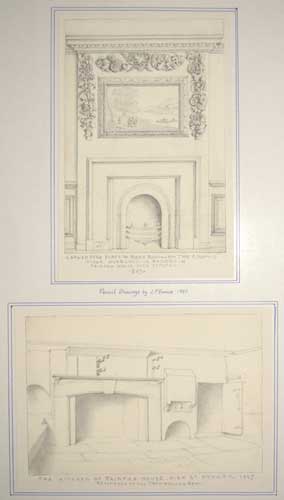
Carved Fireplace in Back Room _ on the Ground Floor Overlooking garden in Fairfax House, High Street, Putney, 1887. [&] The Kitchen at Fairfax House, High St Putney, 1887. Residence of the Cromwellian Genl.
J.P. Emslie 1887.
Two pencil sketches. 240 x 160mm (9½ x 6¼") & 160 x 240mm (6¼ x 9½"). Mounted on cardat sides
Two pencil scetches of the features of the interior of Fairfax House. Built c.1600, it was the residence of General Thomas Fairfax during the Putney Debates (1647). It was demolished to create the junction of Putney High Street and Montserrat Road. John Philipps Emslie (1839–1913) was a British topographical artist and folklorist. The son of the engraver John Emslie, he studied at the Working Men's College under Dante Gabriel Rossetti from 1854. Emslie became known for his topographical drawings, illustrating The Illustrated Topical Record of London (1900) and writing and illustrating New Canterbury Tales (c. 1887). An original member and later council member of the Folklore Society, he also documented local folklore throughout England, combining written observations with topographical sketches. Ex Peter Jackson Collection & Gardiner Collection.
[Ref: 69309] £240.00
(£288.00 incl.VAT)
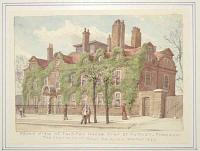
Front View of Fairfax House, High Street, Putney. Formerley the Residence of Gen. Fairfax.
J.P. Emslie 1887. [Signed]
Ink and watercolour sketch. 160 x 235mm (6¼ x 9¼"). Mounted on card at sides
The ivy-covered facade of Fairfax House. Built c.1600, it was the residence of General Thomas Fairfax during the Putney Debates (1647). It was demolished to create the junction of Putney High Street and Montserrat Road. John Philipps Emslie (1839–1913) was a British topographical artist and folklorist. The son of the engraver John Emslie, he studied at the Working Men's College under Dante Gabriel Rossetti from 1854. Emslie became known for his topographical drawings, illustrating The Illustrated Topical Record of London (1900) and writing and illustrating New Canterbury Tales (c. 1887). An original member and later council member of the Folklore Society, he also documented local folklore throughout England, combining written observations with topographical sketches. Ex Peter Jackson Collection & Gardiner Collection. Hollebone Collection Sothebys 1955 Lot 174.
[Ref: 69308] £290.00
(£348.00 incl.VAT)

The Entrance Hall of Fairfax House, High Street, Putney, 1887. [&] [The Continuation of Staircase. From the Hall to the Upper Floors oF Fairfax House, High St. Putney 1887. About to be Destroyed.
J.P. Emslie 1887.
Two pencil sketches. 160 x 240mm (6¼ x 9½") & 235 x 155mm (9¼ x 6"). Mounted on card at corners.
Two pencil scetches of the features of the interior of Fairfax House. Built c.1600, it was the residence of General Thomas Fairfax during the Putney Debates (1647). It was demolished to create the junction of Putney High Street and Montserrat Road. John Philipps Emslie (1839–1913) was a British topographical artist and folklorist. The son of the engraver John Emslie, he studied at the Working Men's College under Dante Gabriel Rossetti from 1854. Emslie became known for his topographical drawings, illustrating The Illustrated Topical Record of London (1900) and writing and illustrating New Canterbury Tales (c. 1887). An original member and later council member of the Folklore Society, he also documented local folklore throughout England, combining written observations with topographical sketches. Ex Peter Jackson Collection & Gardiner Collection.
[Ref: 69306] £240.00
(£288.00 incl.VAT)

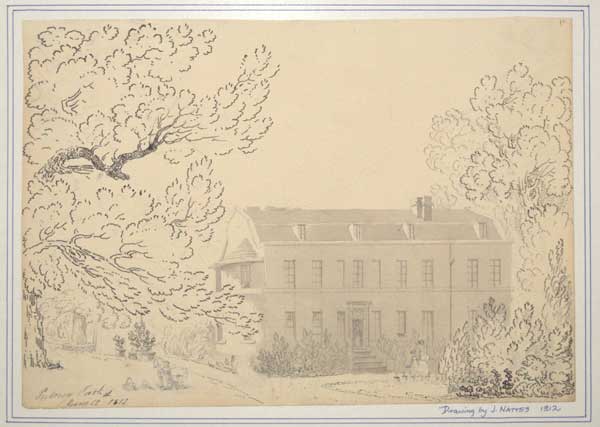
Putney Park June 12th 1812.
[Drawing by John Claude Nattes.]
[n.d., c.1812.]
Ink sketch with grey wash. Sheet 230 x 330mm (9 x 13"). Laid on card at sides
A house and gardens, with a child playing with a wooden horse. Probably the Putney Park House in Pleasance Road, Rowhampton, demolished and replaced by a new house by Decimus Burton (1837-8). John Claude Nattes (c.1765–1839) was a watercolourist and topographical draughtsman of either French or English origin. In 1789, Joseph Banks commissioned Nattes to record the architecture of Lincolnshire, resulting in more than 700 drawings and watercolours produced between 1789 and 1797. This remarkable body of work remains an important record of pre-Victorian topography. He later accompanied John Stoddart on tours of Scotland, providing illustrations for Remarks on Local Scenery and Manners in Scotland (1801). Nattes was among the earliest practitioners of watercolour painting in Britain and was associated with the founding of the Society of Painters in Water Colours in 1804. Although expelled two years later, for exhibiting other people's work as his own, he continued to exhibit at the Royal Academy until 1814. From the Gardiner Collection.
[Ref: 69310] £320.00

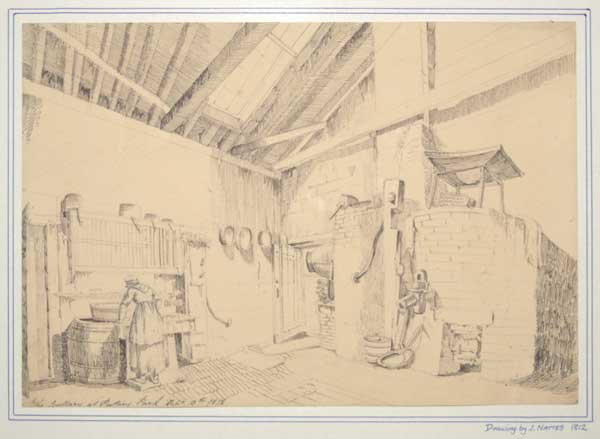
The Scullary at Putney Park Sept 13th 1812.
[Drawing by John Claude Nattes.]
[n.d., c.1812.]
Ink sketch. Sheet 230 x 330mm (9 x 13"). Laid on card at corners.
An antiquated scullery, with a maid at work at a sink. Probably the Putney Park House in Pleasance Road, Rowhampton, demolished and replaced by a new house by Decimus Burton (1837-8). John Claude Nattes (c.1765–1839) was a watercolourist and topographical draughtsman of either French or English origin. In 1789, Joseph Banks commissioned Nattes to record the architecture of Lincolnshire, resulting in more than 700 drawings and watercolours produced between 1789 and 1797. This remarkable body of work remains an important record of pre-Victorian topography. He later accompanied John Stoddart on tours of Scotland, providing illustrations for Remarks on Local Scenery and Manners in Scotland (1801). Nattes was among the earliest practitioners of watercolour painting in Britain and was associated with the founding of the Society of Painters in Water Colours in 1804. Although expelled two years later, for exhibiting other people's work as his own, he continued to exhibit at the Royal Academy until 1814. From the Gardiner Collection.
[Ref: 69307] £290.00
(£348.00 incl.VAT)

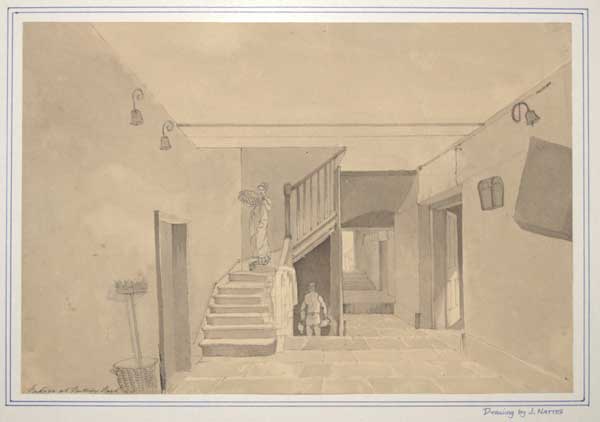
Passage at Putney Park.
[Drawing by John Claude Nattes.]
[n.d., c.1812.]
Ink and wash. Sheet 220 x 330mm (8¾ x 13"). Laid on card at corners.
A servants' passage and back staircase, with call bells on the walls. Probably the Putney Park House in Pleasance Road, Rowhampton, demolished and replaced by a new house by Decimus Burton (1837-8). John Claude Nattes (c.1765–1839) was a watercolourist and topographical draughtsman of either French or English origin. In 1789, Joseph Banks commissioned Nattes to record the architecture of Lincolnshire, resulting in more than 700 drawings and watercolours produced between 1789 and 1797. This remarkable body of work remains an important record of pre-Victorian topography. He later accompanied John Stoddart on tours of Scotland, providing illustrations for Remarks on Local Scenery and Manners in Scotland (1801). Nattes was among the earliest practitioners of watercolour painting in Britain and was associated with the founding of the Society of Painters in Water Colours in 1804. Although expelled two years later, for exhibiting other people's work as his own, he continued to exhibit at the Royal Academy until 1814. From the Gardiner Collection.
[Ref: 69304] £290.00
(£348.00 incl.VAT)
![Putney School. [&] [Putney School]](img-thumbnail/jpegs/69317.jpg)
Putney School. [&] [Putney School]
[n.d., c.1800.]
Two rare aquatints, printed in brown. 115 x 165mm (4½ x 6½") & 120 x 170mm (4¾ x 6¾"). Trimmed, losing inscriptions, laid on card with newspaper article illustrated with these prints.
Two views of a school, the titled one with a group of boys playing cricket. According to the newspaper (Putney's 'Borough News') the building was in Carmalt Road, named after Rev. William Carmalt, headmaster of the school, whose signature is on the untitled plate. From the Peter Jackson Collection & Gardiner Collection.
[Ref: 69317] £390.00

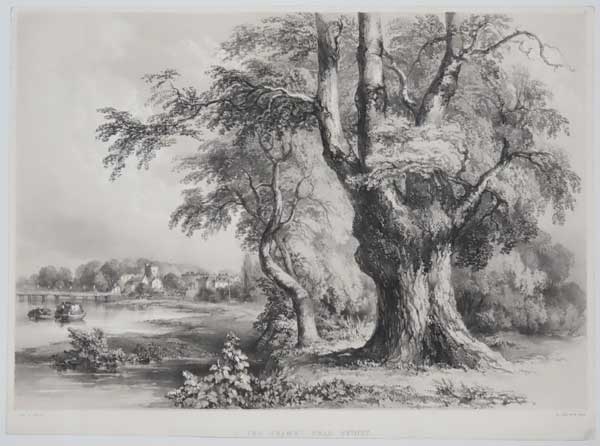
On The Thames, Near Putney.
Drawn by T. Maisey. On Stone by W. Gauci.
[n.d. c.1840]
Lithograph, sheet 305 x 415mm (12 x 16¼"). Trimmed near to image.
A picturesque view of the River Thames at Putney, featuring a large ancient tree in the foreground.
[Ref: 69497] £230.00
(£276.00 incl.VAT)
<<< Previous 1 Next >>>
![[Coldbath Fields Prison.] The House of Correction, Cold Bath Fields.](jpegs/68764.jpg)
![[Hammersmith.]](jpegs/68813.jpg)

![[An Old Building at Putney, Sept 12 1826.] [and another watercolour by Emslie]](jpegs/69314.jpg)

![[Five views of Putney Bridge.]](jpegs/69315.jpg)
![[Sir Joseph Bazalgette's Putney Bridge.]](jpegs/69316.jpg)
![[Three views of Putney Bridge.]](jpegs/69319.jpg)
![[Five views of the Church of St. Mary the Virgin, Putney]](jpegs/69313.jpg)
![[Church of St. Mary the Virgin] Putney Church, S.W.](jpegs/69302.jpg)
![[''Bull & Star'' High Street, Putney.]](jpegs/69318.jpg)
![[Chatfield House. Old Mansion, opposite Fairfax House, No High St Putney 1887]](jpegs/69305.jpg)



![Putney School. [&] [Putney School]](jpegs/69317.jpg)