Results 1-12 of 12
<<< Previous 1 Next >>>
![[Various Clocks & Pieces of Ornamental Furniture.]](img-thumbnail/jpegs/27739.jpg)
[Various Clocks & Pieces of Ornamental Furniture.] Plate VIII.
R. Adam Architect. P. Begbie Sculp.
Published as the Act directs 1773.
Engraving with small margins. Plate 599 x 464mm. 23½ x18¼".
Various ornamental pieces designed and executed for different persons, including 3 clocks, a watch case, executed for Lady Aspley's dressing room; Volume I, part 4, "Works in Architecture". Robert and his brother James Adam forever changed the face of British architecture by introducing innovative Classical design ideas. From 1754-57, Robert lived in Italy where he had a long productive friendship with Piranesi, which was inspirational for both men. Upon his return, the brothers launched their career by building the Adelphi from the Thames to the Strand in London, which although not a commercial success at the time, included one of London's most cherished buildings, the Adlephi Theatre. Together, the Adam brothers designed and built some of the most famous buildings in England, including such bastions of English architecture as Kenwood House, Keddlestone Manor, and Syon House. To the interiors of their English country houses, the Adams brought wonderful ornamental elements in niches, lunettes, festoons and reliefs. Their classically designed buildings were so numerous in London that they changed the prevailing feel of the city and established their brand of neo-Classicism as the model of elegance and importance. It is asserted that the brothers originated the concept of the uniform facade attached to the typical English row house, an architectural device that distinguishes London buildings. This monumental contribution is evidenced in the Adams' designs for Portland Place and Fitzroy Square, and these were used as architectural models for the whole city. The brothers brought their talents into other areas by designing furniture to complement their beautiful interiors and by creating and publishing a treatise of design entitled 'Works in Architecture'. The work was published in three volumes over an extended span of time, beginning in 1773, with the final volume being published posthumously in 1822.
[Ref: 27739] £330.00
![[The first 'Big Ben'] The Largest Bell in England, Cast by John Warner & Sons, London,](img-thumbnail/jpegs/64289.jpg)
[The first 'Big Ben'] The Largest Bell in England, Cast by John Warner & Sons, London, By Order of her most Gracious Majesty Queen Victoria, for the Clock Tower of the New Palace at Westminster, 1856.
[1856.]
Wood-engraved admission ticket on card, unused. Sheet 185 x 145mm (7¼ x 5¾"). Old ink mss on top edge, a few spots, mounted on album paper with newspaper clippings, one showing the same image. One print has come away from the album paper.
A ticket to see the first 'Big Ben' bell, shown on the ground with two men added for perspective. The bell cracked during testing so never reached the Clock Tower.
[Ref: 64289] £240.00
(£288.00 incl.VAT)
view all images for this item

A Draught of a curious Clock in the possession of Mr Rich.d Green of Litchfield.
Engrav'd for the Universal Magazine for J. Hinton at the King's Arms in St Paul's Church Yard London 1748.
Engraving. 205 x 235mm. (8 x 9¼") as normal. Trimmed into plate at bottom, binding folds.
'The Lichfield Clock', a musical longcase clock purchased by apothecary Dr Richard Green in the 1740s and displayed in his Museum of Curiosities. The clock is on the right, with its elaborate gothic church-like case on the left. The clock is now in the Victoria Art Gallery above the public library in Bath. Restored, it still plays five different tunes including a minuet by Handel.
[Ref: 45342] £140.00
(£168.00 incl.VAT)
![[Gianello della Torre] Juanelo Torriano](img-thumbnail/jpegs/63366.jpg)
[Gianello della Torre] Juanelo Torriano
[n.d., c.1820.]
Chine collé mezzotint. 175 x 140mm (6¾ x 5½"),
An illustration of the carrara marble bust of Italo-Spanish clockmaker, engineer and mathematician Gianello della Torre (c.1500-85), attributed to Pompeo Leoni. now in the Museo de Santa Cruz.
[Ref: 63366] £140.00
(£168.00 incl.VAT)

John Harrison Esq. Inventor of the Time Keeper. European Magazine.
Published by John Sewell, No 32 Cornhill, 1st Sept.r 1788.
Engraving. 180 x 115mm (7 x 4½") Thread margins, hole in inscription area.
A portrait of John Harrison (c.1693 - 1776), in profile with wig curled, in an oval frame. Harrison, an English carpenter and clockmaker who invented the marine chronometer, finally solving the Logitude question (of how to establish the East-West position or longitude of a ship at sea) thus revolutionising and extending the possibility of safe long-distance sea travel. The problem was considered so intractable and, following the Scilly naval disaster of 1707, so important that the British Parliament offered the Longitude prize of £20,000.
[Ref: 45040] £160.00
(£192.00 incl.VAT)

John Harrison Esq.r. Inventor of the Time Keeper.
Engrav'd by Burnet Reading.
[London, 1776.]
Engraving. Sheet size: 145 x 95mm (5¾ x 3¾"). Trimmed to image. Glued to backing sheet.
A portrait of John Harrison (c.1693 - 1776) bust, in profile to the left, wearing short wig curled over side of head. In oval frame. An illustration to the 'European Magazine'. Harrison, an English carpenter and clockmaker who invented the marine chronometer, finally solving the Logitude question; how to establish the East-West position or longitude of a ship at sea, thus revolutionising and extending the possibility of safe long-distance sea travel. The problem was considered so intractable and, following the Scilly naval disaster of 1707, so important that the British Parliament offered the Longitude prize of £20,000.
[Ref: 34340] £120.00
(£144.00 incl.VAT)

John Harrison. From an Engraving by Tassaert; published in 1768, after a Painting by King. Under the Superintendance of the Society of the Diffusion of Useful Knowledge.
Engraved by W. Holl.
London, Published by Charles Knight, Ludgate Street. [n.d. c.1835.]
Stipple engraving on steel. 266 x 179mm (10½ x 7"). Hole in the sky area.
John Harrison (c.1693-1776), clockmaker celebrated for his work in marine timekeeping. He was the maker of five innovative and ground-breaking timekeepers and perfected the chronometer, winning the prize for determining Longitude at sea in 1773. Published in the ''The Gallery of Portraits: With Memoirs'', 1833-7.
[Ref: 24815] £140.00
(£168.00 incl.VAT)
![[Belgian horologists' trade card.]](img-thumbnail/jpegs/41264.jpg)
[Belgian horologists' trade card.] Ghiesbreght, Horologer, M.n du Chemin de Fer. Fabrique de Bronzes et d'Horlogeries, Rue de l'Escalier, S.n. 8, No 3, A Bruxelles.
[Brussels, c.1860.]
Chromolithograph on porcelain card, sheet 360 x 275mm (14¼ x 10½").
A large trade card, showing the front elevation of the shop, with clocks, printed in gilt, on display on the ground floor windows.
[Ref: 41264] £320.00
![[Belgian horologists' trade card.]](img-thumbnail/jpegs/41261.jpg)
[Belgian horologists' trade card.] Magasin d'Horlogerie en tous Genres. J. Mortier, Rue des Champs, No 76; Gand.
Lith G. Jacquman, r. Basse, Gand.
[Ghent, c.1860.]
Chromolithograph on porcelain card, sheet 100 x 145mm (4 x 5¾").
A trade card with a view of the shop, two figurative clocks and rococo fronds.
[Ref: 41261] £120.00
(£144.00 incl.VAT)
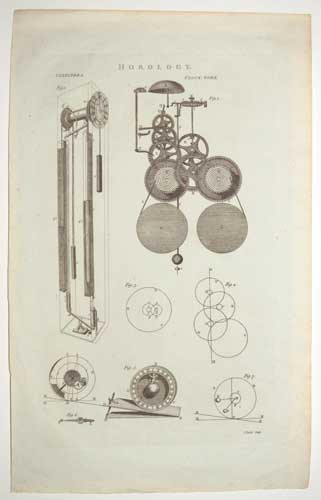
Horology.
I. Taylor Sculp.
[n.d., c.1800.]
Engraving. 350 x 210mm (13¾ x 8¼") very large margins.
A plate with seven figures relating to to clock-making, including a contemporary clepsydra (waterclock) and clockwork. From an encyclopedia.
[Ref: 57126] £80.00
(£96.00 incl.VAT)

1. A Perpetual Log. 2. A Ships, Time Regulator. 3. A Ships, Tell Tale. European Magazine.
V. Gottlieb, Inventor.
Published by J. Sewell, Cornhill, Dec.r 1. 1791.
Engraving. Plate 178 x 127mm (7 x 5"). Trimmed to plate along left edge.
An engraving from the European Magazine illustrating three nautical inventions of V. Gottlieb. In the Collection of the British Horological Institute.
[Ref: 30021] £75.00
(£90.00 incl.VAT)
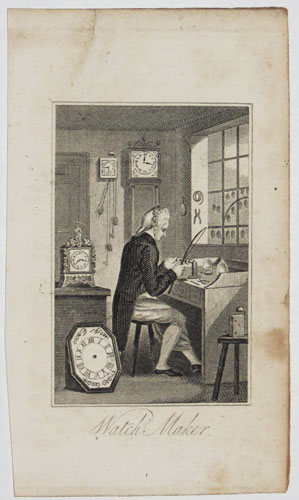
Watch Maker.
[n.d., c.1800.]
Engraving. Sheet: 150 x 90mm (6 x 3½''). Foxing.
A watch maker working in his workshop.
[Ref: 50491] £120.00
(£144.00 incl.VAT)
<<< Previous 1 Next >>>
![[Various Clocks & Pieces of Ornamental Furniture.]](jpegs/27739.jpg)
![[The first 'Big Ben'] The Largest Bell in England, Cast by John Warner & Sons, London,](jpegs/64289.jpg)

![[Gianello della Torre] Juanelo Torriano](jpegs/63366.jpg)


![[Belgian horologists' trade card.]](jpegs/41264.jpg)
![[Belgian horologists' trade card.]](jpegs/41261.jpg)