Results 1-26 of 26
<<< Previous 1 Next >>>

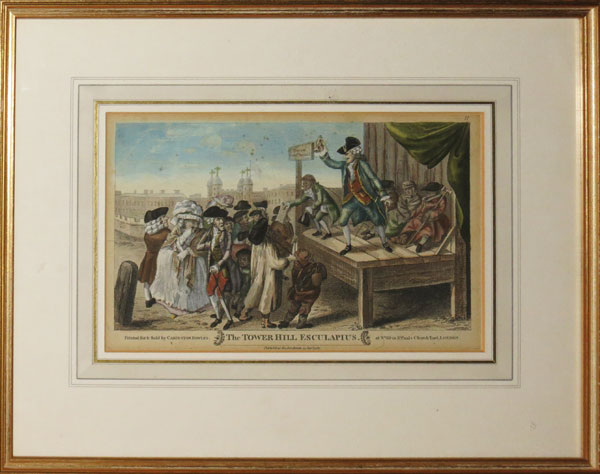
The Tower Hill Esculapius.
Printed for & Sold by Carington Bowles, at N.o.60 in S.t. Paules Church Yard, London. Publish'd as the Act direct, 25 Sep.r. 1782.
Handcoloured etching. Printed area: 265 x 170mm (10½ x 6¾"). Frame: 430 x 340mm (17 x 13½"). Unexamined out of frame. Staining.
A scene by the Tower of London in which a quack stands upon a dias selling his potions to a crowd. A pickpocket rifles through the pockets of a man who is being poked in the eye by a fishing rod.
[Ref: 40336] £160.00
(£192.00 incl.VAT)
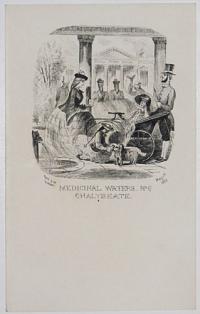
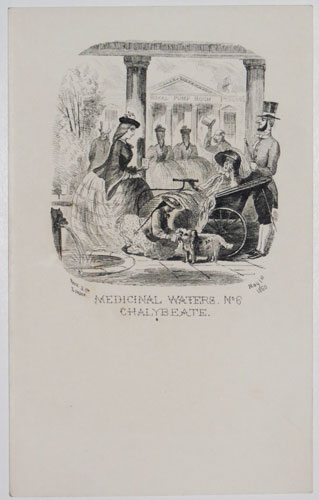
Medicinal Waters. No 6. Chalybeate.
Rock & Co. London. May 1st 1860.
Writing sheet with wood-engraved vignette. 4pp., rare, image 110 x 90mm. (4¼ x 3½").
A scene of the interior of a spa, with an invalid woman in a bath chair, printed as a writing sheet probably designed for the visitors to the most famous source of Chalybeate waters (also known as ferruginous waters, containing iron salts), Tunbridge Wells. When discovered by Dudley North, 3rd Baron North, in 1606 the chalybeate waters of Tunbridge Wells could cure 'the colic, the melancholy, and the vapours; it made the lean fat, the fat lean; it killed flat worms in the belly, loosened the clammy humours of the body, and dried the over-moist brain'. Famous partakers include Henrietta Maria, wife of Charles I, Queen Anne when Princess Anne of Denmark and Queen Victoria when princess.
[Ref: 34257] £65.00
(£78.00 incl.VAT)
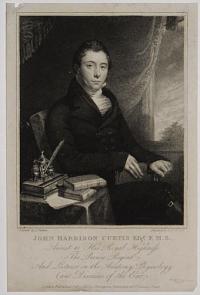
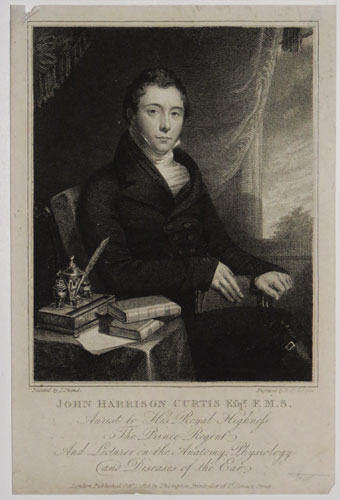
John Harrison Curtis Esq.r F.M.S. Aurist to His Royal Highness The Prince Regent And Lecturer on the Anatomy, Physiology and Diseases of the Ear
Painted by J. Shand. Engraved by Rob.t Cooper
London, Published Oct.r 1 1818 by Thompson, Printseller 26 St. James's Street.
Stipple, sheet 175 x 125mm (7 x 5"). Proof impression; trimmed inside platemark.
John Harrison Curtis (1778-1860), otologist. 'In the early nineteenth century the management of aural conditions not infrequently fell into the hands of certain practitioners who were neither interested in diagnosis nor concerned with the indications for their treatment. Curtis was the most notorious of these; he had been a dispenser in the navy, but had no medical qualifications. His ideas and practice were a mixture of charlatan and of applied common sense' (DNB). Curtis' 'Treatise on the Physiology and Diseases of the Ear' (1817) ran to four editions. Establishing himself in a large property on Soho Square in London, Curtis' clients included George IV and the duke and duchess of Gloucester. In 1816 he founded the first specialist ear hospital in Britain on nearby Carlisle Street. He later squandered his fortune, fled to the Isle of Man to escape his debtors, and died in an asylum. Only later state published by Asperne listed in O'D. W. 738 I.
[Ref: 35283] £70.00
(£84.00 incl.VAT)
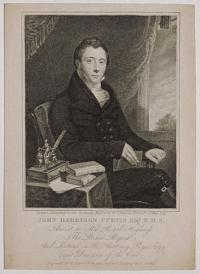
John Harrison Curtis Esq.r F.M.S. Aurist to His Royal Highness The Prince Regent And Lecturer on the Anatomy, Physiology and Diseases of the Ear.
Engraved by R. Cooper, from an original Painting by J. Shand
London, Published for the European Magazine by J. Asperne, Cornhill, 1st May 1819.
Stipple, sheet 175 x 125mm (7 x 5"). Trimmed inside platemark.
John Harrison Curtis (1778-1860), otologist. 'In the early nineteenth century the management of aural conditions not infrequently fell into the hands of certain practitioners who were neither interested in diagnosis nor concerned with the indications for their treatment. Curtis was the most notorious of these; he had been a dispenser in the navy, but had no medical qualifications. His ideas and practice were a mixture of charlatan and of applied common sense' (DNB). Curtis' 'Treatise on the Physiology and Diseases of the Ear' (1817) ran to four editions. Establishing himself in a large property on Soho Square in London, Curtis' clients included George IV and the duke and duchess of Gloucester. In 1816 he founded the first specialist ear hospital in Britain on nearby Carlisle Street. He later squandered his fortune, fled to the Isle of Man to escape his debtors, and died in an asylum. O'D 1 (only engraved likeness listed). W. 738 I.
[Ref: 35282] £70.00
(£84.00 incl.VAT)
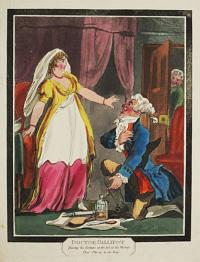
Doctor Gallipot placing his Fortune at the feet of his Mistress. Thro' Physic to the Dogs.
Rowlandson [etched in image lower right.]
[Published by Reeve & Jones No.7 Vere Street Nov.r 1 1808.]
Hand-coloured etching and aquatint. Plate: 335 x 260mm (13 x 10''), with large margins. Trimmed, repaired damage in left edge.
An ugly foppish apothecary, with drink-blotched profile, kneels at the feet of a handsome young woman, one hand on his breast, the other pointing to a cloth at his feet on which are spread clyster-pipes, knife, pestle and mortar, and a bottle: 'Elixer of Life Drops'. She stands, making a gesture of surprise. Behind are the curtains of a bed, and a door round which looks an amused man. BM Satires: 11114.
[Ref: 50740] £360.00

Doctor Adam Donald, Prophet of Bethelnie. Born Anno 1703. ob: Anno 1780. Engraved for The Bee.
J: W,,s [John Williams] ad viv: delint. 1772.
[n.d., 1791]
Rare copper engraving. 145 x 90mm (5¾ x 3½").
Quack doctor Adam Donald (1703-80). Born in Aberdeenshire with disabilities that prevented him from a life of manual labour, his mannerisms, charm, and apparent skills led to his calling as a spiritualist. Donald was called to consult on all matters related to health by the local citizens. A habit of lurking through churchyards ‘speaking’ with the dead fuelled his supernatural legitimacy, while owning several books in other languages (of which he could not speak) contributed to his scholarly image among the townspeople. Prescribing remedies ranging from milk baths to singing on chimneys, he could do no harm. If a death occurred it was the patient’s mistake for not following the ‘Prophet’s’ orders, never Donald’s. While Donald’s wife kept his secret during their marriage, his daughter exposed him as a quack and fraud following his death in 1780.
[Ref: 16193] £120.00
(£144.00 incl.VAT)

Most Extraordinary Invention. Pulvermacher's Patent Portable Hydro-Electric Chain for Personal Use. [...] Acute nervous pains, such as Head, Tooth, and Ear Ache, Rheumatic Pains, &c. are relieved instantaneously, the moment the Chain is applied [...]
[n.d., c.1851.]
Letterpress with wood-engraved vignette. Sheet 135 x 75mm (5¼ x 3"). Trimmed to printed border, laid on card.
An advert for a type of voltaic battery invented by Isaac Lewis Pulvermacher and marketed as a tool for electrotherapy. It includes a glowing testimonal from Golding Bird, a Fellow of the Royal College of Physicians, who had been given a sample to test and found it a good source of electricity for medical purposes. However it was used here by Charles Meining, the Pulvermacher Company's London agent, without permission, alongside outrageous claims about its benefits. Bird's threat of legal action (against Meining as a quack rather than Pulvermacher) caused The Association Medical Journal, Medical Times and The Lancet to remove adverts for the machine. See Wikipedia 'Pulvermacher's chain' for details of the construction and history.
[Ref: 58750] £45.00
(£54.00 incl.VAT)
![[Theriac vendor]](img-thumbnail/jpegs/36926.jpg)
[Theriac vendor] Au grand Magazin de Tériaque / Les voilà donc surpris mais cet air patelin / Trouvera des nigauds qui si laisseront prendre [...]
[Anon., published 8 March 1761? (date on poster in image)]
Etching with small margins, rare, platemark 125 x 160mm (5 x 6¼").
Anti-Jesuit satire, whose subject is made explicit by a notice on the wall which forbids Jesuits from any commercial activities. Theriac was a medical concoction formulated by the Greeks in the first century AD and sold up until the 19th century. Here the medicine, sometimes sold by Jesuit traders, is seen as a quack treatment, as the text below explains, saying that if France welcomes the jesuits, they will deceive those who trusted in them. This print is probably a copy of a more skilfully-etched version, copies of which are in the BNF and Waddesdon.
[Ref: 36926] £140.00
(£168.00 incl.VAT)
![[John George Lambton] The Newest Universal Medicine.](img-thumbnail/jpegs/52788.jpg)
[John George Lambton] The Newest Universal Medicine.
HB. [John Doyle.] A. Ducôte's Litho.y St Martins Lane.
Published by T. M.cLean, 26 Haymarket, July 27th 1837.
Coloured lithograph, stamped 'Subscriber's Copy'. Sheet 285 x 415mm (11¼ x 16¼"). Trimmed to printed border top and bottom.
John George Lambton, Lord Durham, as a quack, standing at a counter, mixing ingredients with a mortar and pestel. Around him are jars marked 'Conservative Opiate', 'Radical Alcohol' 'Whig Alkali', etc. Under the mortar is 'Letter to the Electors of Durham'; on chairs are parcels addressed to Daniel O'Connell, the Bishop of Exeter and the Times and other newspapers. During the 1837 election Lambton 'advised' the electorate of Durham on their choice of candidates. See BM 1868,0808.11811.
[Ref: 52788] £95.00
(£114.00 incl.VAT)
![[Lionel Lockyer]](img-thumbnail/jpegs/37638.jpg)
[Lionel Lockyer] The true Effigies here you may behold, / Of him who for preventing others ill / Hath gaind a Medicine far excelling Gold. / And known to all ye world for Lockyers Pill.
J. Sturt sculp. [n.d., c.1672]
Engraving, sheet 150 x 90mm (6 x 3½"). Trimmed and glued to backing sheet.
Lionel Lockyer (1601-72), inventor who had great success marketing a 'Pill Extracted from the Rays of the Sun'. He is buried in Southwark cathedral. O'D 1 (only likeness listed) Wellcome: 1799-2
[Ref: 37638] £85.00
(£102.00 incl.VAT)

The Loisettian School of Physiological Memory; or, The Instantaneous Art of Never Forgetting. 37, New Oxford Street, London. [2nd June] 188[6]. Dear [Sir] I beg to acknowledge with thanks receipt by [P.P.O.] of [£1/1/-] in full for complete course of Lessons in my System of Memory by Post [...]
[1886.]
2pp. letterpress form, filled in with old ink mms and signed by Loisette, addressed to Mr. D. Cudmase. Sheet 210 x 135mm (8¼ x 5¼"). Creases, spike hole in centre.
A receipt for tuition from Professor Alphonse Loisette, who protected his memory system by forcing a gagging contract on prospective pupils. Those who signed up, including Mark Twain, found it was not only plagerised but also largely ineffective. An exposé was published reporting that Loisette's real name was Marcus Dwight Larrowe and he had no academic degree.
[Ref: 58756] £95.00
(£114.00 incl.VAT)
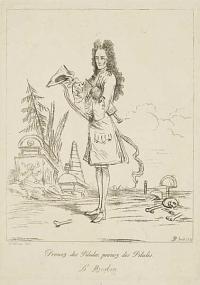
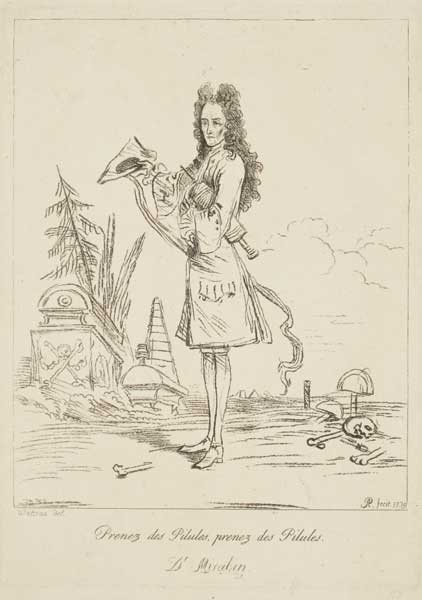
Prenez des Pilules, prenez des Pilules. Dr Misabin.
Watteau del. AP. [Arthur Pond] fecit. 1739.
Caricature of the quack Dr Misaubin, standing holding a tricorn hat amid skulls and tombs. After a lost drawing by Watteau, drawn when he was in London in 1719/20. Arthur Pond [1710-1758] printmake publisher and collector. BM:1987.Welcome:2015
[Ref: 7252] £240.00
(£288.00 incl.VAT)
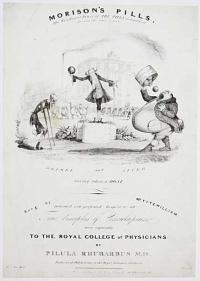
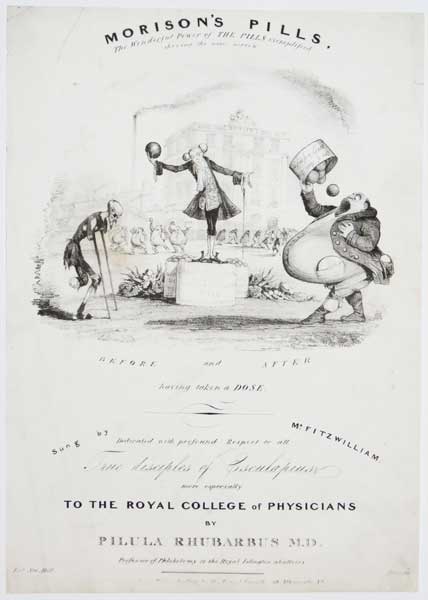
Morison's Pills, The Wonderful Power of the Pills exemplified showing the same person before and after having taken a dose. Sung by Mr Fitzwilliam Dedicated with profound Respect to all True disciples of Esculapios, more especially To the Royal College of Physicians by Pilula Rhubarbius M.D. Professor of Phlebotomy to the Royal Islington abattoirs.
L. Brandard [in image]
[publication line illegible]
Rare lithograph, sheet 345 x 250mm (13½ x 9¾"). Creases, slight stain in centre.
Cover of a comic song based on the Universal Vegetable Pills manufactured by James Morison (1770-1840). Before & after images show the wonderous effect of the pills. Morison suffered from ill health in his youth and believed that bad humours had spread from his digestive tract throughout his body, and that the only certain cure was an all-vegetable remedy capable of purifying the blood and hence his entire system. Morison earnt a fortune (which he later lost) through his pills, but throughout his career would have nothing to do with chemists or druggists and sold his pills through other retailers. The dedication to the Royal College of Physicians is ironic, given the mutual suspicion between Morison and the medical profession at large.
[Ref: 40077] £130.00
(£156.00 incl.VAT)
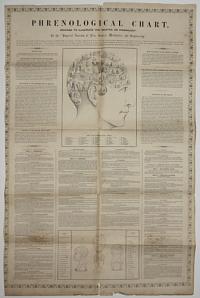
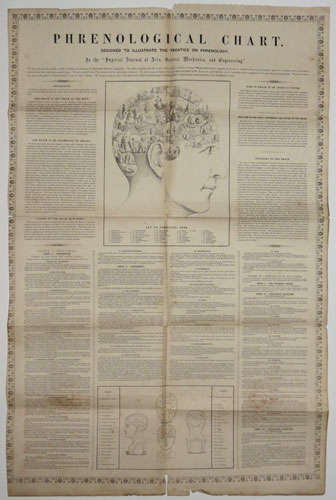
Phrenological Chart. Designed to Illustrate the Treatise on Phrenology, in the ''Imperial Journal of Arts, Science, Mechanics and Engineering''.
[n.d., c.1850.]
Letterpress. Sheet: 530 x 825mm (21 x 32½"). Large tear in top edge and tears along folds.
A letterpress chart illustrating and explaining the various elements of phrenology.
[Ref: 44884] £360.00
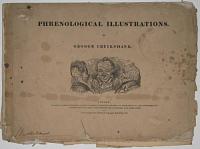
Phrenological Illustrations.
by George Cruikshank.
London: Published by George Cruikshank, Myddelton Terrace, Pentonville; and Sold by J. Robins And Co. Ivy Lane, Paternoster Row; S. Knights, Sweeting's Alley, Royal Exchange; and G. Humphrey, 24, St. James's Street. [n.d., 1826].
Oblong folio, original printed wrapper.; text page, six etched plates, as called for, with contemporary guard leaves. Foxing and staining, with tatty extremities.
George Cruikshank's (1792 - 1878) satirical take on the theories of Franz Joseph Gall (1758-1828) and Johann Caspar Spurzheim (1776-1832). Principal human faculties and emotions are illustrated by five humerous vignette images per plate. Gall was a neuroanatomist, physiologist, and pioneer in the study of the localization of mental functions in the brain. Spurzheim attended the lectures of Gall and became a disciple, accompanying him on a lecturing tour through Central Europe, and settling with him in 1807 in Paris; in 1813 he separated from Gall, and went to lecture in England with much acceptance. He wrote numerous works bearing on phrenology, education, etc. All plates inscribed 'Designed Etched & Published by George Cruikshank August 1st. 1826'.
[Ref: 9088] £250.00
view all images for this item
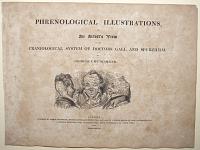
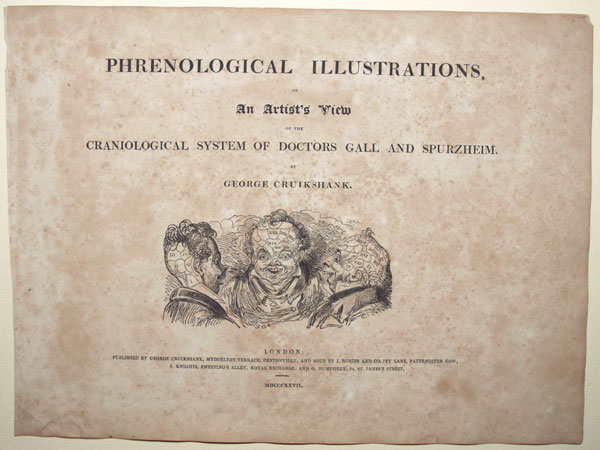
Phrenological Illustrations, or An Artist's View of the Craniological System of Doctors Gall and Spurzheim.
by George Cruikshank.
London: Published by George Cruikshank, Myddelton Terrace, Pentonville; and Sold by J. Robins And Co. Ivy Lane, Paternoster Row; S. Knights, Sweeting's Alley, Royal Exchange; and G. Humphrey, 24, St. James's Street. MDCCCXXVII [1827].
Oblong folio, disbound; etched title, 2pp text, six coloured etched plates, as called for. Title and text page foxed; two plates with single tears.
George Cruikshank's (1792 - 1878) satirical take on the theories of Franz Joseph Gall (1758-1828) and Johann Caspar Spurzheim (1776-1832). Principal human faculties and emotions are illustrated by five humerous vignette images per plate. Gall was a neuroanatomist, physiologist, and pioneer in the study of the localization of mental functions in the brain. Spurzheim attended the lectures of Gall and became a disciple, accompanying him on a lecturing tour through Central Europe, and settling with him in 1807 in Paris; in 1813 he separated from Gall, and went to lecture in England with much acceptance. He wrote numerous works bearing on phrenology, education, etc. All plates inscribed 'Designed Etched & Published by George Cruikshank August 1st. 1826'.
[Ref: 57311] £480.00

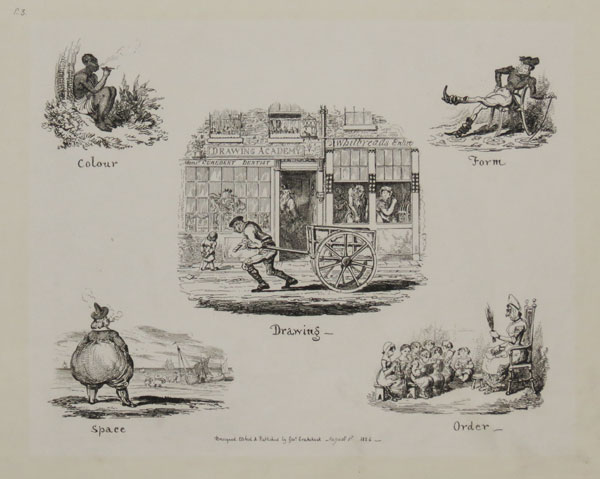
Drawing. Colour. Space. Form. Order. P.3.
Designed, Etched & Published by Geo.e Cruikshank _ August 1.st 1826.
Etching. Plate 253 x 300mm (10 x 11¾").
A satire on 'Drawing' and the different components of the 'art', shows a black man smoking a cigar. From Cruikshank's series of 'Phrenological Illustrations'. BM Satires: 15194; for the complete series in wrappers see ref. 9088. See [Ref: 68082] for with colour.
[Ref: 30361] £110.00
(£132.00 incl.VAT)

Language P.5.
Designed, Etched & Published by George Cruikshank _ August 1.st 1826.
Hand-coloured etching, 250 x 300mm (10 x 11¾"), with margins. Holes in left margin where previously bound. Foxing.
From Cruikshank's series of 'Phrenological Illustrations'. Five vignettes: A Billingsgate market quarrel, where two fishwives hurl insults amid an amused crowd, while a prim woman departs in shock beneath a notice beginning ''Notice All boats laden with Oysters arriving at Billings-Gate Market…'' ''Ideality," a man bolts upright in bed, mistaking clothes on a chair and peg for ghostly figures, as a grinning full moon peers through the window. ''Wit," in a churchyard, boys frighten an old woman with a lantern by raising a turnip-headed ''ghost'' behind a tomb marked ''Alas Poor Yorick.'' ''Imitation— &—Approbation'', Mathews performs a mock phrenological lecture on stage, brandishing a marked skull to the delight of an applauding audience, one holding a bill for ''Mathews at Home.'' ''Comparison'', a comically tall, thin man at ''Long Acre'' meets a very short woman at ''Little St Martin’s Lane,'' as barefoot boys point and jeer. BM Satires 15196. For the complete series in wrappers see [Ref: 9088]
[Ref: 68103] £260.00
(£312.00 incl.VAT)
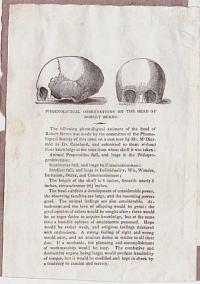
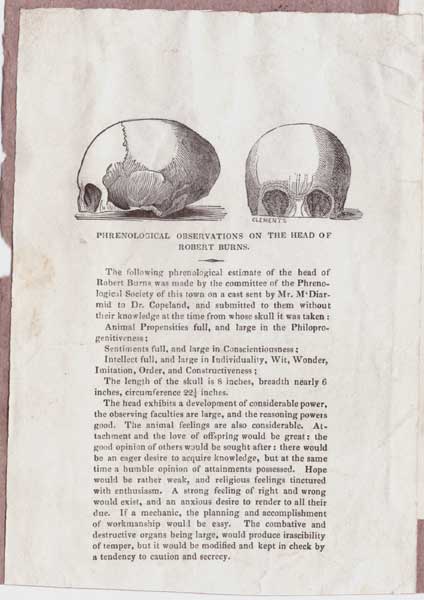
Phrenological Observations on the Head of Robert Burns.
Clements.
[n.d., c.1834.]
Wood engraving and letterpress. Sheet 160 x 110mm (6¼ x 4¼"). Laid on album paper.
In 1834, when the poet's crypt was re-opened to place the remains of Jean Armour, his widow, a cast was made of Robert Burns's skull by local phrenologists. The cast was sent to the Committee of the Phrenological Society of Edinburgh under George Combe, who performed a 'blind' study.
[Ref: 62241] £130.00
(£156.00 incl.VAT)

Mutual Accusation - When once you've told & cant recall a Lye / Boldly, percist in't or your Fame will die. /Learn this ye Wives, with unrelenting Claws /Or right or wrong, Afsert your husbands cause.
Mr. Bunbury del. Js.Bretherton f.
Publish'd by Bretherton 3d. January 1774.
Etching, 18th century watermark; platemark 235 x 300mm (9¼ x 11¾"). Thread margin on bottom and small margin at top.
Two rival quack doctors (whose premises, both advertising Antiscorbutic Pills to prevent scurvy, face each other) argue while their wives fight each other. Even their cats and dogs are involved in the rivalry! Etched after Henry Bunbury, an amateur printmaker who subsequently enjoyed a successful career as a designer for printsellers. 'Prints by Bunbury an his imitators were conspicuously 'polite' and appealed, like novels, 'To the Fashionable World and Polite circles'. Of good family, amply endowed with social skills, a beautiful wife and connections in high society, Bunbury's appeal was not solely aesthetic' and his admirers 'recognized his comic talent, his informed enthusiasm for literature, and his ability to draw a momentary pang with something of the sensitivity with which Sterne could write it' (Clayton). The dubious claims of both are emphasised by the crest top centre, featuring two ducks and the motto 'quack quack quack'. BM Satire 5279; see Timothy Clayton, 'The English Print, 1688-1802', p.245.
[Ref: 67305] £180.00
(£216.00 incl.VAT)
![Animal Magnetizm [&] The Devil to_Pay](img-thumbnail/jpegs/45864.jpg)
Animal Magnetizm [&] The Devil to_Pay Engraved for the Carlton House Magazine.
[Published by W. & J. Stratford (?), 1795]
Two engravings and two letterpress sheets, each platemark approx. 180 x 115mm (6¾ x 4¼").
Two prints published in the 'Carlton House Magazine', reissuing (in two parts) an earlier print. As the letterpress accompanying the two prints confirms, they satirise quack doctors, specifically new experiments with electricity. As the doctor advises his female patient, 'the electrical shock is violent, I confess, but it is not unaccompanied with rapture'. The scene is inside a tavern, with portraits on the wall including one of the painter J.P. de Loutherbourg.
[Ref: 45864] £130.00
(£156.00 incl.VAT)
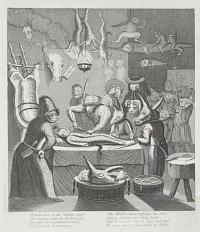
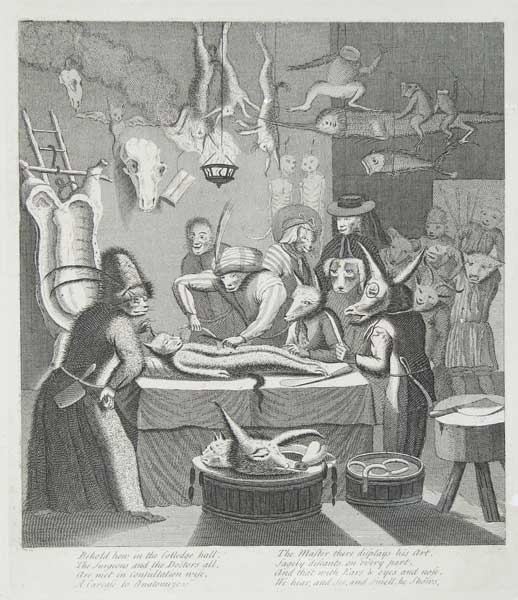
Behold how in the Colledge hall, The Surgeons and the Doctors all, Are met in Consultation wise, A Carcase to Anatomize: The Master there displays his art, Sagely discants on every part, And that with Ears & eyes and nose, We hear, and See, and Smell, he shows.
[E. Heemskerck Pinxt.]
[Published by John Bowles.] [n.d. c.1730.]
Engraving and etching. Plate 286 x 247mm. 11¼ x 9¾".
A satire on quackery. BM Satires: 1861 (after).
[Ref: 15506] £120.00
(£144.00 incl.VAT)
![[William Salmon] Guilielmus Salmon Medicinae Professor. Aetatis Suae. 27. Anno. 1675.](img-thumbnail/jpegs/25227.jpg)
[William Salmon] Guilielmus Salmon Medicinae Professor. Aetatis Suae. 27. Anno. 1675. You see his form and years, but if you would View his just Soule, (which envy can't behold) In to his work; ye following tractate looke the lively picture of his minde ye booke.
W Sherwin ad vita Sculp.t.
[n.d. c.1675.]
Engraving. Sheet 140 x 90mm (5½ x 3½"). Cut.
William Salmon (1644-1713), an empiric doctor and self-proclaimed "Professor of Physick", author of medical texts, often referred to as the 'King of the Quacks'. Ex Collection: R. Hobson of Hove. W: 2588-1.
[Ref: 25227] £120.00
(£144.00 incl.VAT)
![[John St John Long] More Don-Key's!](img-thumbnail/jpegs/53830.jpg)
[John St John Long] More Don-Key's! It is well-known that Asse's are particularly fond of having their Back's Rubbed.
H. Heath Fec.t.
Pub.d 1830 by S.W. Fores, 41 Piccadilly London.
Coloured etching. 250 x 355mm (9¾ x 14"). Trimmed to border and creasing around the edges.
Four donkeys suck tubes sprouting from a barrel marked 'Foetid gas' (in reverse) while a woman and a groom scrub their balding backs with brushes. In the background a man runs from a beadle with a coroner's warrant, shouting 'D.I.O. [Damme I'm off] I'll give you the Long trot'. To the right is 'Long John's Rubbing Stable', closed down. Satire on an infamous quack, John St John Long, who 'treated' consumption and other ailments with corrosive liniments and friction. Despite being denounced in the Lancet as 'king of humbugs' and the deaths of two patients (whose names can be seen in the graveyard), his influential friends and clients seem to have protected him, and the two charges of manslaughter culminated with only one fine of £250. One of these friends would seem to be Mayor of London John Key, whom Heath satirised as 'Don Key'. BM Satire: 16427.
[Ref: 53830] £180.00
(£216.00 incl.VAT)
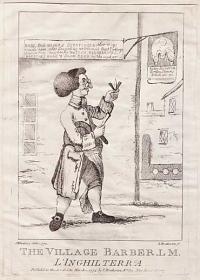
The Village Barber L.M. L'Inghilterra.
HW Bunbury delin: 1772. J. Bretherton f.
Publish'd as the Act directs March 1772 by J.Bretherton No.134 New Bond Street.
Etching. 260 x 175mm (10¼ x 7"). Trimmed close to platemark top and bottom, laid on album paper.
A caricature of a country barber-surgeon, depicting a bespectacled man holding a lancet, razor and a bowl for shaving or blood letting. Above is a shop sign of a wig. Behind are the village stocks. According to Wellcome 'L.M.' is an abbreviation for 'Licentiate in medicine', a qualification to practise medicine or surgery, bestowed by a bishop or archbishop. BM Satire 4757. Wellcome 29464i.
[Ref: 59576] £160.00
(£192.00 incl.VAT)
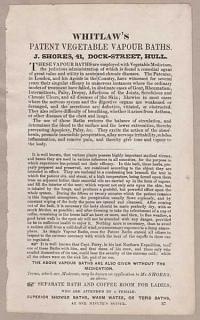
Whitelaw's Patent Vegetable Vapour Baths. J. Shores, 41, Dock-Street Hull. [...] It is well known that Capt. Parry, in his last Northern Expedition, took one of these Baths with him, and that those of his crew, and those only who availed themselves of its use, could bear the severity of the extreme cold [...]
[n.d., c.1825.]
Letterpress advert. Sheet 180 x 110mm (7 x 4¼"). Laid on album paper.
Charles Whitlaw, a Scottish horticulturist, emigrated to North America in 1794 and spent about two decades collecting botanical specimens, some of which are preserved in the herbarium at the National Botanic Gardens, Glasnevin, Dublin. On returning to Britain, he was proposed for election as a Fellow of The Linnean Society of London, but was black-balled. He established ''patent medicated vapour baths'' in which he employed various North American plants with reputed medicinal properties. Claiming to be able to cure diseases such as scrofula, Whitlaw outraged the medical establishment and he was branded a charlatan and a quack.
[Ref: 58760] £45.00
(£54.00 incl.VAT)
<<< Previous 1 Next >>>


![[Theriac vendor]](jpegs/36926.jpg)
![[John George Lambton] The Newest Universal Medicine.](jpegs/52788.jpg)
![[Lionel Lockyer]](jpegs/37638.jpg)




![Animal Magnetizm [&] The Devil to_Pay](jpegs/45864.jpg)
![[William Salmon] Guilielmus Salmon Medicinae Professor. Aetatis Suae. 27. Anno. 1675.](jpegs/25227.jpg)
![[John St John Long] More Don-Key's!](jpegs/53830.jpg)