Results 1-32 of 32
<<< Previous 1 Next >>>
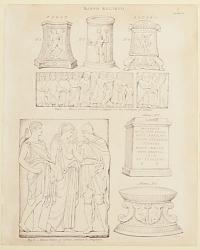
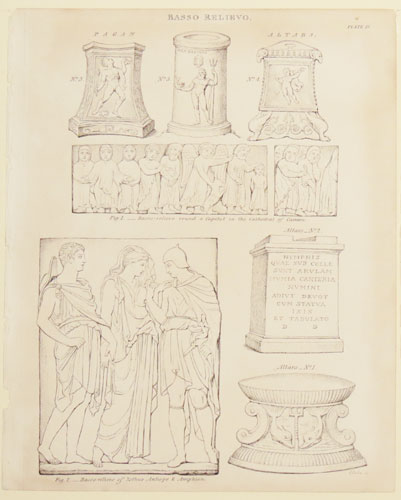
Basso Relievo Basso-relievo round a Capital in the Cathedral of Carrara; Basso-relievo of Zethus Antiope & Amphion; Altars
Blake sc.
[Published by Longman, Hurst, Rees, Orme & Brown, London, Novemr. 11th 1818]
Stipple and line engraving, sheet 265 x 215mm (10½ x 8½"). Trimmed, losing publication line.
Plate from Abraham Rees' 'The Cyclopaedia; or, Universal Dictionary of Arts, Sciences, and Literature', engraved by the visionary artist and poet William Blake (1757-1827) to illustrate a text by sculptor John Flaxman. After a period of coolness, Blake and Flaxman were on good terms again at this time, and the sculptor intervened to secure Blake several engraving commissions (including this one) in the 1810s. Without these commissions, Blake might well have fallen into dire poverty at this time. Russell 105.ii
[Ref: 40867] £110.00
(£132.00 incl.VAT)
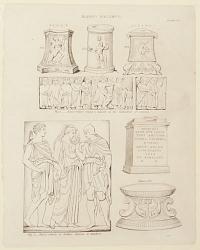
Basso Relievo Basso-relievo round a Capital in the Cathedral of Carrara; Basso-relievo of Zethus Antiope & Amphion; Altars
G.M.
[Published by Longman, Hurst, Rees, Orme & Brown, London, Novemr. 11th 1818]
Stipple and line engraving, sheet 265 x 215mm (10½ x 8½"). Trimmed.
Plate from Abraham Rees' 'The Cyclopaedia; or, Universal Dictionary of Arts, Sciences, and Literature', copied from the engraving by the visionary artist and poet William Blake (1757-1827) to illustrate a text by sculptor John Flaxman. Russell 105.ii (copy)
[Ref: 40868] £45.00
(£54.00 incl.VAT)

Marble size of Life - Townleian. Plate LXIV.
I. Brown del. W. Evans sc.
Published by T. Payne & J. White London, Jan. 1. 1819.
Stipple, printed in light brown. 280 x 230mm (11 x 9").
A marble bust apparently of a woman but identified in pencil as 'Didymean Apollo', an androgynous representation. From "Specimens of Antient Sculpture".
[Ref: 64374] £160.00
(£192.00 incl.VAT)
![[Classical bust]](img-thumbnail/jpegs/46362.jpg)
[Classical bust] Apud Card. Caesium
[Anon, c.1650]
Engraving, platemark 220 x 150mm (8½ x 6"). False margins added.
[Ref: 46362] £75.00
(£90.00 incl.VAT)
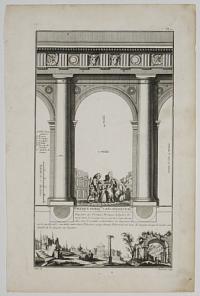
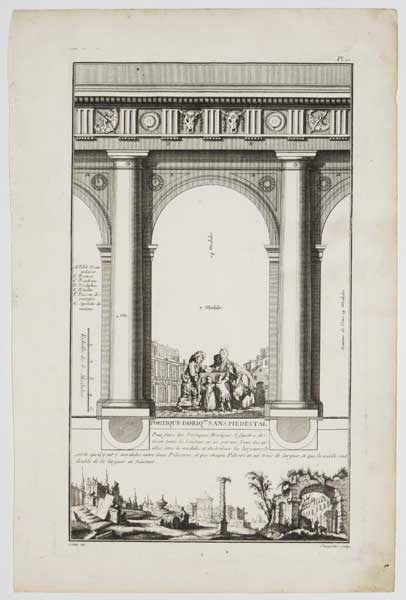
Portiqu Dorique sans Piedestal. Pour fair des Portiques Doriques, il faudra diviser toute la hauteur en 20 parties, l'une des qu'elles sera le module; et distribuer les largeurs de sorte, qu'il y ait 7 modules entre deux Pilastres, et que chaque Pilastre en ait trois de larguer, et que le vuide soit double de la largeur en hauteur. Pl.10.
Cochin inv. Charpentier suclps.
[Paris, 1757.]
Engraving, paper watermarked, with large margins. Plate 356 x 215mm. 14 x 8½".
This folio architectural engraving is from Jacques Barrozzio de Vignole's work "Livre Nouveau ou Regles des Cinq Orders d'Architecture & Recueil des plus Beaux Edifices Anciens et Modernes" showing a magic lantern.
[Ref: 27318] £240.00
(£288.00 incl.VAT)
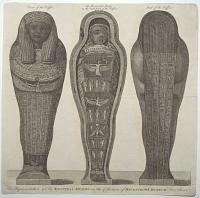
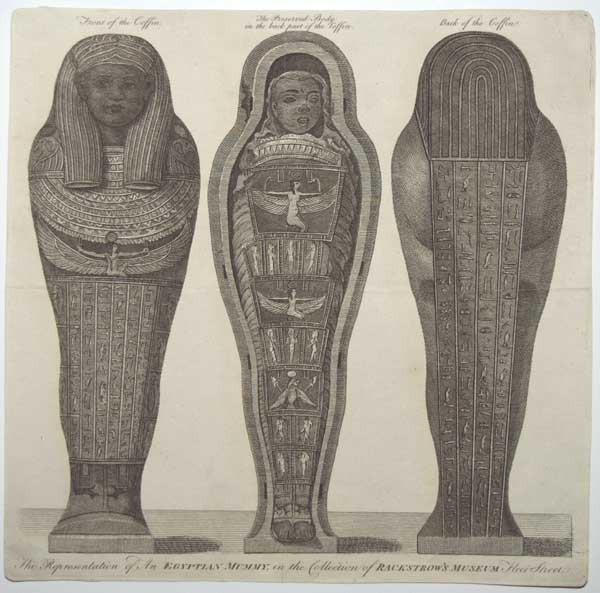
The Representation of an Egyptian Mummy, in the Collection of Rackstrow's Museum Fleet Street.
[n.d., c.1760.]
Engraving. 285 x 285mm (11¼ x 11¼"). Thread margins, tiny hole in corner of folds.
Three illustrations of an Egyptian mummy, said at the time to be a pharoah's daughter: the front and back of the case and the wrapped figure inside. It was probably published as a souvenir of Benjamin Rackstrow's Museum, 197 Fleet Street, which contained curiosities, waxworks (including one of a dissected pregnant woman) and electrical devices. Rackstrow was colonel of the Trained Bands (Militia) of the City of London, which had an inactive Samuel Johnson in its ranks.
[Ref: 57718] £260.00
(£312.00 incl.VAT)
![[Egyptian Mummy]](img-thumbnail/jpegs/47287.jpg)
[Egyptian Mummy] Cadaver Balsamo conditum; simul cum Loculo ferali [...]
GV Sc. [1724]
Engraving with original hand-colouring, sheet 340 x 445mm (13½ x 17½"). Trimmed, losing publication line, and glued to backing sheet.
Four views of a mummy case, engraved by George Vertue after a drawing by William Lethieullier. Lethieullier was an army officer who had visited Egypt and was a member of the Egyptian Society founded in 1741. Vertue presented an impression to the Society of Antiquaries, the dedicatee of the print, in 1724. In 1775 Mrs Vertue presented the society with the copper plate. Note on front of album suggests the colour was added by Vertue. Lethieullier bequeathed his mummies to the British Museum in 1756, the first they acquired. Although there were mummies in the collection of Sir Hans Sloane, the basis of the Museum, they later proved to be fake. Alexander 372.
[Ref: 47287] £320.00
![[Egyptian Mummy, for Alexander Gordon's 'Essay...']](img-thumbnail/jpegs/47203.jpg)
[Egyptian Mummy, for Alexander Gordon's 'Essay...'] Viro Ingenio et Artibus ornatiss.mo Richardo Mead Medico Regio: [...]
A.G. del. [...] Vertue Sc. [1733]
Engraving with original hand-colouring, sheet 390 x 240mm (15¼ x 9½"). Trimmed inside platemark; glued to backing sheet.
Engraving of a mummy, published as Plate XIII of Alexander Gordon's 'An Essay Towards explaining the Hieroglyphical Figures on the Coffin of the Ancient Mummy belonging to Capt William Lethieullier' (1737). Gordon (c.1692-1754?) was an antiquary and singer. Lethieullier bequeathed his mummies to the British Museum in 1756, the first they acquired. Although there were mummies in the collection of Sir Hans Sloane, the basis of the Museum, they later proved to be fake. Alexander 672.
[Ref: 47203] £240.00
(£288.00 incl.VAT)
![[Coffin of Irtyru, 26th Dynasty, 600-300 BCE] 3. Loculi Conspectus anterior, auctior aliquantum, quo Figuræ clarius et distinctius appareant.](img-thumbnail/jpegs/61268.jpg)
[Coffin of Irtyru, 26th Dynasty, 600-300 BCE] 3. Loculi Conspectus anterior, auctior aliquantum, quo Figuræ clarius et distinctius appareant.
GV [George Vertue] Sc.
[LOndon: Society of Antiquaries 1724.]
Engraving. 360 x 220mm (14¼ x 8¾"), with large margins.
The lower half of an Egyptian coffin, identified as a man called Irtyru, published in Alexander Gordon's 'An Essay Towards explaining the Hieroglyphical Figures on the Coffin of the Ancient Mummy belonging to Capt William Lethieullier'. Among the illustrations are the winged Isis, the sky goddess Nut, Anubis, and Irtyru being judged by Osiris and Thoth. Lethieullier bequeathed his mummies to the British Museum in 1756, the first they acquired. Although there were mummies in the collection of Sir Hans Sloane, the basis of the Museum, they later proved to be fake. See BM EA6695.
[Ref: 61268] £120.00
(£144.00 incl.VAT)
![[Coffin of Irtyru, 26th Dynasty, 600-300 BCE] Cadaver Balsamo conditum;](img-thumbnail/jpegs/61267.jpg)
[Coffin of Irtyru, 26th Dynasty, 600-300 BCE] Cadaver Balsamo conditum; simul cum Loculo ferali [Greek letters] Pictura hieroglphica pulcerime insignito. Ex vetustis Ægypti Sepulchretis sublatum Londinum attulit D. Guil: Lethieullier. A.º D.º 1722.
GV [George Vertue] Sc.
Societati Antiquariæ Londonensi Georgius Vertue D.D.D. et excudit 1724.
Engraving. 350 x 460mm (13¾ x 18¼"). Trimmed into image at top.
Four illustrations of an Egyptian coffin (the front, front profile, interior and back), published in Alexander Gordon's 'An Essay Towards explaining the Hieroglyphical Figures on the Coffin of the Ancient Mummy belonging to Capt William Lethieullier'. Among the illustrations are the winged Isis, the sky goddess Nut, Anubis, and Irtyru being judged by Osiris and Thoth. Lethieullier bequeathed his mummies to the British Museum in 1756, the first they acquired. Although there were mummies in the collection of Sir Hans Sloane, the basis of the Museum, they later proved to be fake. See BM EA6695.
[Ref: 61267] £160.00
(£192.00 incl.VAT)

Epicurus, on Onyx, Dr. Chauncey.
T. Worlidge sc.
According to Act of Parliam.t [n.d., c.1760]
Etching, platemark 80 x 70mm (3 x 2½"), with very large margins.
A cameo of ancient philosopher Epicurus, founder of Epicureanism, a school of philosophy holding that pleasure is the greatest good (although obtained through living modestly and gaining knowledge of the workings of the world). From a collection of 180 prints the 'English Rembrandt' Thomas Worlidge (1700-66) made from antique gems. For another print from the same collection see refl. 32584.
[Ref: 39758] £65.00
(£78.00 incl.VAT)
![The Sarcophagus of Galen the Physcian of Pergamus, where the celebrated Barbarini, or Portland Vase, was discovered [...]](img-thumbnail/jpegs/59160.jpg)
The Sarcophagus of Galen the Physcian of Pergamus, where the celebrated Barbarini, or Portland Vase, was discovered [...]
T. Windus F.S.A. Direxit. Dean & Co. Lith.
[London: W. Pickering for the Author, 1845.]
Lithograph. Sheet 170 x 240mm (6¾ x 9½"). Crease in top left corner.
A sketch of a sarcophagus in the Capitoline Museum, with the Portland Vase drawn to scale on either side. An illustration from 'A New Elucidation of the Subjects on the Celebrated Portland Vase, Formerly Called the Barberini, and the Sarcophagus in which it was Discovered' by Thomas Windus. If Windus's theory is to believed the vase would have been at least 150 years old at the time of Galen's death.
[Ref: 59160] £140.00
(£168.00 incl.VAT)
![[An amphora]](img-thumbnail/jpegs/57492.jpg)
[An amphora]
[n.d., c.1780.]
Engraving with very fine original hand colour. 250 x 330mm (9¾ x 13"), with large margins.
An illustration of a Corinthian amphora, with panels showing the patterns of lions and geese on the body and base. From the Airlie collection, Cortachy Castle.
[Ref: 57492] £280.00
(£336.00 incl.VAT)
![[A lekythos]](img-thumbnail/jpegs/57491.jpg)
[A lekythos]
[n.d., c.1780.]
Engraving with very fine original hand colour. 230 x 230mm (9 x 9"), with large margins.
An illustration of a Greek lekythos, with a panel of a woman's head underneath. From the Airlie collection, Cortachy Castle.
[Ref: 57491] £280.00
(£336.00 incl.VAT)
![[Attic red-figure vase design, with comic actors.] 59. Tom. IV.](img-thumbnail/jpegs/63437.jpg)
[Attic red-figure vase design, with comic actors.] 59. Tom. IV.
[n.d., c.1780.]
Engraving with hand colour. 130 x 205mm (5 x 8"), large margins on 3 sides. Narrow left margin.
Two men, one with a huge phallus, the other with a ladder, look up at a woman in a window. From a series taking Sir William Hamilton's ''Collection of Etruscan, Greek, and Roman antiquities'' as inspiration.
[Ref: 63437] £95.00
(£114.00 incl.VAT)
![[Attic red-figure vase design, with a naked couple grappling.] 71. Tom. IV.](img-thumbnail/jpegs/63443.jpg)
[Attic red-figure vase design, with a naked couple grappling.] 71. Tom. IV.
[n.d., c.1780.]
Engraving with hand colour. 130 x 205mm (5 x 8"), large margins. Narrow left margin.
From a series taking Sir William Hamilton's ''Collection of Etruscan, Greek, and Roman antiquities'' as inspiration.
[Ref: 63443] £95.00
(£114.00 incl.VAT)
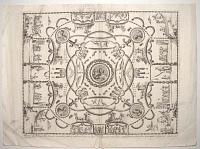
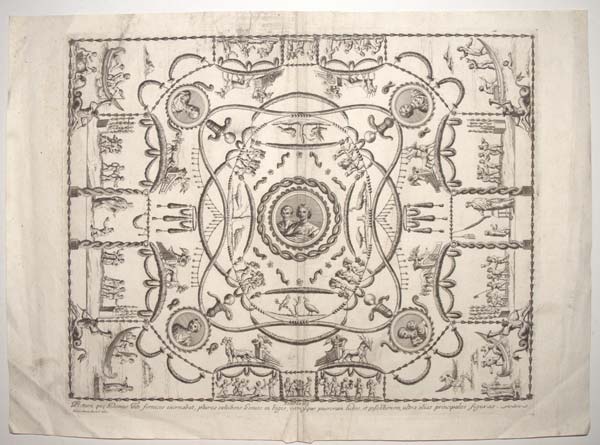
Tabula III Pictura, que Domus Titi fornices exornabat, plures exhibens Genios in bigis, variosque puerorum ludos, et piscationem, ultra alias principales figuras.
Petrus Sancte Bartoli delin.
Rome [n.d.1635-1700].
Engraving. 430 x 525mm (15½ x 20¾"). Vertical creasing down the centre. Some discolouring along top left margin. Both lower corners creased slightly.
This print depicts various figures and scenes from the House of Titus, including angels in chariots and boys playing games, along with other typically Roman motifs.
[Ref: 54007] £480.00

Cave Canem. [Pompei. Mosaico. __ Mosaique.]
[Lenghi Dis.]
[G. Lenghi Edit.] [n.d., c.1840.]
Lithograph in fine contemporary hand colour. Sheet 195 150mm (7¾ x 6"). Trimmed to image, losing all inscriptions.
The iconic mosaic of a guard dog at Pompeii with the warning 'Cave Canem' ("Beware of the dog"). It is on the floor of the entrance hall to the House of the Tragic Poet, facing the Via di Nola.
[Ref: 63521] £160.00
(£192.00 incl.VAT)

Apud Wellow prope Aquas Solis in agro Somersetensi repertum. Sumptibus Societatis Antiquariae Londini aeri incisum Ao.MDCCXXXVIII.
[George Vertue.]
[Published the Society of Antiquaries, 1783.]
Copper Engraving. 355 x 446mm. 14 x 17½". Vertical crease through centre; two wormholes.
A plate, from a set of three, showing Roman mosaic pavements found at Wellow, Somerset. Ex Collection: Norman Blackburn.
[Ref: 19810] £130.00
(£156.00 incl.VAT)

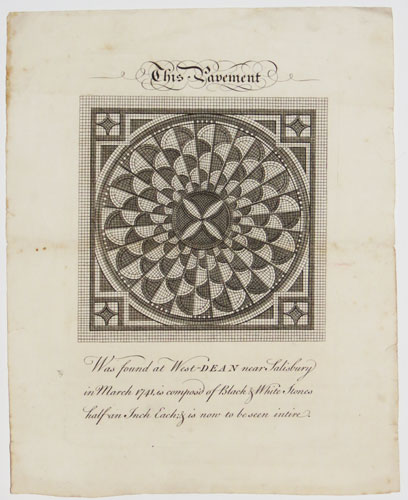
This Pavement Was found at West-Dean near Salisbury in March 1741, is compos'd of Black & White Stones halftg an Inch Each; & is now to be seen intire.
[n.d., c.1770]
Engraving with large margins, scarce, platemark 190 x 130mm (7½ x 5"). Creased.
Example of the interest in English history in the eighteenth century, typified by the activities of the Society of Antiquaries, which saw many examples of early pavements, mosaic fragments and other ruins dissimentated through prints.
[Ref: 31855] £190.00
(£228.00 incl.VAT)

Tesselated Pavement Found in Dyer Street Cirencester Sep: Ad. MDCCCXLIX. with Part of the Under Structure. [&] Tesselated Pavement Found in Dyer Street Cirencester August 1849.
Drawn on Stone & Printed by J. Beauchamp, Cirencester. [&] Drawn on Stone, Printed & Published by J. Beauchamp, Park S.t Cirencester. [n.d., c.1849]
Two scarce & fine coloured lithographs. Printed areas 330 x 320mm (13 x 12½) & 300 x 290mm (11¾ x 11½"), large margins.
Two rare lithographs locally published recording the 2nd century Roman mosaics dug up when excavating new sewers in Dyer Street. The first features heads representing three of the Four Seasons and an illustration of Greek hero Actaeon, transformed into a stag by Artemis and being killed by his own dogs. The second has the head of Medusa, hunting dogs, dragons and geometric patterns. Both are now in the Corinium Museum.
[Ref: 67939] £520.00
view all images for this item
![[Watercolour of a Roman Fresco?].](img-thumbnail/jpegs/50478.jpg)
[Watercolour of a Roman Fresco?].
Jessex ? pinx.t.
[n.d, c.1830.]
Watercolour. Sheet: 330 x 235mm (13 x 9¼''). Laid on album sheet.
A portrait of a serving girl in pink and yellow robes, carrying a tray of figs and a jug. Perhaps a copy of an Ancient Roman fresco?
[Ref: 50478] £180.00
(£216.00 incl.VAT)
![[Four putti sacrificing a goat]](img-thumbnail/jpegs/43134.jpg)
[Four putti sacrificing a goat]
[Francesco Bartolozzi with/or a student, c.1780]
Etching and stipple printed in brown on embossed paper, platemark 195 x 230mm (7¾ x 9"). Trimmed to platemark top edge; glued to backing sheet; slight foxing.
Print from the collection of Dr. Augusto Calabi of Milan, art historian who co-authored (with A.B. de Vesme) the authoritative catalogue raisonné of the work of Francesco Bartolozzi (1725-1815). In the catalogue, Calabi and de Vesme suggest the print was probably executed by one of Bartolozzi's many students, but with Bartolozzi's assistance. Calabi & de Vesme 2367
[Ref: 43134] £180.00
(£216.00 incl.VAT)
![[Sculpture head.]](img-thumbnail/jpegs/62404.jpg)
[Sculpture head.]
H. Howard, A. delin. W. Skelton Sculpsit.
[n.d., 1809.]
Engraving with etching, printed in dark brown ink. 330 x 235mm (13 x 9¼"), with very large margins.
From 'Specimens of Antique Sculptures, Ægyptyan, Etruscan, Greek, and Roman: selected from different collections in Great Britain'
[Ref: 62404] £130.00
(£156.00 incl.VAT)
![[Sirius Canis.]](img-thumbnail/jpegs/21205.jpg)
[Sirius Canis.]
[F. Bartolozzi.]
[n.d. c.1780.]
Stipple and etching. 127 x 102mm. 5 x 4". Cut.
Head of a dog with human and lion-esque features; derived for the latin meaning dog star. De Vesme: 2341.
[Ref: 21205] £65.00
(£78.00 incl.VAT)
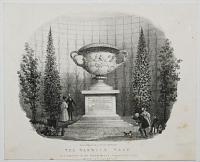
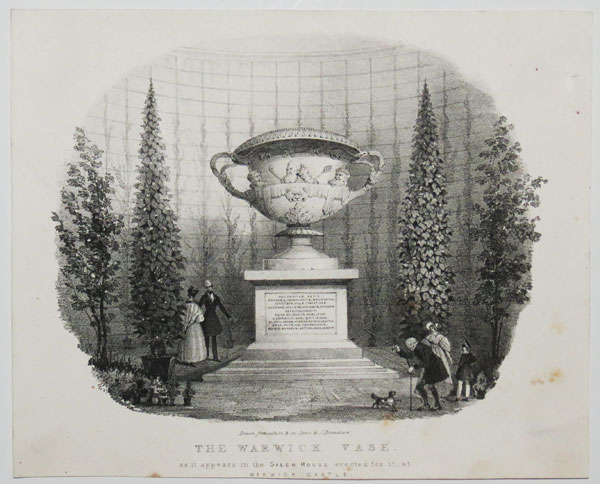
The Warwick Vase, as it appears in the Green House erected for it, at Warwick Castle.
Drawn from Nature & on Stone by J. Brandard.
[Leamington, Published by C. Elston, 12, Lower Union Parade. M&N Hanhart, Lith Printers.][n.d. c.1845.]
Lithograph. Sheet: 185 x 230mm (7¼ x 9''). Creasing
A view of a large antique vase, standing on an inscribed pedestal among trees planted in pots and in the ground, with figures of a man and woman standing at its side to the left, and a man on crutches pointing at the vase. The Warwick Vase is an ancient Roman marble vase that was discovered at Hadrian's Villa in Tivoli c.1771 by Gavin Hamiton. It was sold to the British envoy at the court of Naples, Sir William Hamilton, who shipped the vase to his elder nephew, George Greville, 2nd Earl of Warwick, who commissioned a special greenhouse for it to preserve it from the British Climate.
[Ref: 50280] £75.00
(£90.00 incl.VAT)
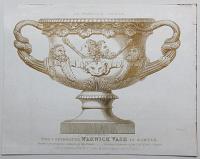
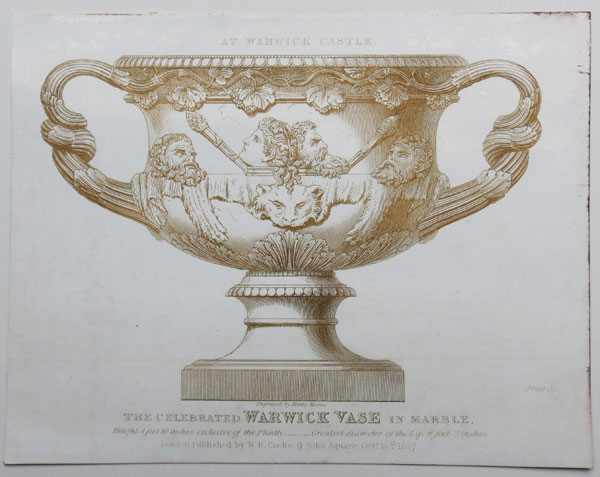
At Warwick Castle The Celebrated Warwick Vase in Marble, Height 4 fett 10 inches, exclusively of the Plinth._Greated diameter of the Lip 6 feet 3 inches.
Engraved by Henry Moses.
London Published by W.B. Cookes, 9 Soho Square, Oct.r 13.th 1827.
Engraving on porcelain card. Sheet: 155 x 200mm (6 x 8'').
The Warwick Vase is a Roman marble vase with Bacchic ornament, discovered in the silt of a marshy pond at Hadrian's Villa about 1771 by Gavin Hamilton. He sold the fragments to Sir William Hamilton who repaired it with Carrara marble and shipped it to his nephew George Greville, 2nd Earl of Warwick, who set it on a lawn at Warwick Castle before building a conservatory for it. As a famous piece, a mould was made of it and two full-size bronze replicas were cast, one now Windsor Castle, the other in the Fitzwilliam Museum. At auction in 1978 the vase was purchased by the Metropolitan Museum of Art, but after it was declared an object of national importance an export licence was denied. It is now in the Burrell Collection near Glasgow in Scotland.
[Ref: 50486] £140.00
(£168.00 incl.VAT)
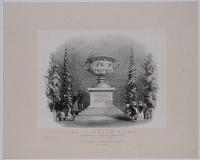
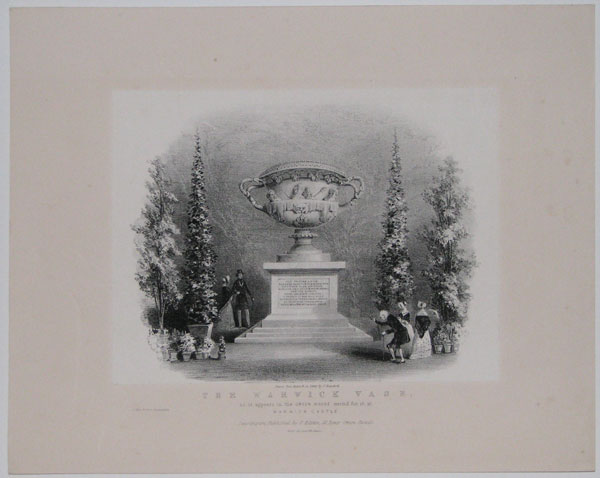
The Warwick Vase, as it appears in the Green House erected for it, at Warwick Castle. 2 Miles W from Leamington.
Drawn from Nature & on Stone by J. Brandard.
Leamington, Published by C. Elston, 12, Lower Union Parade. M&N Hanhart, Lith Printers. [n.d. c.1845.]
Lithograph on india. 258 x 318mm (10 x 12½").
A view of a large antique vase, standing on an inscribed pedestal among trees planted in pots and in the ground, with figures of a man and woman standing at its side to the left, and a man on crutches pointing at the vase. The Warwick Vase is an ancient Roman marble vase that was discovered at Hadrian's Villa in Tivoli c.1771 by Gavin Hamiton. It was sold to the British envoy at the court of Naples, Sir William Hamilton, who shipped the vase to his elder nephew, George Greville, 2nd Earl of Warwick, who commissioned a special greenhouse for it to preserve it from the British Climate.
[Ref: 20061] £95.00
(£114.00 incl.VAT)
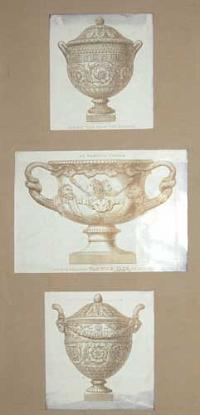
At Warwick Castle The Celebrated Warwick Vase in Marble. [&] Marble Vase from the Antique. [&] Antique Marble Vase.
Engraved by Henry Moses.
[London Published by W.B. Cookes, 9 Soho Square, Oct.r 13.th 1827.]
Three engravings on porcelain card. Sheets 140 x 200mm (5½ x 8''), 135 x 120mm (5¼ x 4¾") & 135 x 125mm (5¼ x 5"). Laid on scrap sheet, some discolouration.
The Warwick Vase is a Roman marble vase with Bacchic ornament, discovered in the silt of a marshy pond at Hadrian's Villa about 1771 by Gavin Hamilton. He sold the fragments to Sir William Hamilton who repaired it with Carrara marble and shipped it to his nephew George Greville, 2nd Earl of Warwick, who set it on a lawn at Warwick Castle before building a conservatory for it. As a famous piece, a mould was made of it and two full-size bronze replicas were cast, one now in Windsor Castle, the other in the Fitzwilliam Museum. At auction in 1978 the vase was purchased by the Metropolitan Museum of Art, but after it was declared an object of national importance an export licence was denied. It is now in the Burrell Collection near Glasgow in Scotland.
[Ref: 60934] £240.00
(£288.00 incl.VAT)
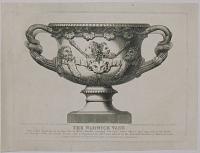
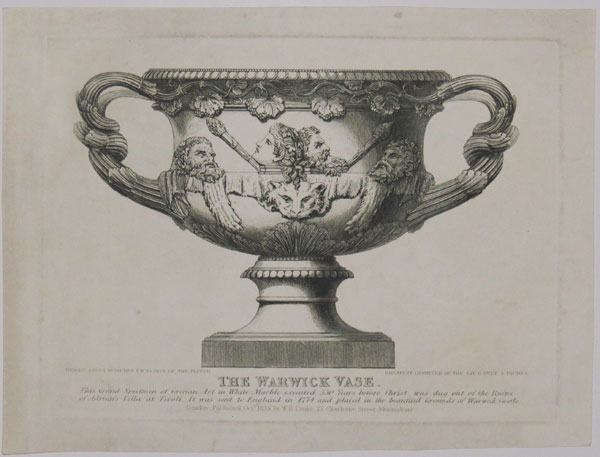
The Warwick Vase. This Grand Specimen of Grecian Art in White Marble exectuted 350 Years before Christ, was dug out of the Ruins of Adrian's Villa at Tivoli. It was sent to England in 1774 and placed in the beautiful Grounds of Warwick Castle.
London, Published Oct.r 1835 by W.B. Cooke, 27, Charlotte Street, Bloomsbury.
Etching. 150 x 205mm (6 x 8"). Small margins.
The Warwick Vase is a Roman marble vase with Bacchic ornament, discovered in the silt of a marshy pond at Hadrian's Villa about 1771 by Gavin Hamilton. He sold the fragments to Sir William Hamilton who repaired it with Carrara marble and shipped it to his nephew George Greville, 2nd Earl of Warwick, who set it on a lawn at Warwick Castle before building a conservatory for it. As a famous piece, a mould was made of it and two full-size bronze replicas were cast, one now Windsor Castle, the other in the Fitzwilliam Museum. At auction in 1978 the vase was purchased by the Metropolitan Museum of Art, but after it was declared an object of national importance an export licence was denied. It is now in the Burrell Collection near Glasgow in Scotland.
[Ref: 38836] £120.00
(£144.00 incl.VAT)
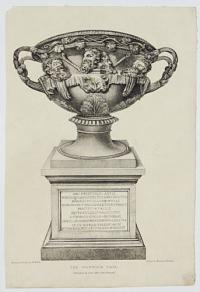
The Warwick Vase.
Drawn on stone by W. Rider. Printed by Rowney & Forster.
Published by John Merridew, Warwick. [n.d., c.1825.]
Lithograph, rare. Printed area 330 x 230mm (13 x 9")
The famous Warwick Vase, a Roman marble vase with Bacchic ornament, discovered in the silt of a marshy pond at Hadrian's Villa about 1771 by Gavin Hamilton. He sold the fragments to Sir William Hamilton who repaired it with Carrara marble and shipped it to his nephew George Greville, 2nd Earl of Warwick, who set it on a lawn at Warwick Castle before building a conservatory for it. As a famous piece, a mould was made of it and two full-size bronze replicas were cast, one now in Windsor Castle, the other in the Fitzwilliam Museum. At auction in 1978 the vase was purchased by the Metropolitan Museum of Art, but after it was declared an object of national importance an export licence was denied. It is now in the Burrell Collection near Glasgow in Scotland.
[Ref: 43348] £230.00
(£276.00 incl.VAT)

Apollo, on Cornelian, Duke of Marlborough.
T. Worlidge sculp.
[British, n.d., c.1770.]
Etching with drypoint with very wide margins, laid paper. 135 x 95mm. 5¼ x 3¾". Fine.
A cameo of the Greek god Apollo, holding a lyre. Thomas Worlidge (1700-1766), portrait painter and etcher. Pupil of Alessandro Maria Grimaldi, whose daughter Arabella he married. His widow issued his plates in 1766 and 1767 after his death; very few impressions were issued and sold by Worlidge during his lifetime.
[Ref: 26464] £70.00
(£84.00 incl.VAT)
<<< Previous 1 Next >>>


![[Classical bust]](jpegs/46362.jpg)
![[Egyptian Mummy]](jpegs/47287.jpg)
![[Egyptian Mummy, for Alexander Gordon's 'Essay...']](jpegs/47203.jpg)
![[Coffin of Irtyru, 26th Dynasty, 600-300 BCE] 3. Loculi Conspectus anterior, auctior aliquantum, quo Figuræ clarius et distinctius appareant.](jpegs/61268.jpg)
![[Coffin of Irtyru, 26th Dynasty, 600-300 BCE] Cadaver Balsamo conditum;](jpegs/61267.jpg)

![The Sarcophagus of Galen the Physcian of Pergamus, where the celebrated Barbarini, or Portland Vase, was discovered [...]](jpegs/59160.jpg)
![[An amphora]](jpegs/57492.jpg)
![[A lekythos]](jpegs/57491.jpg)
![[Attic red-figure vase design, with comic actors.] 59. Tom. IV.](jpegs/63437.jpg)
![[Attic red-figure vase design, with a naked couple grappling.] 71. Tom. IV.](jpegs/63443.jpg)



![[Watercolour of a Roman Fresco?].](jpegs/50478.jpg)
![[Four putti sacrificing a goat]](jpegs/43134.jpg)
![[Sculpture head.]](jpegs/62404.jpg)
![[Sirius Canis.]](jpegs/21205.jpg)