Mess.rs Harding Howell & Co. 89 Pall Mall.
[Pugin & Rowlandson delt.]
For No.3 of Ackermann's Repository of Arts &c. Pub March 1809, 101, Strand London.
Coloured etching. Sheet 230 x 140mm (9 x 5½"). Trimmed close to publication line.
An interior view of Harding Howell & Co, a drapers. Women are surrounded by draped fabric whilst they shop, in the centre of the image a woman looks at fabric whilst her dog waits behind her.
[Ref: 65970] £120.00
(£144.00 incl.VAT)

Ackermann's Repository of Arts, 101 Strand.
Pugin & Rowlandson delt.
[Ackermann.] Jan.y 1809.
Coloured etching. Sheet 230 x 140mm (9 x 5½"). Trimmed close to plate. Slight damage to bottom of plate.
View of Rudolph Ackermann's Repository of Arts at 101 Strand, London. Several customers are viewing the prints and other objects, the counter can be seen on the right.
[Ref: 65968] £220.00
(£264.00 incl.VAT)

Wedgwood & Byerley. York Street, St James's Square.
[Pugin & Rowlandson delt.]
For No.2 of Ackermann's Repository of Arts. Published Feb.y 1809 at 101, Strand London.
Coloured etching. Sheet 230 x 140mm (9 x 5½"). Some damage in publication area. Trimmed.
An interior view of Wedgwood & Byerley showroom in London. Thomas Byerley (1747 - 1810) was an English businessman, a partner in the Wedgwood pottery firm. Thomas and his wife had successfully run the showroom but Josiah Wedgwood had managed the money. When their uncle Josiah died in 1795 the business ceased to thrive.
[Ref: 65972] £160.00
(£192.00 incl.VAT)

Society for the Encouragement of Arts, &c. Adelphi. Plate, 71.
Pugin & Rowlandson del.t et sculp.t J.Bluck, aqua.t.
London. Pub. July 1st, 1809 at R. Ackermann’s Repository of Arts 101, Strand.
Hand coloured aquatint, plate 230 x 280mm (9 x 11"), with very large margins.
Founded in 1754 by William Shipley as the Society for the Encouragement of Arts, the RSA moved into a purpose-built building designed by the Adam Brothers (James and Robert Adam) in their Adelphi development,. This scene shows the Great Room, with its sequence of six paintings by Irish artist James Barry: called "The progress of human knowledge and culture". A plate from Ackermann's 'Microcosm of London' (1808-9), a landmark publication in the documentation of London, bringing together two specialist artists, Thomas Rowlandson to design the figures and Augustus Pugin to provide the architectural draughtsmanship. The result was a series of scenes unprecedented in their combination of vivid activity and architectual accuracy. Abbey, Scenery: 212.
[Ref: 62696] £180.00
(£216.00 incl.VAT)
After Sweet Meat comes Sour Sauce. or Corporal Casey got into the wrong box. Tegg's Caricatures NO. 24.
Rowlandson Del.
[Pub.d Nov.r 30 1810 by Thos Tegg No 111 Cheapside.]
Coloured etching. 245 x 350mm (9¾ x 13¾"). Narrow margins.
In a rustic bedroom a buxom young woman kneels to kiss her soldier who has been hiding in a large chest. A later printing with the publication line erased. BM Satires 11642.
[Ref: 41121] £290.00
(£348.00 incl.VAT)
Unfortunately this item is either sold or reserved. If you are interested in similar items and cannot find what you're looking for on our website, please consider filling in our interests form. If you register, we can also send you items that match your interests when the website is updated.

A charm for a democracy, reviewed, analysed & destroyed Jany 1st 1799 to the confusion of its affiliated friends.
[After Thomas Rowlandson]
Publish'd February 1st 1799 by [Wright's name erased] for the Anti Jacobin Review. by J Whittle Peterborough Court Fleet Street.
Etching with fine hand colour. Sheet 305 x 460mm (12¼ x 18"). Trimmed within plate. Vertical crease as normal in centre where previously folded.
Satirical illustration from the ‘Anti-Jacobin Review’ (vol. ii, frontispiece) depicts a chaotic, hellish scene titled the Cave of Despair, where radical political figures are shown as demonic conspirators. A divine light from above drives away evil, symbolizing divine intervention against revolution and sedition. Three robed figures (wizards) prepare a grotesque potion in a cauldron inscribed with names and symbols of rebellion, such as Kosciuszko’s blade (1746-1817) and Fox’s (1749-1806) fur, while the Devil and a monster watch approvingly. Pamphlets promoting radical ideas like atheism, sedition, and insurrection fuel the flames beneath the cauldron, added by figures like Horne Tooke (1736-1812). A grim procession of opposition politicians, including Fox, Erskine (1750-1823), Tierney (1761-1830), and Thelwall (1764-1834), file into the cave, each uttering phrases of regret or defiance. Above them, the King (1738-1820) and ministers like Pitt (1759-1806) and Grenville (1759-1834) appear in divine light, symbolizing order and justice. Meanwhile, defeated demons including Robespierre (1758-94) and Voltaire (1694-1778) flee, and an ape dressed as a newsboy (symbolizing the radical press) sounds his horn, spreading seditious ideas. The scene is a visual condemnation of revolutionary ideology, radical journalism, and political opposition, portraying them as part of a satanic conspiracy against Britain. BM Satires 9345.
[Ref: 67299] £320.00
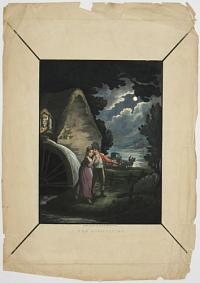
The Assignation.
[after Rowlandson.]
Published 1.st August 1799 by R. Ackermann 101 Strand for D.r In.o Trusler.
Hand-coloured aquatint and etching, very fine colour. Plate 450 x 356mm (17¾ x 14"). Paper watermarked: J Whatman 1794. Nick and tears to edges and inside platemark. Trimmed in bottom left corner. Overall toning.
A young couple try to escape from a mother under the cover of darkness; a horse-drawn carriage waits by the lake. A transparency image.
[Ref: 34776] £320.00
view all images for this item

Astley's Amphitheatre.
Pugin & Rowlandson del. et Sculpt. Hill, Aquat.
London. Pub Jany 1, 1808 at R. Ackermann’s Repository of Arts 101, Strand.
Hand coloured aquatint with large margins. Platemark: 240 x 285mm (9½ x 11¼").
An interior view of Astley's Amphitheatre at Westminster Bridge Road, as rebuilt in 1803 after one of several fires in its history. The scene shows a performance in progress. A man is balancing on the backs of three horses and the ring master is dressed as a clown. Published in Ackermann's famous work, the 'Microcosm of London', the figures were drawn by the famous caricaturist Thomas Rowlandson and the architecture by Augustus Pugin. Abbey, Scenery: 212.
[Ref: 34071] £220.00
(£264.00 incl.VAT)

Bartholomew Fair. Plate 8.
Rowlandson & Pugin del. et sculpt. J. Bluck Aquat.
London. Pub Feb. 1, 1808 at R. Ackermann’s Repository of Arts 101, Strand.
Hand coloured aquatint, J. Whatman 1806 watermark; plate 230 x 280mm (9 x 11"), with large margins. Two small stains within plate but not image.
The Bartholomew Fair was one of London's pre-eminent summer Charter fairs or street markets. The fair was established to fund the Priory of St Bartholomew and from 1133 to 1855 it took place on 24th August within the precincts of the Priory at West Smithfield, outside Aldersgate of the City of London. Published in Ackermann's famous work, the 'Microcosm of London', the figures were drawn by the famous caricaturist Thomas Rowlandson and the architecture by Augustus Pugin. Abbey, Scenery: 212.
[Ref: 62775] £180.00
(£216.00 incl.VAT)

Bartholomew Fair.
Rowlandson & Pugin del. et sculpt. J. Bluck Aquat.
London. Pub Feb. 1, 1808 at R. Ackermann’s Repository of Arts 101, Strand.
Hand coloured aquatint with large margins. Platemark: 240 x 285mm (9½ x 11¼").
The Bartholomew Fair was one of London's pre-eminent summer Charter fairs or street markets. The fair was established to fund the Priory of St Bartholomew and from 1133 to 1855 it took place on 24th August within the precincts of the Priory at West Smithfield, outside Aldersgate of the City of London. Published in Ackermann's famous work, the 'Microcosm of London', the figures were drawn by the famous caricaturist Thomas Rowlandson and the architecture by Augustus Pugin. Abbey, Scenery: 212.
[Ref: 34093] £220.00
(£264.00 incl.VAT)

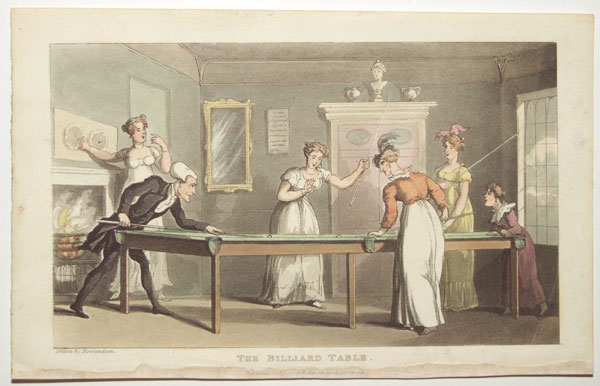
The Billiard Table.
Design'd & Etched by Rowlandson.
[London, R. Ackermann, c.1820 (publication line faint).]
Hand coloured etching with aquatint, sheet 150 x 235mm. 6 x 9¼".
Doctor Syntax playing billiards in an interior with five women; one lady scores the match using a wall-mounted dial above the fireplace to left. From 'The Tour of Doctor Syntax, in Search of a Wife' by William Combe. The various tours following the escapades of the fictional 19th century clergyman 'Dr. Syntax' were a satire on William Gilpin’s series of picturesque journeys to different parts of England. By Thomas Rowlandson (1757 - 1827). Abbey Life: 267, 8.
[Ref: 56175] £160.00
(£192.00 incl.VAT)
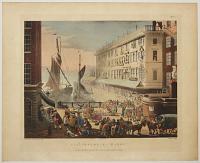
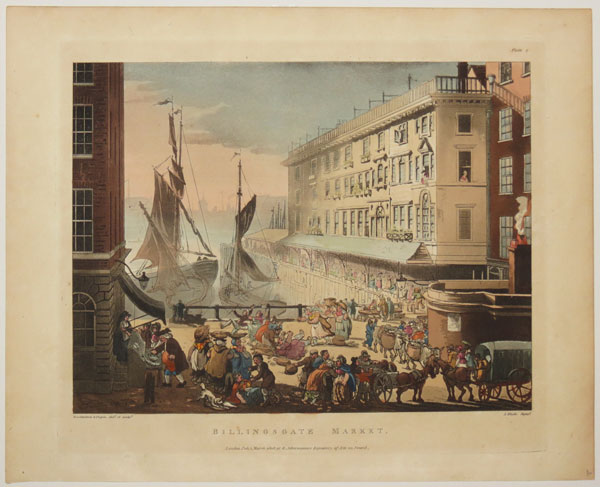
Billingsgate Market.
Rowlandson & Pugin del. et sculpt. J. Bluck, Aquat.
London. Pub March 1, 1808 at R. Ackermann’s Repository of Arts 101, Strand.
Hand coloured aquatint with large margins. Platemark: 240 x 285mm (9½ x 11¼").
A general view, from the north, of Billingsgate Quay and market with stalls. In the foreground there is a crowd of streetsellers and larger retailers. In the 19th century, boats delivered fish to this small inlet of the Thames and business was conducted on the quayside. Published in Ackermann's famous work, the 'Microcosm of London', the figures were drawn by the famous caricaturist Thomas Rowlandson and the architecture by Augustus Pugin. Abbey, Scenery: 212.
[Ref: 46882] £260.00
(£312.00 incl.VAT)

The Hall, Blue Coat School. Plate 10.
Rowlandson & Pugin del. et sculpt. Hill, Aquat.
London. Pub March 1, 1808 at R. Ackermann’s Repository of Arts 101, Strand.
Hand coloured aquatint, plate 230 x 280mm (9 x 11"), with large margins.
A view inside the hall of the school at Blue Coat School, London. Two students wearing blue coats stand on platform in centre of hall, with scholars and elegantly dressed figures seated around edge. A large "figure painting" can be seen across the top half of the wall above the panelling on the right. Published in Ackermann's famous work, the 'Microcosm of London', the figures were drawn by the famous caricaturist Thomas Rowlandson and the architecture by Augustus Pugin. Abbey, Scenery: 212.10.
[Ref: 62752] £120.00
(£144.00 incl.VAT)
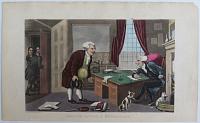
Doctor Syntax & Bookseller.
Drawn by Rowlandson.
[n.d., c.1820].
Hand coloured etching with aquatint. Sheet: 150 x 249mm. (6 x 9¾").
The fictional 19th century clergyman 'Dr. Syntax’ at his desk in his study talking to a portly bookseller; scrolling map hanging on wall behind. From 'The Tour of Doctor Syntax, in search of the picturesque' by William Combe. The various tours following the escapades of Dr. Syntax were a satire on William Gilpin’s series of picturesque journeys to different parts of England. By Thomas Rowlandson (1757 - 1827). Abbey Life 269, 26.
[Ref: 30293] £130.00
(£156.00 incl.VAT)
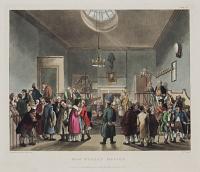
Bow Street Office.
Rowlandson & Pugin del. et sculpt. Hill, Aquat.
London. Pub March 1, 1808 at R. Ackermann’s Repository of Arts 101, Strand.
Hand coloured aquatint with large margins. Platemark: 240 x 285mm (9½ x 11¼").
An interior view with a crowd in Bow Street Office, a Magistrates Court where criminals were brought and their cases heard and witnesses gave evidence before the magistrate. The original six Bow Street Runners, whose role was to apprehend and capture the criminals, was increased to 70 men in 1792. Published in Ackermann's famous work, the 'Microcosm of London', the figures were drawn by the famous caricaturist Thomas Rowlandson and the architecture by Augustus Pugin. Abbey, Scenery: 212.
[Ref: 34075] £220.00
(£264.00 incl.VAT)
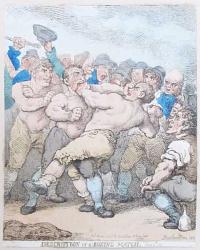
Description of a Boxing Match, June 9th 1812.
Rowlandson 1812.
Pub.d March 1st 1812 by Th. Rowlandson, N1 James Street, Adelphi.
Coloured etching. 355 x 255mm (14 x 10"). Paper slightly toned. Cut without nine-line description of the fight.
A caricature of the brutal bare-knuckled match with Rowlandson giving as much attention to the braying spectators as to the boxers. Ward, the better boxer, was beaten by Quirk, the stronger man. Not in the BM.
[Ref: 58502] £650.00
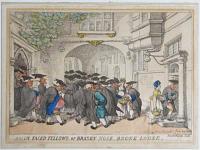
Bacon Faced Fellows of Brazen Nose, Broke Loose.
Rowlandson. Del.
Pub. d [erased]1811 by Tho.s Tegg No 111 Cheapside. Price One Shilling
Coloured etching, visible area 240 x 335mm (9½ x 13¼"). Date erased (as BM example). Laid down.
A crowd of burlesqued elderly Fellows in cap and gown stream from a doorway and walk through an archway towards a quadrangle. One enters the Principal's Lodge followed by a buxom girl with baskets of fruit, exciting the prurient interest of some of the Fellows. Others buy fruit from another pretty girl. At the time the Principal of Brazenose was Frodsham Hodson (1770-1822), Regius Professor of Divinity 1820. Although the architecture is realistically drawn it is not Brazenose. BM Satires 11782.
[Ref: 58481] £260.00
(£312.00 incl.VAT)
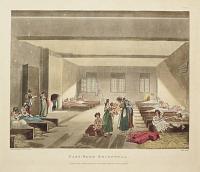
Pass-Room Bridewell.
Pugin & Rowlandson del.t. et sculp.t. Hill aqua.t.
London Pub, 1 March 1808 at R. Ackermann's Repository of Arts Strand.
Hand-coloured aquatint. Plate: 235 x 280mm (9¼ x 11"), with large margins.
An interior view of the pass room in Bridewell Prison, an institution for unmarried mothers, prostitutes, the homeless and criminals. The pass room was a room which housed women waiting to be passed to the parishes of their birth. Published in Ackermann's famous work, the 'Microcosm of London'; the figures were drawn by the famous caricaturist Thomas Rowlandson and the architecture by Augustus Pugin. Abbey, Scenery: 212.
[Ref: 47234] £70.00
(£84.00 incl.VAT)
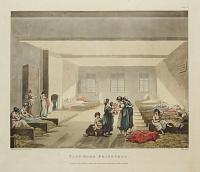
Pass-Room Bridewell.
Pugin & Rowlandson del.t. et sculp.t. Hill aqua.t.
London Pub, 1 March 1808 at R. Ackermann's Repository of Arts Strand.
Hand-coloured aquatint. Plate: 235 x 280mm (9¼ x 11") large margins.
An interior view of the pass room in Bridewell Prison, an institution for unmarried mothers, prostitutes, the homeless and criminals. The pass room was a room which housed women waiting to be passed to the parishes of their birth. Published in Ackermann's famous work, the 'Microcosm of London'; the figures were drawn by the famous caricaturist Thomas Rowlandson and the architecture by Augustus Pugin. Abbey, Scenery: 212.
[Ref: 47235] £70.00
(£84.00 incl.VAT)

British Institution (Pall Mall) Plate 13.
Rowlandson & Pugin del.t. et sculpt. J. Bluck aquat.
London. Pub 1.st April 1808. at R. Ackermann’s Repository of Arts 101. Strand.
Hand coloured aquatint, plate 235 x 275mm (9¼ x 10¾"), with very large margins.
View inside the institution; paintings hang from walls, artists set up around sides with canvases supported by easels copying the displayed work; a table in centre of room with paints and brushes; an arch leads on to the next room with a similar set up. A plate from Ackermann's 'Microcosm of London' (1808-9), a landmark publication in the documentation of London, bringing together two specialist artists, Thomas Rowlandson to design the figures and Augustus Pugin to provide the architectural draughtsmanship. The result was a series of scenes unprecedented in their combination of vivid activity and architectual accuracy. Abbey, Scenery: 212.
[Ref: 62697] £260.00
(£312.00 incl.VAT)
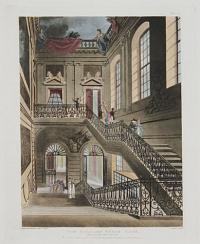
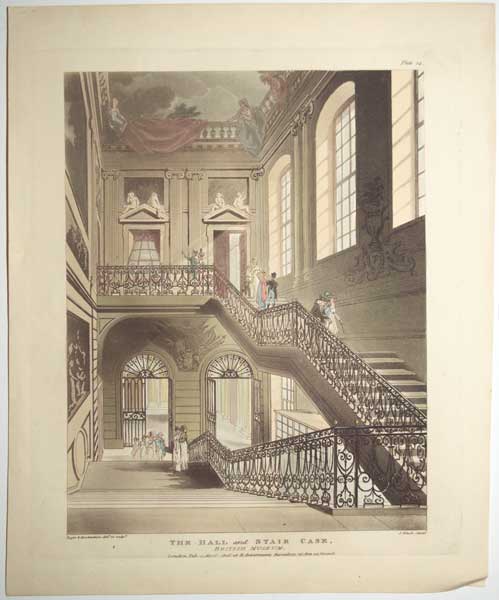
The Hall and Stair Case, British Museum.
Pugin & Rowlandson del. et Sculpt. J. Bluck, Aquat.
London. Pub April 1, 1808 at R. Ackermann’s Repository of Arts 101, Strand.
Hand coloured aquatint with large margins. Platemark: 285 x 240mm (11¼ x 9¾").
An interior view of the Great Staircase in the British Museum, London. Montagu House was the first home of the British Museum. When it was built in 1686, the French style of decoration was fashionable. The walls of the Great Staircase and the ceiling above it were painted mainly by Charles de la Fosse (1636-1716). The painting on the ceiling illustrated a story from Greek mythology - Phaeton asking for permission to drive the chariot of the sun-god, Apollo. The Great Staircase led from the Entrance Hall (which was near the site of the present-day colonnade) to a landing on the first floor. From there visitors walked through the upper rooms, where they could see some of the Museum's collections of manuscripts, medals, antiquities and natural history specimens. Published in Ackermann's famous work, the 'Microcosm of London', the figures were drawn by the famous caricaturist Thomas Rowlandson and the architecture by Augustus Pugin. Abbey, Scenery: 212.
[Ref: 34076] £160.00
(£192.00 incl.VAT)
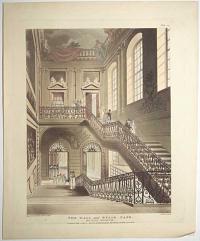
The Hall and Stair Case, British Museum.
Pugin & Rowlandson del. et Sculpt. J. Bluck, Aquat.
London. Pub April 1, 1808 at R. Ackermann’s Repository of Arts 101, Strand.
Hand coloured aquatint with large margins, 1807 J. Whatman watermark. Platemark: 285 x 240mm (11¼ x 9¾").
An interior view of the Great Staircase in the British Museum, London. Montagu House was the first home of the British Museum. When it was built in 1686, the French style of decoration was fashionable. The walls of the Great Staircase and the ceiling above it were painted mainly by Charles de la Fosse (1636-1716). The painting on the ceiling illustrated a story from Greek mythology - Phaeton asking for permission to drive the chariot of the sun-god, Apollo. The Great Staircase led from the Entrance Hall (which was near the site of the present-day colonnade) to a landing on the first floor. From there visitors walked through the upper rooms, where they could see some of the Museum's collections of manuscripts, medals, antiquities and natural history specimens. Published in Ackermann's famous work, the 'Microcosm of London', the figures were drawn by the famous caricaturist Thomas Rowlandson and the architecture by Augustus Pugin. Abbey, Scenery: 212.
[Ref: 61997] £160.00
(£192.00 incl.VAT)
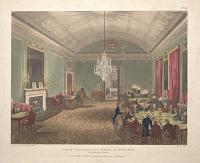
Great Subscription Room at Brooks's, St. James's Street.
Rowlandson & Pugin Delt. et Sculpt. J. Bluck Aquat.
London. Pub.1st Octr, 1808 at R. Ackermann’s Repository of Arts 101, Strand.
Coloured aquatint. 230 x 280mm, 9 x 11", paper watermarked "1808" large margins.
The gaming room at Brooks's, a gentlemen's club founded in 1764, with a barrel-vault ceiling designed by John Adam. Notable members of the club include David Garrick, Herbert Walpole, Joshua Reynolds, William Pitt the Younger, William Wilberforce, George IV and William IV. Abbey, Scenery: 212.
[Ref: 53543] £260.00
(£312.00 incl.VAT)
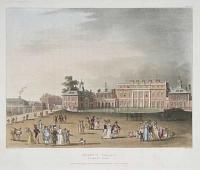
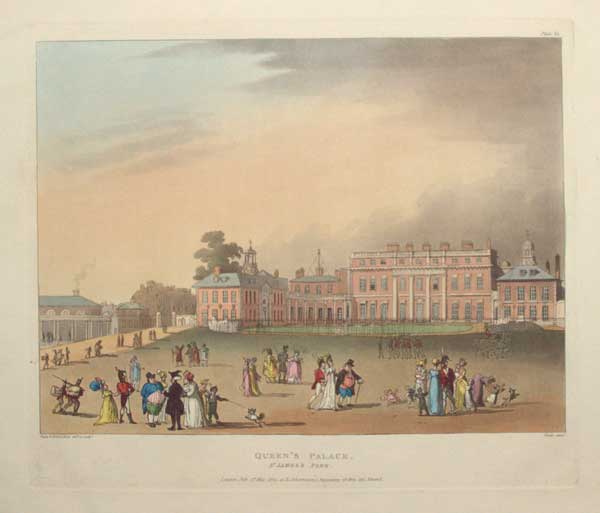
Queen's Palace, St. James's Park.
Rowlandson & Pugin delt. et sculpt. Bluck, aquat.
London Pub. 1st. May 1809, at R. Ackermann’s Repository of Arts 101, Strand.
Hand coloured aquatint, 230 x 275mm. 9 x 10¾".
Buckingham House, the building which forms the core of today's Buckingham Palace, was a large townhouse built for the Duke of Buckingham in 1703 and acquired by George III in 1761as a private residence, known as "The Queen's House". It was enlarged over the next 75 years, principally by architects John Nash and Edward Blore, forming three wings around a central courtyard. Buckingham Palace finally became the official royal palace of the British monarch on the accession of Queen Victoria in 1837. Plate to Volume III of Rudolph Ackermann's 'Microcosm of London', 3 vols., 1808-10. Numbered 'Plate 65.' upper right. Abbey, Scenery: 212, 65.
[Ref: 9879] £260.00
(£312.00 incl.VAT)
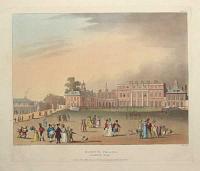
Queen's Palace, St. James's Park.
Rowlandson & Pugin delt. et sculpt. Bluck, aquat.
London Pub. 1st. May 1809, at R. Ackermann’s Repository of Arts 101, Strand.
Fine hand coloured aquatint, plate 230 x 275mm (9 x 10¾"), with large margins.
Buckingham House, the building which forms the core of today's Buckingham Palace, was a large townhouse built for the Duke of Buckingham in 1703 and acquired by George III in 1761as a private residence, known as "The Queen's House". It was enlarged over the next 75 years, principally by architects John Nash and Edward Blore, forming three wings around a central courtyard. Buckingham Palace finally became the official royal palace of the British monarch on the accession of Queen Victoria in 1837. Plate to Volume III of Rudolph Ackermann's 'Microcosm of London', 3 vols., 1808-10. Numbered 'Plate 65.' upper right. Abbey, Scenery: 212, 65.
[Ref: 58326] £260.00
(£312.00 incl.VAT)
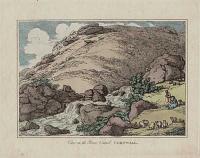
View on the River Camel, Cornwall.
Drawn & Etched by Rowlandson.
[London: Thomas Tegg, n.d., 1822.]
Coloured etching. 185 x 235mm (7¼ x 9¼"), with very large margins.
A view of the River Camel on Bodmin Moor. From Rowlandson's 'Sketches from Nature': The plate was first published in 1812 by Rowlandson in a fortnightly series: it was not published in a book until 1822. Abbey 33.
[Ref: 61107] £130.00
(£156.00 incl.VAT)

The Hall Carlton House. Plate 15.
Rowlandson & Pugin del.t. et sculpt. J. Bluck aquat.
London. Pub 1.st April 1808. at R. Ackermann’s Repository of Arts 101. Strand.
Hand coloured aquatint, sheet 250 x 320mm (10 x 12¾"). Trimmed to plate at top.
Interior of the grand hall; six Ionic columns supporting room, presumably two further columns behond viewer; a small fireplace at far end with two armchairs; a slim red carpet crosses hall, a man leads two military men across carpet. A plate from Ackermann's 'Microcosm of London' (1808-9), a landmark publication in the documentation of London, bringing together two specialist artists, Thomas Rowlandson to design the figures and Augustus Pugin to provide the architectural draughtsmanship. The result was a series of scenes unprecedented in their combination of vivid activity and architectual accuracy. Abbey, Scenery: 212.15.
[Ref: 62750] £90.00
(£108.00 incl.VAT)
![[John Cartwright] The Drum Major of Sedition.](img-thumbnail/jpegs/61823.jpg)
[John Cartwright] The Drum Major of Sedition. All Gentlemen and others Electors for Westminster who are ready and willing to Surrender their rights and those of their Fellow Citizens to Secret Influence and the Lords of the Bedchamber let them repair to the Prerogative Standard lately erected at the Cannon Coffee House where they shall be kindly receiv'd untill their Services are no longer Wanted....
[Thomas Rowlandson]
Pub.d March 29 1784 by Mrs. Dacheray St James's Street.
Coloured etching, 18th century watermark. 350 x 250mm (13¾ x 9¾"). Printer's crease entering image left centre tear in margin taped top centre.
Major John Cartwright stands legs apart, holding a long staff, addressing the populace before the hustings in Covent Garden, being ignored by everyone but Lord Hood in admiral's uniform, sword drawn. Under the title is a lengthy speech. John Cartwright (1740-1824) campaigned for Parliamentary reform, including universal suffrage and secret ballots. His younger brother Edmund Cartwright was the inventor of the power loom. BM Satires 6474; Grego I, 121.
[Ref: 61823] £380.00
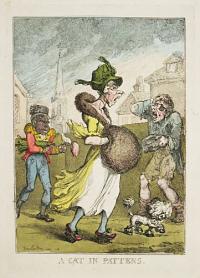
A Cat in Pattens.
Rowlandson inv 1812.
Coloured etching, 350 x 250mm (13¾ x 9¾"). Watermarked 1809, very large margins. Creasing.
A woman in oversized muff, accompanied by a negro page and a poodle, ignores a ragged beggar. She wears pattens (protective blocks) tied to her shoes to raise them out of the mud. A black page carries an umbrella and a skewer of 'Cat's Meat'. BM Satires 11973.
[Ref: 50791] £320.00

Chelsea Hospital.
Rowlandson & Pugin delt. et sculpt. J. Bluck aquat.
London Pub. Jany. 1st. 1810 at R. Ackermann’s Repository of Arts 101 Strand.
Hand coloured aquatint, 235 x 280mm. 9¼ x 11".
Interior view of the dining hall at the Royal Hospital Chelsea, the Chelsea Pensioners eating. Plate to Volume III of Rudolph Ackermann's 'Microcosm of London', 3 vols., 1808-10. Numbered 'Plate 98.' upper right. Abbey, Scenery: 212, 98.
[Ref: 61933] £160.00
(£192.00 incl.VAT)

Military College, Chelsea.
Rowlandson & Pugin delt. et sculpt. Sunderland aquat.
London Pub. Jany. 1, 1810, at R. Ackermann’s Repository of Arts 101 Strand.
Hand coloured aquatint, 245 x 280mm (9½ x 11"), large margins.
Interior view showing students attending a lecture at the Military College, Chelsea. Plate to Volume III of Rudolph Ackermann's 'Microcosm of London', 3 vols., 1808-10. Numbered 'Plate 99.' upper right. Abbey, Scenery: 212, 99.
[Ref: 56120] £160.00
(£192.00 incl.VAT)

Christie's Auction Room. Plate 6.
Rowlandson & Pugin del.t et sculp.t. J.Bluck Aqua.t.
London. Pub. Feb.1. 1808 at R. Ackermann’s Repository of Arts 101, Strand.
Fine hand coloured aquatint, plate 230 x 280mm (9 x 11"), with very large margins.
A auction of paintings, with the clientele a mixture of connoisseurs, clergy and rakes, all caricatured in Rowlandson's unique style. From Ackermann's 'Microcosm of London'. Abbey, Scenery: 212.
[Ref: 62692] £360.00

Christie's Auction Room. Plate 6.
Rowlandson & Pugin del.t et sculp.t. J.Bluck Aqua.t.
London. Pub. Feb.1. 1808 at R. Ackermann’s Repository of Arts 101, Strand.
Fine hand coloured aquatint, plate 230 x 280mm (9 x 11"), with very large margins. With explanatory text.
An auction of paintings, with the clientele a mixture of connoisseurs, clergy and rakes, all caricatured in Rowlandson's unique style. In December 1788 James Christie held first sale in London. From Ackermann's 'Microcosm of London'. Abbey, Scenery: 212.
[Ref: 62785] £360.00
![[Mary Anne Clarke] The Road to Preferment Through Clarkes Passage.](img-thumbnail/jpegs/62054.jpg)
[Mary Anne Clarke] The Road to Preferment Through Clarkes Passage.
[Thomas Rowlandson.]
Pub.d March 5. 1809 by Tho.s Tegg No 111 Cheapside.
Coloured etching, pt. watermark. Sheet 230 x 330mm (9 x 13"). Trimmed within plate, small tear in title.
Mrs Clarke, dressed in a military jacket and hat, stands in a massive archway, addressing a mixture of young, old and infirm soldiers, parsons and civilians, one of whom holds up a money bag marked '500'. Mary Anne Clarke (1776-1852), mistress of Frederick, Duke of York, was found out to be selling army commissions while he was Commander-in-Chief of the army. York was forced to resign from his position, though he was later exonerated and reinstated. Mrs Clarke was prosecuted for libel in 1813 and imprisoned. On her release, she went to live in France. BM Satires 11239; Grego II 149.
[Ref: 62054] £180.00
(£216.00 incl.VAT)
![[Mary Anne Clarke] Dissolution of Partnership or the Industrious Mrs Clarke Winding Up Her Accounts.](img-thumbnail/jpegs/63418.jpg)
[Mary Anne Clarke] Dissolution of Partnership or the Industrious Mrs Clarke Winding Up Her Accounts.
[Thomas Rowlandson.]
Pub.d M Feb.y 15. 1809 by Tho.s Tegg N.º 111 Cheapside.
Coloured etching. Sheet 230 x 330mm (9 x 13"). Trimmed within plate.
Mary Anne Clarke sits on the left, raising her skirts to receive a money bag from Jeremiah Donovan, an ex-army surgeon who was her main go-between when she was selling commissions. On the right is Captain Tuck, who received a written scale of Mrs. Clarke's prices from Donovan. Mary Anne Clarke (1776-1852), mistress of Frederick, Duke of York, was found out to be selling army commissions while he was Commander-in-Chief of the army. York was forced to resign from his position, though he was later exonerated and reinstated. Mrs Clarke was prosecuted for libel in 1813 and imprisoned. On her release, she went to live in France. BM Satires 11217.
[Ref: 63418] £260.00
(£312.00 incl.VAT)

Coal Exchange.
Rowlandson & Pugin del.t. et sculp.t. Hill Aqua.t.
London. Pub 1 May, 1808 at R. Ackermann’s Repository of Arts 101, Strand.
Coloured aquatint. 225 x 270mm. 9¾ x 10½".
The interior of the Coal Exhange, Thames Street. Published in Ackermann's famous work, the 'Microcosm of London', the figures were drawn by the famous caricaturist Thomas Rowlandson and the architecture by Augustus Pugin. Abbey, Scenery: 212.
[Ref: 11444] £140.00
(£168.00 incl.VAT)
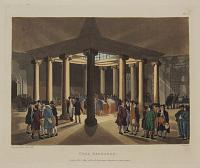
Coal Exchange.
Rowlandson & Pugin del. et sculpt. Hill, Aquat.
London. Pub May 1, 1808 at R. Ackermann’s Repository of Arts 101, Strand.
Hand coloured aquatint with large margins. Platemark: 240 x 285mm (9½ x 11¼").
An interior view of the Coal Exchange, Thames Street, London. A coal exchange was established in 1770 near the site of Smart's Quay and close to Billingsgate Market. The market was established by the main coal merchants as a private body to regulate the trade of coal in the capital, and was controlled by a private coal merchant until the old Coal Exchange was bought by the Corporation of London in 1807. A new building had been built in 1805, with a recessed classical portico supported by small Doric pillars and triangular pediment above, as seen in the centre of the image. Under the control of the City Corporation, the Coal Exchange became a free and open market, regulated by various Acts of Parliament. Published in Ackermann's famous work, the 'Microcosm of London'; the figures were drawn by the famous caricaturist Thomas Rowlandson and the architecture by Augustus Pugin. Abbey, Scenery: 212.
[Ref: 34077] £140.00
(£168.00 incl.VAT)
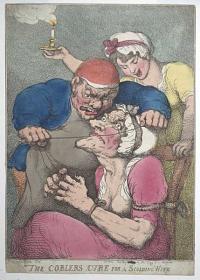
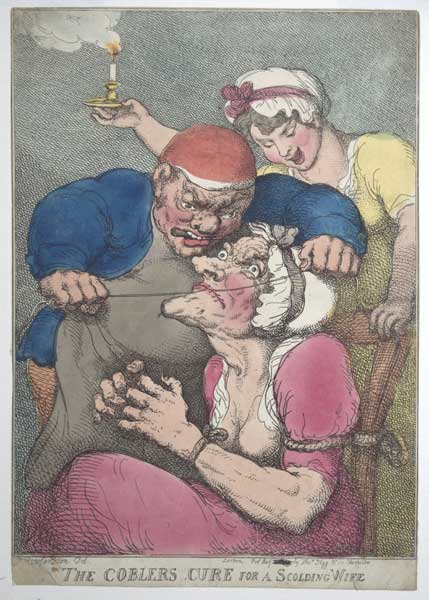
The Coblers Cure for a Scolding Wife.
Rowlandson Del.
London Pub Aug by Thos Tegg No 111 Cheapside. [n.d, c.1815.]
Fine hand-coloured etching, J. Whatman watermark. 350 x 255mm (13¾ x 10"). Trimmed within plate. Left corner loss. Taped into mount at top.
A cobbler sews his wife's mouth shut, aided by a laughing maid, who holds up a candle to light the room. BM Satires 12148, with the date scratched out rather than erased as this example.
[Ref: 68796] £260.00
(£312.00 incl.VAT)

Royal Cock Pit. Plate 18.
Rowlandson & Pugin del. et sculpt. Bluck, Aquat.
London. Pub May 1, 1808 at R. Ackermann’s Repository of Arts 101, Strand.
Hand coloured aquatint, plate 230 x 280mm (9 x 11"), with very large margins.
An interior scene showing the Royal Cock Pit, as a large frantic crowd has gathered to watch a cockfight. The Cockpit-in-Court (also known as the Royal Cockpit) was an early theatre in London, located in Dartmouth Street, Whitehall, demolished in 1816. Published in Ackermann's famous work, the 'Microcosm of London', the figures were drawn by the famous caricaturist Thomas Rowlandson and the architecture by Augustus Pugin. Abbey, Scenery: 212.
[Ref: 62694] £180.00
(£216.00 incl.VAT)
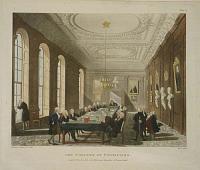
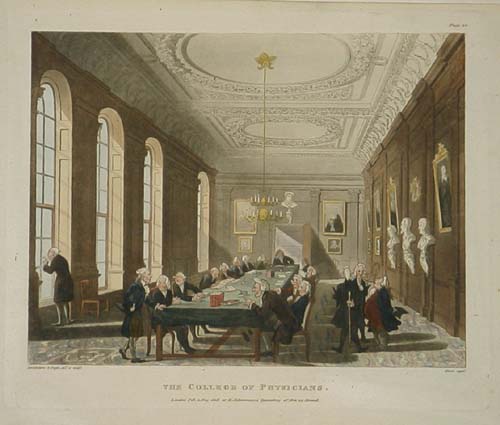
The College of Physicians
Rowlandson & Pugin Delt. Et Sculpt. J. Bluck, Aquat.
London. Pub 1st May, 1808 at R. Ackermann’s Repository of Arts 101, Strand
Coloured aquatint. 240 x 285mm.
Abbey, Scenery: 212.
[Ref: 5241] £140.00
(£168.00 incl.VAT)
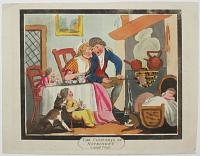
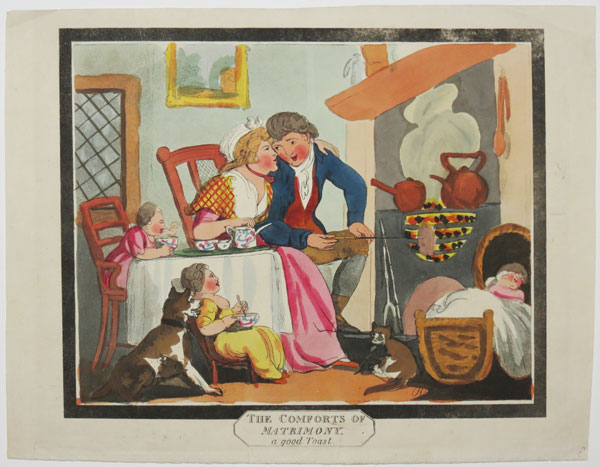
The Comforts of Matrimony. a good Toast.
Rowlandson.
[n.d., c.1810.]
Coloured aquatint. 270 x 320mm (10½ x 12½"), watermarked 'J Whatman 1810, large margins.
A handsome young couple sit at a breakfast-table near a fire, the husband toasting a muffin, his wife with her arm round his shoulder. Around them are three young children and a dog. Originally published 1809 by Reeve & Jones, this example has their inscription removed and the thick aquatint border reduced, with much of the detail of the scene worn away. BM: 11452.
[Ref: 51875] £260.00
(£312.00 incl.VAT)
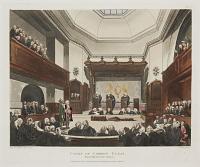
Court of Common Pleas, Westminster Hall.
Pugin & Rowlandson del. et Sculpt. J. C. Stadler, Aquat.
London. Pub June 1, 1808 at R. Ackermann’s Repository of Arts 101, Strand.
Hand coloured aquatint with large margins. Platemark: 240 x 285mm (9½ x 11¼").
An interior view of the Court of Common Pleas, Westminster, London. Authorised by the Magna Carta to sit in a fixed location, the Common Pleas sat in Westminster Hall for its entire existence, joined by the Exchequer of Pleas and Court of King's Bench. Published in Ackermann's famous work, the 'Microcosm of London', the figures were drawn by the famous caricaturist Thomas Rowlandson and the architecture by Augustus Pugin. Abbey, Scenery: 212.
[Ref: 34082] £230.00
(£276.00 incl.VAT)
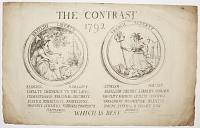
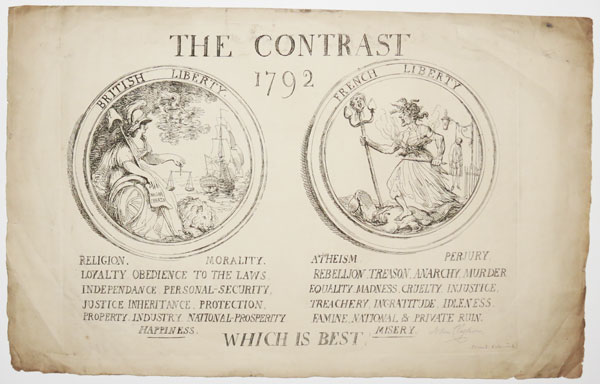
The Contrast 1792. Which is Best?
[Thomas Rowlandson.]
[n.d., c.1792.]
Etching. Plate: 270 x 375mm (10¾ x 14¾''), with very large margins on 3 sides. Creasing. Paper tone.
A satirical print commenting on the barbarity of the French Revolution. The medallion on the left shows the figure of Britannia holding the Magna Carta and the scales of Justice, beneath the medallion are positive words like 'Protection', 'Morality' and 'Loyalty'. On the right is a contrasting medallion showing a murderous Fury walking over the dead while carrying a trident with a head impaled on it representing the French Revolution. Beneath this oval are inscribed words such as 'Rebellion', 'Cruelty' and 'Injustice'. Etched by Rowlandson after a design by Lord George Murray, a Kent clergyman, these prints were circulated as propaganda by the Crown and Anchor Society; the price of the etching was low in order to maximise circulation. BM Satire 8149 (variation with added grammar.)
[Ref: 48161] £520.00
![[Cook's Ferry?]](img-thumbnail/jpegs/64351.jpg)
[Cook's Ferry?]
Rowlandson Fecit & Sculpt.
Pub.d. May 1 1816, at R. Ackermann's, 101, Strand.
Etching. Sheet 155 x 245mm (6 x 9½"). Trimmed within plate, mounted in album paper at edges.
A slightly satirical scene of passengers boarding a punted ferry outside a rustic inn. Plate 15 of the 'World in Miniature'. 'Cook's Ferry' is written in ink on the album paper. Grego, pp. 312 & 405.
[Ref: 64351] £130.00
(£156.00 incl.VAT)

Lottery Drawing: Coopers Hall. N.o 53.
Rowlandson & Pugin Delt. et Sculpt. Stadler aquat.
London. Pub 1st Feby, 1809 at R. Ackermann’s Repository of Arts 101, Strand.
Hand coloured aquatint, plate 230 x 280mm (9 x 11"), with large margins.
View of the interior of a hall in which a lottery is taking place; at centre on a raised stage, five men seated at a table, in front of and beneath which are seated more men; to either side, in front of tall, open receptacles each topped with a crown, is a man reading a piece of paper, a woman holding up an empty hand, and a seated man watching proceedings; at the front, many spectators watching from rows of counters on which are laid broad sheets of paper Published in Ackermann's famous work, the 'Microcosm of London', the figures were drawn by the famous caricaturist Thomas Rowlandson and the architecture by Augustus Pugin. Abbey, Scenery: 212.
[Ref: 62779] £170.00
(£204.00 incl.VAT)
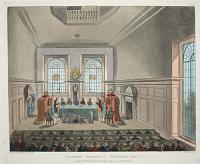
Lottery Drawing: Coopers Hall.
Rowlandson & Pugin Delt. et Sculpt. Stadler aquat.
London. Pub 1st Feby, 1809 at R. Ackermann’s Repository of Arts 101, Strand.
Coloured aquatint. 272 x 220mm.
Abbey, Scenery: 212.
[Ref: 5229] £170.00
(£204.00 incl.VAT)
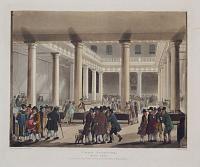
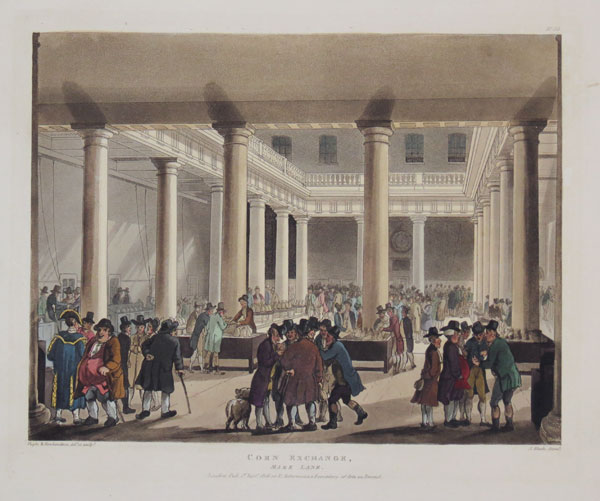
Corn Exchange, Mark Lane.
Pugin & Rowlandson del.t et sculp.t. J. Bluck Aquat.
London. Pub Sept.r 1, 1808 at R. Ackermann’s Repository of Arts 101, Strand.
Hand coloured aquatint with large margins. Platemark: 240 x 285mm (9½ x 11¼").
An interior view of the colonaded atrium of the Corn Exchange, London, with 'corn factors' at desks showing samples of corn to potential buyers. Published in Ackermann's famous work, the 'Microcosm of London', the figures were drawn by the famous caricaturist Thomas Rowlandson and the architecture by Augustus Pugin. Abbey, Scenery: 212.
[Ref: 34149] £180.00
(£216.00 incl.VAT)
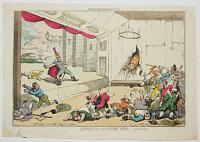
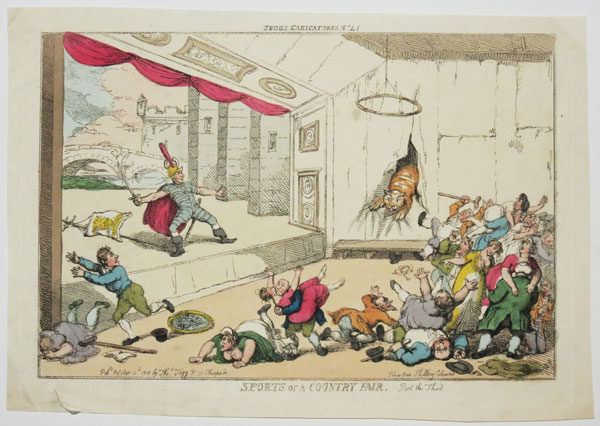
Sports of a Country Fair. Part the Third. Teggs Caricatures No 41.
[Thomas Rowlandson.]
Pub.d October 5th 1810 by Thos Tegg No 111 Cheapside.
Coloured etching. 250 x 355mm (9¾ x 14"). Tear reaching image lower left, creasing.
Chaos in the interior of a large theatrical tent as a tiger bursts through the flimsy canvas wall. From a set of four plates of similar disasters. BM Satires 11631
[Ref: 51688] £190.00
(£228.00 incl.VAT)
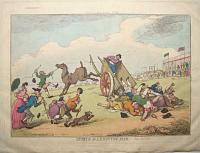
Sports of a Country Fair. Part the First. Teggs Caricatures No 38.
[Thomas Rowlandson.]
Pub.d October 5th 1810 by Thos Tegg No 111 Cheapside. Price One Shilling Coloured.
Very finely coloured etching, early state. 250 x 355mm (9¾ x 14"). Laid on album paper with some cockling of paper.
The horse breaks free from a cart carrying people around the fair, tipping them onto the ground. From a set of plates of similar disasters. Showmen including tight rope walkers in background. Pasted on the back are two Bunbury caricatures of coach drivers. BM Satires 11629.
[Ref: 59288] £350.00
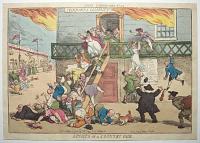
Sports of a Country Fair. Teggs Caricatures No 40.
[Thomas Rowlandson.]
Pub.d October 5th 1810 by Thos Tegg No 111 Cheapside. Price One Shilling Coloured.
Coloured etching, early state with very fine colour. 250 x 355mm (9¾ x 14"). Trimmed within plate, laid on album paper.
Spectators flee from the upper storey of a burning theatre, landing in a heap at the bottom of some stairs. From a set of plates of similar disasters. Circus including tight rope walker in background. BM Satires 11629. See Ref: 59288
[Ref: 59290] £350.00








![[John Cartwright] The Drum Major of Sedition.](jpegs/61823.jpg)


![[Mary Anne Clarke] The Road to Preferment Through Clarkes Passage.](jpegs/62054.jpg)
![[Mary Anne Clarke] Dissolution of Partnership or the Industrious Mrs Clarke Winding Up Her Accounts.](jpegs/63418.jpg)




![[Cook's Ferry?]](jpegs/64351.jpg)