Results 1-5 of 5
<<< Previous 1 Next >>>

A Group of Carnations.
Henderson pinx. Caldwell sculp.
London. Published April 2nd, 1803 by Dr. Thornton.
Aquatint with stipple and line, printed in colours and hand-finished. 510 x 390mm.
Published in Thornton's 'Temple of Flora', the first series of flower prints to show the plant within a habitat. Third and last state.
[Ref: 6133] £1,700.00

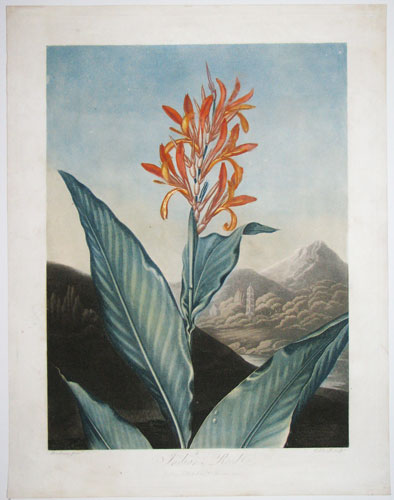
Indian Reed.
Henderson pinxt. Caldwall Sculpt.
London. Published by Dr. Thornton. 1804.
Coloured aquatint. Plate 538 x 412mm. 21¼ x 16¼".
From Dr. Thornton's "Temple of Flora" London: 1799-1807. Published in Thornton's 'Temple of Flora', the first series of flower prints to show the plant within a habitat. Dr Robert John Thornton (1768-1837) was an English physician and botanical writer. At Trinity College, Cambridge he turned away from the church towards medicine, having been inspired by the works of Linnaeus and Thomas Martyn's lectures. He went on to work at Guy's Hospital, London, where he later lectured in medical botany. Ht took some time off to travel abroad, whish is when he begain his ambitious work, the 'Temple of Flora', for which, he produced a total of thirty-three coloured plates. His original plan was to publish seventy folio-size plates, however the lack of public interest spelled disaster and Thornton died in poverty.
[Ref: 16504] £720.00

The Maggot-bearing Stapelia.
Henderson pinx.t. Stadler sculp.t.
London Published July 1, 1801, by Dr. Thornton, Hinde Street.
Aquatint with some stipple & line, printed in colours, hand-finished. 530 x 400mm, 20¾ x 16". Smith watermark Tears repaired.
Stapelia hirsuta L. or Carrion Flower, from Dr Robert John Thornton's 'Temple of Flora' 1799-1807, considered by many to be the greatest English colour-plate flower book, and the first series of flower prints to show the plant within a habitat. Here this South African plant is shown in an almost alpine environment. Hiding underneath is a snake. Thornton (1768-1837) was an English physician and botanical writer. At Trinity College, Cambridge he turned away from the church towards medicine, having been inspired by the works of Linnaeus and Thomas Martyn's lectures. He went on to work at Guy's Hospital, London, where he later lectured in medical botany. Ht took some time off to travel abroad, which is when he began his ambitious work, the 'Temple of Flora', for which he produced a total of 33 coloured plates. His original plan was to publish seventy folio-size plates, however the lack of public interest spelled disaster and Thornton died in poverty. Dunthorne: p. 250, state ii of ii.
[Ref: 19482] £450.00
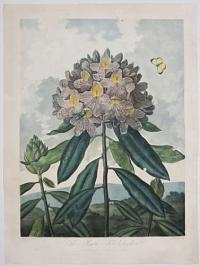
The Pontic Rhododendron.
Henderson del. Caldwell sculp.
London. Published by Dr. Thornton, Dec.r 1st 1802.
Aquatint with stipple & line engraving, small margins,printed in colours and hand-finished. 530 x 405mm (21 x 16"). Two small fly spots in sky.
An illustration of Rhododendron ponticum, or Common Rhododendron. It was published in Dr Robert John Thornton's 'Temple of Flora' 1799-1807, considered by many to be the greatest English colour-plate flower book, and the first series of flower prints to show the plant within a habitat. Dunthorne, p.250, only state.
[Ref: 30321] £850.00
view all images for this item
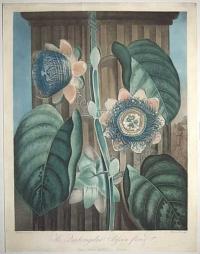
The Quadrangular Passion Flower.
Henderson pinx.t. Hopwood sculp.t.
London. Published by Dr Thornton June 1st 1802.
Aquatint with stipple, printed in colours and hand-finished. Sheet 520 x 405mm (20½ x 16"). Trimmed within plate, small tear in top edge.
Published in Thornton's 'Temple of Flora', the first series of flower prints to have the plant in its natural habitat. Although originally from South America the plant is shown here climbing a column, with a Grecian temple in the background. State iii of iii. Dunthorne, p.251: "One of the best examples of colour printing".
[Ref: 55285] £950.00
<<< Previous 1 Next >>>