Charles Beckwith, Lt. Colonel Anglais, Bienfaiteur des Vaudois.
Adeveria. Lith de Lemercier, A Paris.
[n.d. c.1846.]
A very rare lithograph. 545 x 376mm. 21½ x 14¾". Two holes. Some creasing.
John Charles Beckwith (1789-1862) was a British army officer and missionary. He entered the British army in 1803, and in 1815 he served with Sir Thomas Picton's divsion at the battles of Quatre-Bras and Waterloo, where he lost his leg after it was shattered by a cannonball. He was awarded the Waterloo Medal and promoted to lieutenant-colonel. In 1837 he was raised to colonel and in 1846 to major-general. After his injury he returned home to Halifax, where he became a founder and patron of the town's first Sunday school, and in 1826 he was invited to visit the Duke of Wellington at Apsley House in London where he read Dr William Stephen Gilly's "Narrative of an Excursion to the Mountains of Piemont" (London, 1824). This inspired Beckwith to take an interest in the plight of a small group of Protestants known as Waldensians or Vaudois who lived in the Piedmont valleys near Pinerolo. He visited the Waldensians for several years until he decided to move to Turin and devote the rest of his life to assisting them. He worked to improve Waldensian schools, and therefore collected money from friends in England, visited the schools, urged building of new schools by the community, sent teachers to Lausanne and Florence for training, and encouraged the education of women. In all he opened or restored 120 district schools. In 1848, in recognition of his labours with the Waldensians, Beckwith received the cross of St Maurice and St Lazarius from the king.
[Ref: 17805] £190.00
(£228.00 incl.VAT)
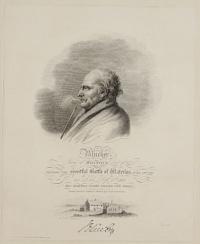
Blucher. Born at Rostock Dec.r 16.th 1742. Decided the Eventful Battle of Waterloo, June 18.th 1815 and Died Sep.r 10.th 1819. His Martial Glory Filled the World. Emori Domuit Ferum Qui Nappoleonta.
Engraved by J. Swaine after a Drawing from Life by F. Rehberg Esq.r.
Pub.d by J. Swaine Engraver, 84 Dean St.t. Soho Square London.
Engraving. Proof. Sheet: 220 x 270mm (8½ x 10½"). Trimmed within plate and tipped into album sheet.
Portrait of Gebhard Leberecht von Blücher, Marshal of the Prussian armies at the battles of Liepzig and Waterloo, in which the French, under the personal command of Napoleon, were defeated. Blucher faces to the left, smoking a pipe. A view of La Belle Alliance below portrait.
[Ref: 42157] £120.00
(£144.00 incl.VAT)
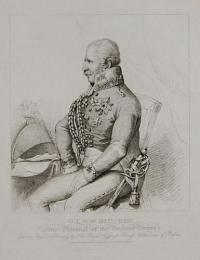
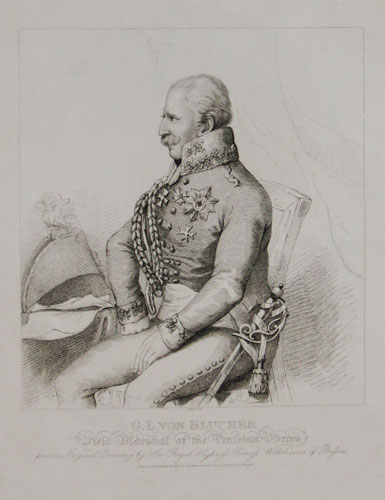
G.L. von Blucher. Field Marshal of the Prussian Forces from an Original Drawing by Her Royal Highness Princess Wilhelmina of Prussia.
London: Pub: March 10 1814 at R. Ackermanns Repository of Arts, 101 Strand.
Rare stipple. 305 x 255mm (12 x 10"), with large margins.
Sketch portrait of Gebhard Leberecht von Blücher, Marshal of the Prussian armies at the battles of Liepzig and Waterloo, in which the French, under the personal command of Napoleon, were defeated. The artist, Wilhelmina of Prussia (1751-1820) was consort of William V of Orange and mother of King William I of the Netherlands, the founder of the present Dutch monarchy.
[Ref: 35332] £260.00
(£312.00 incl.VAT)
![[Blücher] To his Royal Highness the Duke of Gloucester, Chancellor of the University of Cambridge](img-thumbnail/jpegs/34262.jpg)
[Blücher] To his Royal Highness the Duke of Gloucester, Chancellor of the University of Cambridge This Print of Prince Blucher, in the Costume of D.r in Civil Law of that University, is Humbly Dedicated, by His Royal Highnesses most obedient Servant W. Mason.
W. Mason del.t. J. Swaine sc.
Pub.d Oct.r 5 1815 by W. Mason, near the Hospital, Cambridge.
Aquatint. 330 x 235mm (13 x 9¼"). Scuffing lower right. Bit dusty.
Portrait of Gebhard Leberecht von Blücher, Marshal of the Prussian armies at the battles of Liepzig and Waterloo, in which the French, under the personal command of Napoleon, were defeated.
[Ref: 34262] £130.00
(£156.00 incl.VAT)
![[Blucher. Copied from a Bust, Modeled at Paris, by M. Bosin.]](img-thumbnail/jpegs/33005.jpg)
[Blucher. Copied from a Bust, Modeled at Paris, by M. Bosin.]
[Engraved by Charles Turner.]
[Pub. Aug.t 1814, by R. Ackermanns Repository of Arts, 101 Strand.]
Mezzotint, proof before all letters with large margins. 355 x 255mm (14 x 10").
Portrait of Gebhard Leberecht von Blücher, Marshal of the Prussian armies at the battles of Liepzig and Waterloo, in which the French, under the personal command of Napoleon, were defeated. It is based on a bust by François Joseph Bosio.
[Ref: 33005] £280.00
(£336.00 incl.VAT)
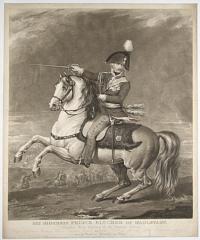
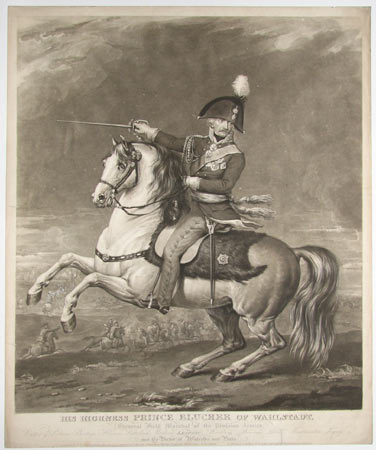
His Highness Prince Blucher of Wahlstadt General Field Mrshall of the Prussian Armies, Victor of Lutzen, Bautzen, Hainan, Katzbach, Möckern, Leipzig, Wartburg, Brienne, Loan, Montmartre, Ligny, and Co-Victor of Waterloo and Paris.
Engrav'd by C.Turner from the picture painted by C.Back of Breslaw, for Her Highness Princess Blucher.
Published London 1st August 1815 by R.Ackermann, 101 Strand.
Mezzotint. Sheet 615 x 510mm. A few small tears, laid on paper. Image scratched between the front feet of the horse.
Gebhard Leberecht von Blücher (1742-1819), Prussian Field Marshal, whose arrival at Waterloo saved the day for Wellington. Published less that three months after the battle. Whitman: 47. Ex: Collection of The Hon. C. Lennox-Boyd.
[Ref: 478] £580.00
![[Five portraits of Marshal Blücher]](img-thumbnail/jpegs/55845.jpg)
[Five portraits of Marshal Blücher] Sketches of the veteran Field Marshal Blücher taken from life June 12.h by Fr Rehberg.
J. Swaine sc.
London, Pubd, July 13, 1814 by M.r Colnaghi's, Cockspur St.t & M.r Rehberg, 30, St, James's Street.
Rare proof etching, sheet 515 x 420mm (20¼ x 16½"). Taped into mount. Large crease across the middle.
Portraits of Gebhard Leberecht von Blücher, Fürst von Wahlstatt (1742-1819), three bust length and two full length of him smoking. The Prussian field marshal best known for leading his army against Napoleon I at the Battle of the Nations at Leipzig in 1813 and the Battle of Waterloo in 1815.
[Ref: 55845] £360.00
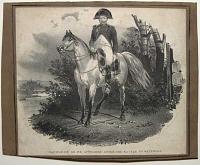
Napoleon as he Appeared after the Battle of Waterloo.
On stone by A. Picken.
W. Day, Lith.r to the King, Gate St. [n.d., c.1825.]
Lithograph. Sheet 140 x 160mm (5½ x 6¼"). Trimmed close to image, laid on album paper, artist's name indistinct.
Napoleon mounted on Marengo, before the horse was captured by William Petre.
[Ref: 55899] £70.00
(£84.00 incl.VAT)
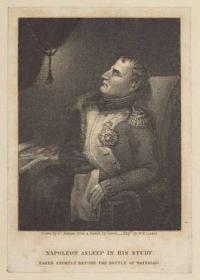
Napoleon Asleep in his Study. Taken Shortly Before the Battle of Waterloo.
Drawn by Dr Memes from a sketch by David. _ Eng.d by W.H. Lizars.
[n.d., c.1820.]
Engraving. Sheet 180 x 180mm (4¾ x 7"). Trimmed within plate, laid on album paper. Foxed.
Napoleon Bonaparte in uniform, asleep in a chair in a tent.
[Ref: 55824] £65.00
(£78.00 incl.VAT)
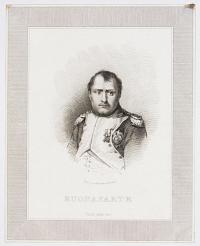
Buonaparte.
Peint par Muneret Avril 1815.
Publié Juillet 1815.
Stipple and engraving, rare. 202 x 165mm (8 x 6½"). Trimmed to border.
Napoleon I (1769-1821), French Emperor from 1804 to 1815. The portrait from which this print derives was painted in April 1815, during the '100 days' between Napoleon's return from Elba and the Battle of Waterloo. The print itself was published soon after the Battle of Waterloo. In this sense the print incorporates both the period of Napoleon's final hopes and the subsequent end of his military career. Provenance: Elizabeth Anne Hippisley of Ston Easton.
[Ref: 29451] £95.00
(£114.00 incl.VAT)
![[British cavalry.]](img-thumbnail/jpegs/41553.jpg)
[British cavalry.]
D Dighton.
Pub by Dighton Spring Gardens [c.1805].
Rare early lithograph, sheet 230 x 285mm (9 x 11¼"). Trimmed.
A cavalryman in a battlefield, aiming his sword. A lithograph by Denis Dighton (1791-1827), military painter who painted battle scenes such as large canvases of Waterloo (Plas Newydd, Anglesey) and Trafalgar (National Maritime Museum) as well as uniform studies. In 1815 he was appointed military draughtsman to the prince regent; the Royal Collection holds over 300 watercolours and drawings by Dighton.
[Ref: 41553] £260.00
(£312.00 incl.VAT)
![[Keyplate] Chelsea Pensioners reading the Gazette of the Battle of Waterloo.](img-thumbnail/jpegs/36975.jpg)
[Keyplate] Chelsea Pensioners reading the Gazette of the Battle of Waterloo.
[after David Wilkie, R.A.] J. Moyes, Castle Street, Leicester Square.
[London, Moon, Boys, & Graves, c.1831.]
Very rare letterpress broadside with woodcut vignette. Sheet 850 x 570mm (33½ 22½"). Folds with worn holes, foxed.
Keyplate and list of subscribers for David Wilkie's lively scene of Chelsea pensioners sitting round a wooden table outside the Duke of York inn, listening to one reading the news of the Battle of Waterloo. The key lists the variant uniforms of the old soldiers. The extensive list of subscribers include the Duke of Wellington, the artist and Francis Moon, one of the publishers. For Chelsea Pensioner's Print: Ref: 32632
[Ref: 36975] £280.00
(£336.00 incl.VAT)
view all images for this item
![[Keyplate] Chelsea Pensioners reading the Gazette of the Battle of Waterloo.](img-thumbnail/jpegs/58217.jpg)
[Keyplate] Chelsea Pensioners reading the Gazette of the Battle of Waterloo.
[after David Wilkie, R.A.] J. Moyes, Castle Street, Leicester Square.
[London; Moon, Boys, & Graves, c.1831.]
Rare letterpress broadside with woodcut vignette. Sheet 880 x 570mm (34½ x 22½"). Creases and tears.
The keyplate to Sir David Wilkie's painting of a group of Chelsea pensioners sitting round a wooden table outside the Duke of York inn, with one reading aloud the news of Waterloo, highlighting 16 points of interest including variant uniforms of the old soldiers. Below is an extensive list of subscribers, noting whether they bought proofs or prints, including Wilkie himself, the Duke of Wellington (to whom the print was dedicated) and F.G. Moon, one of the publishers. See: 36975 for keyplate & Ref: 32632 for print.
[Ref: 58217] £260.00
(£312.00 incl.VAT)
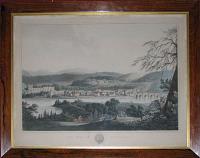
The Town of Dunkeld.
Drawn on the Spot by I. Clark.
London, Published by Smith, Elder & Co. 65 Cornhill, 1824.
Coloured aquatint, 510 x 665mm. 20 x 26¼". Framed in fine rosewood frame. Some marking in edge of margins.
Dunkeld in Scotland, from the "Views in Scotland" series. On the right is the stone bridge over the River Tay built by Thomas Telford in 1809. Although it cannot be proved it is believed that 'I. Clark" is the Scottish painter John Heaviside Clark, famed as 'Waterloo Clark' for his early sketches of the Battle. He was also skilled in aquatinting, and certainly none of this series has a named engraver. Abbey No: 489.
[Ref: 12696] £490.00
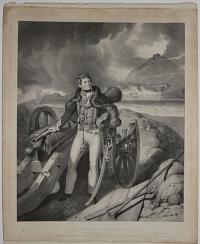
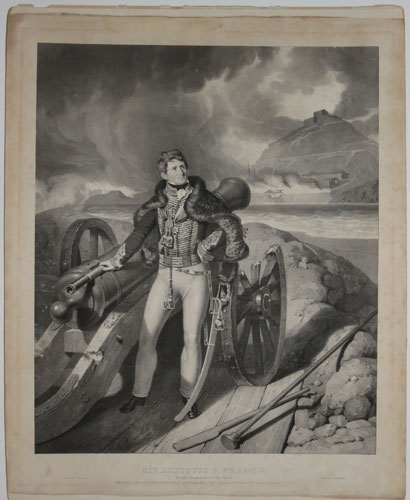
Sir Augustus S. Frazer. Knight Commander of the Bath. Colonel of the Royal Horse Artillery and Director of the Royal Laboratory.
On Stone by C. Hamberger. Printed by C. Hullmandel.
[n.d. c.1820.]
Scarce lithograph, India proof. Sheet 610 x 507mm (24 x 20"). Mount staining, paper toning, Laid on card.
A wonderful heroic portrait of a Gunner next to his cannon. Colonel Sir Augustus Simon Frazer, K.C.B, (1776-1835). A month before his fourteenth birthday he was admitted as a Gentleman Cadet into the Royal Military Academy, Woolwich. In 1793 he was commissioned as a Second Lieutenant in the Royal Regiment of Artillery and in December he joined the army in Flanders, then under the command of HRH the Duke of York. He was promoted Lieutenant in January 1794 and saw action in the Flanders campaign, returning to England with the army in May 1795 when he was appointed to the Royal Horse Artillery (RHA). In September 1799, now a Captain-Lieutenant, he again went on active service, to North Holland, returning to England in November. He became a captain in 1803 and was given command of a troop of RHA which, in 1807 he took to South America where he commanded the Artillery of the expedition against Buenos Aires. Promoted Major in June 1811 he went to the Peninsula in November 1812, and it is from this date that the letters begin. In April 1813 Frazer was appointed to command the Horse Artillery of the army and as such saw action at Salamanca, Osma, Vitoria, St Sebastian, the crossings of the Bidassoa, Nive and Adour. He was severely wounded at the siege of Bayonne on 27 February 1814 but was back for the final battle of Toulouse in April which brought hostilities against the French to a close. He then returned to England, receiving the Peninsular Medal with two clasps and KCB, and appointed to command of the Artillery in the eastern district. He was promoted Lieutenant-Colonel in December 1814. When war with France broke out again on Napoleon's escape from Elba Sir Augustus joined the allied army in Flanders, under the Duke of Wellington, in March 1815 and resumed command of the Horse Artillery, the post he held during the battle of Waterloo. On return to England he was appointed Commander HQ RHA, Woolwich until promoted Colonel in January 1825. Subsequently he was Assistant Inspector of the Ordnancer Carriage Department, and finally Director of the Royal Laboratory, a position he held till his death in 1835. Frazer was a prolific letter writer and the letters contained in a book written to his wife, Lady Emma Frazer and to his wife's sister and her husband, Major and Mrs Moore. They give a fascinating account of the stirring events of the time. 140 of them were written during the Peninsular campaign and a further 41 during the Waterloo campaign. Not in Parker.
[Ref: 28264] £280.00
(£336.00 incl.VAT)
![[Sir Augustus Frazer.]](img-thumbnail/jpegs/20169.jpg)
[Sir Augustus Frazer.] [Facsimile:] Y Sincerely Aug S Frazer.
[n.d. c.1859.]
Lithograph. Collector's stamp lower right corner outside image. 222 x 132mm. 8¾ x 5¼".
Colonel Sir Augustus Simon Frazer, K.C.B, (1776-1835). A month before his fourteenth birthday he was admitted as a Gentleman Cadet into the Royal Military Academy, Woolwich. In 1793 he was commissioned as a Second Lieutenant in the Royal Regiment of Artillery and in December he joined the army in Flanders, then under the command of HRH the Duke of York. He was promoted Lieutenant in January 1794 and saw action in the Flanders campaign, returning to England with the army in May 1795 when he was appointed to the Royal Horse Artillery (RHA). In September 1799, now a Captain-Lieutenant, he again went on active service, to North Holland, returning to England in November. He became a captain in 1803 and was given command of a troop of RHA which, in 1807 he took to South America where he commanded the Artillery of the expedition against Buenos Aires. Promoted Major in June 1811 he went to the Peninsula in November 1812, and it is from this date that the letters begin. In April 1813 Frazer was appointed to command the Horse Artillery of the army and as such saw action at Salamanca, Osma, Vitoria, St Sebastian, the crossings of the Bidassoa, Nive and Adour. He was severely wounded at the siege of Bayonne on 27 February 1814 but was back for the final battle of Toulouse in April which brought hostilities against the French to a close. He then returned to England, receiving the Peninsular Medal with two clasps and KCB, and appointed to command of the Artillery in the eastern district. He was promoted Lieutenant-Colonel in December 1814. When war with France broke out again on Napoleon's escape from Elba Sir Augustus joined the allied army in Flanders, under the Duke of Wellington, in March 1815 and resumed command of the Horse Artillery, the post he held during the battle of Waterloo. On return to England he was appointed Commander HQ RHA, Woolwich until promoted Colonel in January 1825. Subsequently he was Assistant Inspector of the Ordnance Carriage Department, and finally Director of the Royal Laboratory, a position he held till his death in 1835. Frazer was a prolific letter writer and the letters contained in a book written to his wife, Lady Emma Frazer and to his wife's sister and her husband, Major and Mrs Moore. They give a fascinating account of the stirring events of the time. 140 of them were written during the Peninsular campaign and a further 41 during the Waterloo campaign. Lugt: 2832; Ex Collection: Sir W.A. Frazer.
[Ref: 20169] £95.00
(£114.00 incl.VAT)
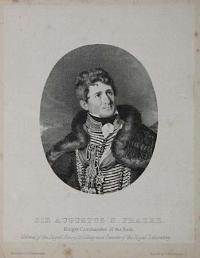
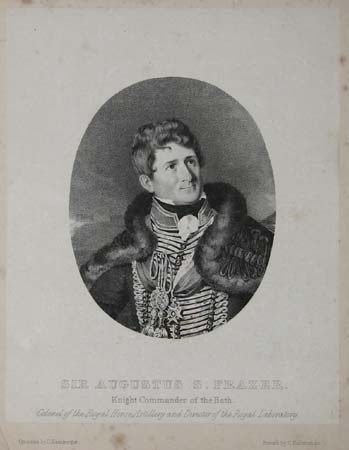
Sir Augustus Frazer. Knight Commander of the Bath. Colonel of the Royal Horse Artillery and Director of the Royal Laboratory.
On stone by C. Hamberger.
Printed by C. Hullmandel. [n.d. c.1830].
Lithograph. Sheet 210 x 280mm. Foxing outside india paper.
Commander of Horse Artillery during the Battle of Waterloo [1776 - 1835]. Rare. Not in Wellcome.
[Ref: 2928] £120.00
(£144.00 incl.VAT)
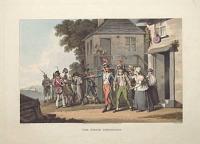
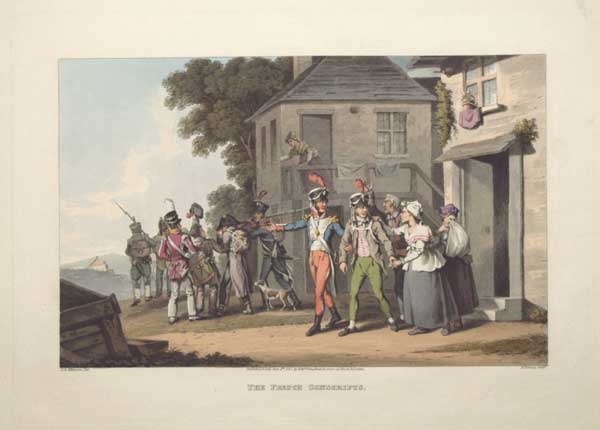
The French Conscripts.
J.A. Atkinson Del. M. Dubourg Sculp.t.
Published & Sold June 4th 1817, by Edw.d Orme, Bond Street, corner of Brook St. London.
Coloured aquatint. 255 x 360mm (10 x 14¼"), with large margins watermarked 'J Whatman 1816'. Mint
Soldiers pull young men from their rural home, probably to reinforce Napoleon Bonaparte's army for the Hundred Days. From Orme's ''Historic, Military, and Naval Anecdotes, of Personal Valour, Bravery, and particular Incidents which occurred to the Armies of Great Britian and her Allies, in the last long-contested War, terminating with the Battle of Waterloo''. John Augustus Atkinson (1775-1830) was a British etcher, painter, draughtsman and printmaker. He spent 1784-1801 in Russia with James Walker who is thought to be his uncle. After returning to London in 1801, he made prints after his works, of Russian subjects, and made outline etchings for other artists. He also executed paintings on military subjects and battles.
[Ref: 55803] £130.00
(£156.00 incl.VAT)

Colonel Gordon mortally Wounded. Battle of Waterloo.
London, Published by Thomas Kelly, Paternoster Row, Sept.r 28 1816.
Engraving. Sheet 265 x 205mm (10 x 8"). Trimmed within plate.
Sir Alexander Gordon (1786-1815), ADC to the Duke of Wellington at Waterloo.
[Ref: 46101] £60.00
(£72.00 incl.VAT)
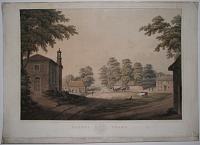
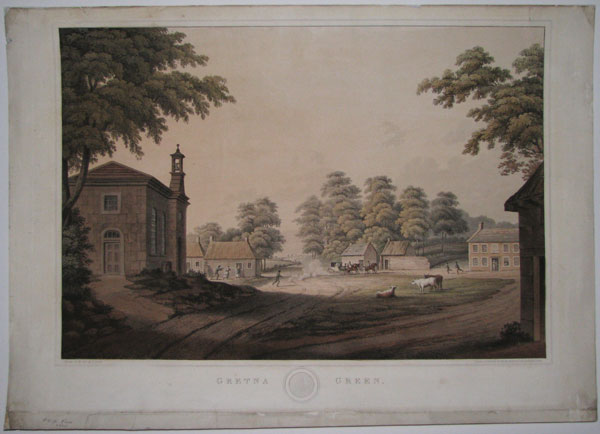
Gretna Green.
Drawn on the Spot by I. Clark.
London, Published by Smith, & Elder, Fenchurch Street, 1825.
Coloured aquatint. 475 x 625mm. 18¾ x 24¾". Some restoration.
A view of the centre of Gretna Green in Dumfriesshire, from the "Views in Scotland" series. In the C18th & C19th the village became the favourite destination of eloping couples because of disparity between marriage laws: in England brides under 21 needed parental consent, while in Scotland they could be as young as twelve. Situated just over the border it was the nearest place for elopers to marry. As long as there were at least two witnesses even the blacksmith could perform the ceremony. Although it cannot be proved it is believed that 'I. Clark" is the Scottish painter John Heaviside Clark, famed as 'Waterloo Clark' for his early sketches of the battle. He was also skilled in aquatinting, and certainly none of this series has a named engraver. This is one of the few plates in the series to feature 'action': a coach and four has just pulled up in a cloud of dust and locals are rushing out, probably to offer their services. Abbey No: 489.
[Ref: 18606] £240.00
(£288.00 incl.VAT)
![[Lt Col John Gurwood] J.Gurwood [facsimile signature].](img-thumbnail/jpegs/63230.jpg)
[Lt Col John Gurwood] J.Gurwood [facsimile signature]. 27 Mai 1845.
[Alfred d'Orsay].
Lithograph on chine collé. 225 x 160mm (8¾ x 6¼"), very large margins. Backing sheet spotted and toned at edges.
Lt Col John Gurwood (1788-1845). After surviving a forlorn hope at Ciudad Rodrigo in the Peninsular War and the Battle of Waterloo, he edited and published the 'Dispatches of the Duke of Wellington', a major contribution to military history.
[Ref: 63230] £130.00
(£156.00 incl.VAT)
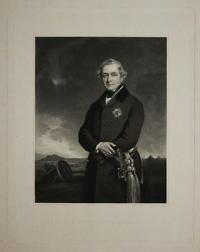
The Right Hon.ble Viscount Hardinge, G.C.B., P.C. Proof.
Painted by F. Grant R.A. Engraved by J. Faed.
London Published April 20th, 1846, by Thomas Mc Lean, 26 Haymarket. Printed November 1st 1851 by Paul & Dominic Colnaghi & Co., 13 & 14 Pall Mall East _ Publishers to Her Majesty.
Proof mezzotint on chine collé. 410 x 320mm (16 x 12½") very large margins. Small scratch on his coat.
Henry Hardinge (1785-1856), 1st Viscount Hardinge, a field marshal, Governor-general of India (1844-8) and the commander-in-chief of the British Army during the Crimean War. He is wearing the star of the Bath, and the sword which Napoleon wore at Waterloo, presented to him by the Duke of Wellington at the Great Review of the Allied Army in 1816. He hides one cuff: he lost his left hand to a shot at the Battle of Ligny on 16 June 1815, which prevented him fighting at Waterloo two days later.
[Ref: 51456] £230.00
(£276.00 incl.VAT)

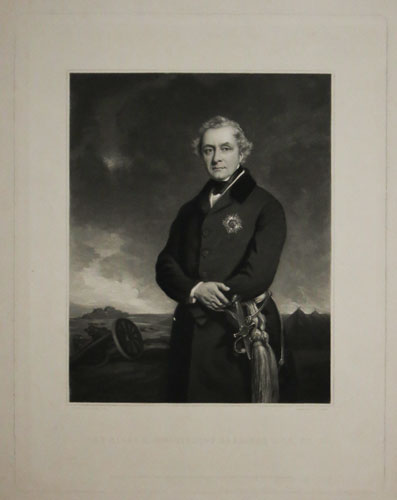
The Right Hon.ble Viscount Hardinge, G.C.B., P.C.
Painted by F. Grant R.A. Engraved by J. Faed.
London Published November 1st 1851 by Paul & Dominic Colnaghi & Co., 13 & 14 Pall Mall East _ Publishers to Her Majesty.
Mezzotint. 410 x 320mm (16 x 12½").
Henry Hardinge (1785-1856), 1st Viscount Hardinge, a field marshal, Governor-general of India (1844-8) and the commander-in-chief of the British Army during the Crimean War. He is wearing the star of the Bath, and the sword which Napoleon wore at Waterloo, presented to him by the Duke of Wellington at the Great Review of the Allied Army in 1816. He hides one cuff: he lost his left hand to a shot at the Battle of Ligny on 16 June 1815, which prevented him fighting at Waterloo two days later. Ex: Collection of The Hon. Christopher Lennox-Boyd.
[Ref: 65925] £320.00

The Right Hon.ble Viscount Hardinge, G.C.B., P.C.
Painted by F. Grant R.A. Engraved by J. Faed.
London Published November 1st 1851 by Paul & Dominic Colnaghi & Co., 13 & 14 Pall Mall East _ Publishers to Her Majesty.
Mezzotint. 410 x 320mm (16 x 12½"), with large margins. Repaired tear just entering plate on right.
Henry Hardinge (1785-1856), 1st Viscount Hardinge, a field marshal, Governor-general of India (1844-8) and the commander-in-chief of the British Army during the Crimean War. He is wearing the star of the Bath, and the sword which Napoleon wore at Waterloo, presented to him by the Duke of Wellington at the Great Review of the Allied Army in 1816. He hides one cuff: he lost his left hand to a shot at the Battle of Ligny on 16 June 1815, which prevented him fighting at Waterloo two days later. Ex: Collection of The Hon. Christopher Lennox-Boyd.
[Ref: 65922] £260.00
(£312.00 incl.VAT)
![[The Right Hon.ble Viscount Hardinge, G.C.B., P.C.]](img-thumbnail/jpegs/65924.jpg)
[The Right Hon.ble Viscount Hardinge, G.C.B., P.C.]
[Painted by F. Grant R.A. Engraved by J. Faed.]
[London Published November 1st 1851 by Paul & Dominic Colnaghi & Co., 13 & 14 Pall Mall East _ Publishers to Her Majesty.]
Fine mezzotint, proof before letters, printed on chine collé. 410 x 320mm (16 x 12½"), with large margins
Henry Hardinge (1785-1856), 1st Viscount Hardinge, a field marshal, Governor-general of India (1844-8) and the commander-in-chief of the British Army during the Crimean War. He is wearing the star of the Bath, and the sword which Napoleon wore at Waterloo, presented to him by the Duke of Wellington at the Great Review of the Allied Army in 1816. He hides one cuff: he lost his left hand to a shot at the Battle of Ligny on 16 June 1815, which prevented him fighting at Waterloo two days later. Ex: Collection of The Hon. Christopher Lennox-Boyd.
[Ref: 65924] £320.00
![[The Right Hon.ble Viscount Hardinge, G.C.B., P.C.]](img-thumbnail/jpegs/65923.jpg)
[The Right Hon.ble Viscount Hardinge, G.C.B., P.C.]
[Painted by F. Grant R.A. Engraved by J. Faed.]
[London Published November 1st 1851 by Paul & Dominic Colnaghi & Co., 13 & 14 Pall Mall East _ Publishers to Her Majesty.]
Mezzotint, proof before letters, printed on chine collé. 410 x 320mm (16 x 12½"), large margins. Faint staining on right.
Henry Hardinge (1785-1856), 1st Viscount Hardinge, a field marshal, Governor-general of India (1844-8) and the commander-in-chief of the British Army during the Crimean War. He is wearing the star of the Bath, and the sword which Napoleon wore at Waterloo, presented to him by the Duke of Wellington at the Great Review of the Allied Army in 1816. He hides one cuff: he lost his left hand to a shot at the Battle of Ligny on 16 June 1815, which prevented him fighting at Waterloo two days later. Ex: Collection of The Hon. Christopher Lennox-Boyd.
[Ref: 65923] £260.00
(£312.00 incl.VAT)

Grand Display of Fire-Works Postponed, Until Thursday the 20th instant. The Inhabitants of Hull and its Vicinity are most respectfully informed, That in consequence of Mr. Nervoni making several Additions to the Plan of the Fire-Works Already Announced, The Exhibition will unavoidably be Postponed until Thursday next, the 20th Inst. When it will positively take place at the Pottery Barrack Yard.
(Robert Peck, Printer, Hull.)
Hull, July, 17th, 1815.]
Scarce letterpress handbill. Sheet 220 x 170mm (8¾ x 6¾").
A firework display, probably celebrating the Battle of Waterloo the previous month. Signor Nervoni was conductor of fire works at Vauxhall Gardens.
[Ref: 57174] £260.00
(£312.00 incl.VAT)

The Town of Inverness.
Drawn on the Spot by I. Clark.
London, Published by Smith & Elder, Fenchurch Street, 1823 (but later).
Hand-coloured etching and aquatint. Plate 475 x 629mm (18¾ x 24¾"). Slightly trimmed, slight paper toning.
Inverness, in the Scottish Highlands, where the River Ness enters the Moray Firth, from the "Views in Scotland" series. Although it cannot be proved it is believed that 'I. Clark" is the Scottish painter John Heaviside Clark, famed as 'Waterloo Clark' for his early sketches of the Battle. He was also skilled in aquatinting, and certainly none of this series has a named engraver. Abbey Scenery:489.32. GAC: 3933. RMG: PAH9852.
[Ref: 28777] £320.00
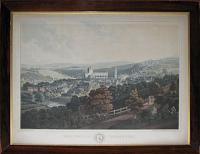
The Town of Jedburgh.
Drawn on the Spot by I. Clark.
London, Published by Smith, Elder & Co. 65 Cornhill, 1825.
Coloured aquatint, 510 x 665mm. 20 x 26¼". Framed in fine rosewood frame. Vertical crease at centre, some paper toning.
Jedburgh in the Scottish Borders, from the "Views in Scotland" series. On the centre are the ruins of Jedburgh Abbey, founded by the Augustines in 1138; above the town on the right is Jedburgh Castle Jail, built in the early 19th century on the site of the medieval castle Although it cannot be proved it is believed that 'I. Clark" is the Scottish painter John Heaviside Clark, famed as 'Waterloo Clark' for his early sketches of the Battle. He was also skilled in aquatinting, and certainly none of this series has a named engraver. Abbey No: 489.
[Ref: 12697] £490.00
![Edw.d Kerrison [facsimile signature].](img-thumbnail/jpegs/57854.jpg)
Edw.d Kerrison [facsimile signature].
T. H. Maguire. 1851. [etched in plate]
M & N Hanhart. Imp.t.
Lithograph on octagonal chine collé. Sheet: 610 x 445mm (24 x 17½"), very large margins. Some foxing. Toning around the edges.
A seated half length portrait of Sir Edward Kerrison (1776-1853) from the Ipswich Museum Portraits series published by George Ransom in 1852: the sixty portraits of distinguished men of science were commissioned to commemorate the foundation of the museum in 1846. Kerrison was a respected officer of the British Army, serving as a Lieutenant-Colonel in the 7th Light Dragoons and commanded his own regiment at the Battle of Waterloo.
[Ref: 57854] £75.00
(£90.00 incl.VAT)
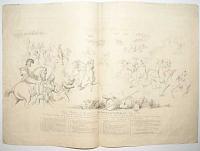
Key of Reference to the print of The Battle of Waterloo, June 18th, 1815. The period of time is towards the Close of the Day when the whole French Army were thrown into Confusion. The Marquis of Anglesey having broken the French Lines and pass'd the high road, pursues the Enemy into a hollow, and the Cavalry charge and capture their Artillery.
London; Published June 18th, 1819, by R.Lambe, 96, Gracechurch Street, and T.Clay, 18, Ludgate Hill.
Etched key plate. Sheet 540 x 755mm (21¼ x 29¾"). On paper watermarked 'Turkey Mills J Whatman 1819'. Folded at centre. Taped tears. Trimmed to plate left and right.
Keyplate to a painting by Alexander Sauerweid, as engraved by H.R.Cook, with a 19-point key of persons and a 15-point key of the battle. BM: 1872-5-11-449.
[Ref: 60061] £320.00
![[Siege of Kufstein] The Tyrolese Patriots,](img-thumbnail/jpegs/55802.jpg)
[Siege of Kufstein] The Tyrolese Patriots, Men and Women storming the fortress of Kuffstein with their Wooden Guns.
Manskirch Del. Clark & Dubourg Sculp.t.
Published & Sold April 1st 1816, by Edw.d Orme, Bond Street, corner of Brook St. London.
Coloured aquatint. 245 x 325mm (9¾ x 12¾"), with very large margins watermarked 'J Whatman 1814'. Mint.
Tyrolese irregulars attacking the fortress of Kufstein in 1809, attempting to remove the Bavarians who had held it since 1703. After a month, relief arrived, but the fortress was returned to Austria in 1814. From Orme's ''Historic, Military, and Naval Anecdotes, of Personal Valour, Bravery, and particular Incidents which occurred to the Armies of Great Britian and her Allies, in the last long-contested War, terminating with the Battle of Waterloo''.
[Ref: 55802] £120.00
(£144.00 incl.VAT)

Precepitate Flight of the French through Leipsic Pursued by the Allied Armies. 19th October 1813.
London, Pub'd by R. Bowyer, 1815.
Coloured aquatint. 340 x 580mm (13½ x 22¾"). Trimmed within plate at sides, laid down, mount glued onto sheet, colour faded, staining.
A view of Napoleon's army retreating after the 1813 Battle of Leipzig (or 'Battle of the Nations') broke Napoleon's hold on Germany. It was published in Robert Bowyer's 'Triumphs in Europe, in the Campaigns of the Years 1812, 1813, 1814 commemorated by a Series of Twelve Views...', which celebrated (prematurely) the end of the Napoleonic Wars. This work was republished the following year as 'An Illustrated Record of Important Events in the Annals of Europe', and again with an sister publication 'The Campaign of Waterloo' from 1816.
[Ref: 55810] £230.00
(£276.00 incl.VAT)

Leipzic.
Publish'd by R. Bowyer, Pall Mall, 1814.
Very fine coloured aquatint. 305 x 400mm (12 x 15¾").
A view of Leipzig, soon after the 1813 Battle of Leipzig (or 'Battle of the Nations') broke Napoleon's hold on Germany. It was published in Robert Bowyer's 'Triumphs in Europe, in the Campaigns of the Years 1812, 1813, 1814 commemorated by a Series of Twelve Views...', which celebrated (prematurely) the end of the Napoleonic Wars. This work was republished the following year as 'An Illustrated Record of Important Events in the Annals of Europe', and again with an sister publication 'The Campaign of Waterloo' from 1816.
[Ref: 35511] £230.00
(£276.00 incl.VAT)

Grand Entry of the Allied Armies into Leipsic. 19th October 1813.
London, Pub'd by R. Bowyer, Pall Mall, 1815.
Coloured aquatint. 340 x 580mm (13½ x 22¾"). Trimmed within plate at sides, laid down, mount glued onto sheet, colour faded, staining.
The Coalition armies of Austria, Prussia, Sweden, and Russia entering the city after the 1813 Battle of Leipzig (or 'Battle of the Nations') broke Napoleon's hold on Germany. It was published in Robert Bowyer's 'Triumphs in Europe, in the Campaigns of the Years 1812, 1813, 1814 commemorated by a Series of Twelve Views...', which celebrated (prematurely) the end of the Napoleonic Wars. This work was republished the following year as 'An Illustrated Record of Important Events in the Annals of Europe', and again with an sister publication 'The Campaign of Waterloo' from 1816.
[Ref: 55811] £230.00
(£276.00 incl.VAT)
![[Leipzig] 'Brother the Lord is with us.'](img-thumbnail/jpegs/37118.jpg)
[Leipzig] 'Brother the Lord is with us.' The Emperor of Russia, King of Prussia, and the Emperor of Austria, Spontaneously returning thanks in the Field of Battle after the Great Victory at Leipsic, in 1813.
London, Pub. by Thomas Kelly, No. 53 Paternoster row, Feb. 4 1815.
Coloured engraving. Sheet 195 x 240mm (7¾ x 9¾"). Trimmed and mounted in album paper.
From Christopher Kelly's 'The Memorable Battle of Waterloo'.
[Ref: 37118] £75.00
(£90.00 incl.VAT)
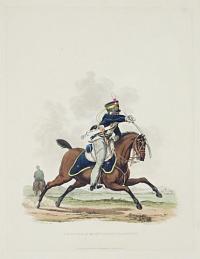
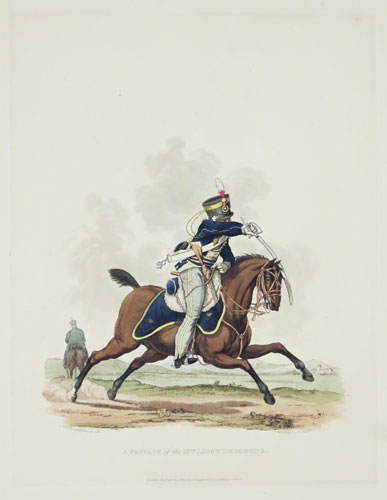
A Private of the 13.th. Light Dragoons.
Drawn & Etched by C. H. S. Aquatinted by J. C. Stadler.
London Pub.d. April 1.st. 1812 by Colnahgi & C.o. 23 Cockspur Street.
Very fine coloured aquatint with large margins. 255 x 320mm (10 x 12½").
Exterior scene depicting a mounted private of the 13th Light Dragoons (now Light Dragoons) galloping across the landscape, brandishing a sword. A mounted soldier is depicted behind, exiting the scene. The 13th Light Dragoons were engaged in the Peninsular War in 1812 and went on to participate in the Battle of Waterloo and the Crimean War. From 'Costumes of the Army of the British Empire, according to the last regulations of 1812'. Ogilvy 870.
[Ref: 33554] £260.00
(£312.00 incl.VAT)
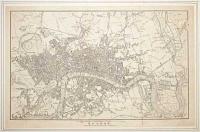
London.
Published as the Act directs Feb.y 1815 by G. Jones, Ave Maria Lane.
Engraved map. Sheet 255 x 405mm (10 x 16"). Vertical fold, laid on card.
A Georgian plan of London, published a matter of months before the Battle of Waterloo. It shows from the Serpentine River in Hyde Park, clockwise to Paddington, Regent's Park, Hackney, Stratford, the East India Docks, Greenwich, Walworth, Nine Elms and Chelsea. The map shows Regent's Park and the Millbank Penitentiary under construction, and 'Tomlins Town', a shanty town for workers off the Edgware Road. Darlington & Howgego 265.
[Ref: 61729] £260.00

The Stranger's Guide to London and Westminster, Exhibiting all the various Alterations and Improvements complete to the Present Time.
London, Published Jan.y 1.s. 1814 by Edward Mogg, N.º 14 Little Newport Street, Leicester Square.
Engraved map with hand colour. Dissected and laid on linen, as issued. Sheet 415 x 585mm (16¼ x 23"). Green oxidised, glue stains around edge, some wear at folds.
A detailed map of Georgian London, published the year before the Battle of Waterloo. It extends from Knightsbridge in the west, clockwise to Paddington, Pentonville, Hackney, Stepney, Walworth, Vauxhall Gardens, and the Royal Hospital at Chelsea. Regents Park is still Marylebone Park, with the Jew's Harp tea rooms and the original site of Lord's Cricket Ground.
[Ref: 64128] £280.00
![[In pencil:] "Marengo". Buonaparte's... Charger at the battle of Waterloo.](img-thumbnail/jpegs/31227.jpg)
[In pencil:] "Marengo". Buonaparte's... Charger at the battle of Waterloo.
from a Drawing by James Ward R.A. [Etched in plate:] MB.
[n.d. c.1820.]
Etching. 222 x 305mm (8¾ x 12").
A reversed copy of 'Marengo, the favourite charger of Napoleon I' after James Ward. Marengo (c.1793-1831), the Arab horse purchased by Napoleon Bonaparte after the Battle of Aboukir in 1799 and named after the French victory at Marengo in 1800. Marengo was captured after the Battle of Waterloo and brought to England, where, after his death in 1831, his remains were preserved. His skeleton can now be seen in the 'Changing the World' gallery at the National Army Museum.
[Ref: 31227] £220.00
(£264.00 incl.VAT)

Theatre of War 1815. From the Straits of Dover, to the Rhine at Strasburg, and from Holland to Paris.
Published Feb.y 1. 1816, by J.no Booth, Duke Street, Portland Place.
Engraved map with hand colour. Sheet 220 x 285mm (8¾ x 11¼"). Trimmed within plate, original binding fold.
A map of the theatre of the Waterloo Campaign, showing from Paris to Rotterdam, with the borders according to the Treaty of 1814 and the positions of the French, British and Prussian troops at the beginning of the campaign. From 'The Battle of Waterloo: containing the accounts published by authority, British and foreign'.
[Ref: 66693] £140.00
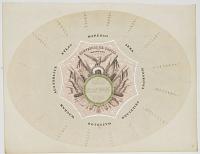
Souvenirs de Gloire et de Maleurs.
[n.d., c.1830.]
Rare engraving. Oval sheet 205 x 275mm (8 x 10¾") Trimmed as oval, laid on album paper.
A design celebrating the triumphs and failures of Napoleon Bonaparte, with four verses within a circle within a collection of trophies, surrounded by a list of battles including Waterloo.
[Ref: 37383] £140.00
(£168.00 incl.VAT)
![[The Fall of Napoleon.]](img-thumbnail/jpegs/55754.jpg)
[The Fall of Napoleon.]
[Painted by G. Wallis. Engraved by G. Zobel.]
[London, Published Jane 18th 1837, by J. McCormick, 147, Strand.]
Scarce & eare mezzotint. Sheet 320 x 265mm (12½ x 10½"). Trimmed within image, very damage, laid on old paper.
A scene outside the 'Waterloo Tavern' in 'Wellington Street'. A soldier and black figure smile at each other as the soldier trips up an Italian boy carrying on his head a board on which is balanced a statue of Napoleon that is about to crash to the ground. A church can be seen in the background to the right, and posters on the wall of the tavern to the left advertising a gala, 'Anniversary of the Glorious Battle of Waterloo' at Vauxhall Gardens, and a performance of 'The Fall of Napoleon', or 'The Unfortunate Italian' at the Theatre Royal, in celebration of the anniversary of the battle of Waterloo. The original painting is in the Wolverhampton Art Gallery (OP486).
[Ref: 55754] £90.00
(£108.00 incl.VAT)
![[The Capture of French trophies during the Battle of Waterloo]](img-thumbnail/jpegs/37537.jpg)
[The Capture of French trophies during the Battle of Waterloo] Among the Trophies of the memorable 18th of June the Standard of the 45th and 105th Reg.ts form no inconsiderable feature [...]
J Atkinson del.t. R Ackermann's Lithography [n.d., c.1815]
Lithograph, printed area 210 x 300mm (8¼ x 12").
Print made to commemorate the famous capture of two French standards (those of the 45eme and 105eme de la ligne) during the Seventh Coalition's victory in the Battle of Waterloo. It is not known who captured the eagle of the 45eme (the text here only noting it was taken by Scotch Greys), but Corporal F. Stiles was credited with the capture of the 105eme eagle, as recorded here. Stiles was the only officer rewarded for the capture by being made a sergeant and later given and ensigncy, although competing accounts credit another officer, Captain Alexander Clark, with the capture. The eagle standard of the 105eme is now in the collection of the National Army Museum, London. By John Augustus Atkinson (1775 - 1830), painter, draughtsman and printmaker. He spent 1784-1801 in Russia and subsequently made many prints during the Napoleonic Wars. Following the Battle of Waterloo Atkinson actually visited the battlefield as research for a large painting of the battle (exhibited 1817). The duke of Wellington was one of Atkinson's patrons.
[Ref: 37537] £190.00
(£228.00 incl.VAT)
![[Netherlands] General Chassé.](img-thumbnail/jpegs/31538.jpg)
[Netherlands] General Chassé.
Lith. v Paalzom, gedr. bei J. Stock in Berlin. Eigenthum v. Carl Marz, Jerusalemer str. 56.
[n.d., 1850].
Lithograph. Size: 230 x 280mm. (9 x 11").
A portrait of David Hendrik, Baron Chassé (1765 – 1849), standing in a battle field, holding a flag with his sword raised. In 1788 Chassé received a commission as a first lieutenant in the royal French army. After the revolution of 1789 he took part in the campaigns of the revolutionary French armies as a captain. Chassé fought both for and against Napoleon and commanded the Third Netherlands Division that intervened at a crucial moment in the Battle of Waterloo. In 1830 he bombarded the city of Antwerp as commander of its citadel during the Belgian Revolution.
[Ref: 31538] £90.00
(£108.00 incl.VAT)
![[Netherlands] Z.K.H. De Prins Van Oranje.](img-thumbnail/jpegs/9760.jpg)
[Netherlands] Z.K.H. De Prins Van Oranje.
J.B.V.D. Hulst, Koninklijke hofschilder pinxt. Get. door Last en V.D. Hulst: gedr. by Desguerrois en Co.
Uitgegeven door A.H. Bakhuijsen, te S'Gravenhage [n.d., c.1825].
Lithograph on india laid paper, image 320 x 250mm. 12½ x 9¾". Small tears to left paper edge.
William Frederick George Louis, Prince of Orange and future King Willliam II of the Netherlands (1792 - 1849). He entered the British Army, and in 1811, as aide-de-camp to Arthur Wellesley, Duke of Wellington, took part in several campaigns in the Peninsular War. He returned to the Netherlands in 1813 when his father became sovereign prince. In 1815, William became crown prince and he took service in the army when Napoleon escaped from Elba. He fought as commander of the Dutch-Belgian forces at the Battle of Quatre Bras (16 June 1815) as well as at Waterloo. He showed personal courage and energy, but frequently displayed atrocious military judgement, leading to many heavy casualties. The Duke of Wellington attributed this to his lack of command experience, however, rather than to him being a bad leader.
[Ref: 9760] £190.00
(£228.00 incl.VAT)
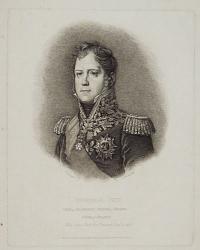
Marshal Ney. Duke of Elchingen, Prince of Moskwa, Peer of France. Who was Shot for Treason, Dec.r 8, 1815.
Gerard pinx.t. A. Easton Sculp.t.
Published April 9th 1816 by Edw.d Orme, Bond Street, corner of Brook Street, London.
Stipple, with very large margins. 260 x 205mm (10¼ x 8").
François Gérard's famous portrait of Marshal Michel Ney (17690815), in ceremonial uniform. He fought for Napoleon from begining to end: after his command of French rear-guard on the Retreat from Moscow in 1812 he was jokingly referred to as 'the last Frenchman on Russian soil. Although he persuaded the emperor to abdicate and accept his first exile in 1814 and prepared a force to stop Napoleon reaching Paris during the Hundred Days, Ney joined with Napoleon in 1815. At the Battle of Waterloo, seeing the day was lost, Ney led a final charge, shouting to his men 'Come see how a marshal of France dies!'. However he survived, only to be shot for treason, one of very few of Napoleon's generals not to be exonerated by the restored Bourbon monarchy. Gérard's oil remained in the family until the death of the 6th (and last) Prince of Moskow and his daughter, selling at auction for $242,500 in New York, 2013.
[Ref: 36029] £85.00
(£102.00 incl.VAT)
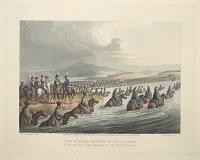
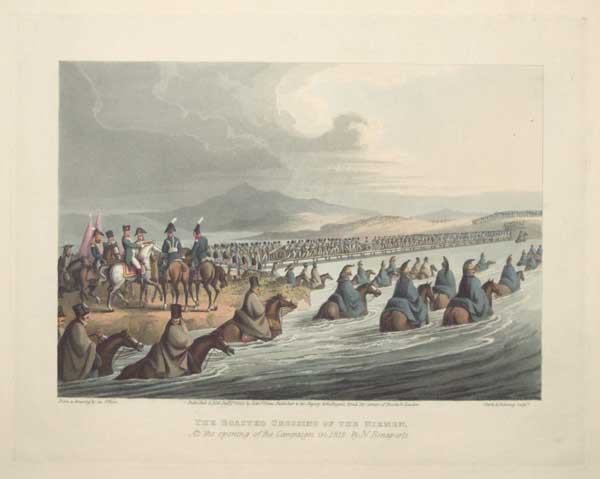
The Boasted Crossing of the Nieman, At the opening of the Campaign in1812, by N. Bonaparte.
From a drawing by an Officer. Clark & Dubourg Sculp.t.
Published & Sold Jan.y 1st 1816, by Edw.d Orme, Publisher to his Majesty & the Regent, Bond Str. corner of Brook St. London.
Coloured aquatint. 255 x 360mm (10 x 14¼"), with large margins. Mint.
Napoleon Bonaparte watches from the bank as his infantry cross a makeshift bridge (actually three pontoon bridges) and his cavalry ford the Neman River into Lithuania, at the start of the Russuan Campaign. From Orme's ''Historic, Military, and Naval Anecdotes, of Personal Valour, Bravery, and particular Incidents which occurred to the Armies of Great Britian and her Allies, in the last long-contested War, terminating with the Battle of Waterloo''.
[Ref: 55804] £140.00
(£168.00 incl.VAT)
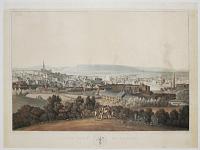
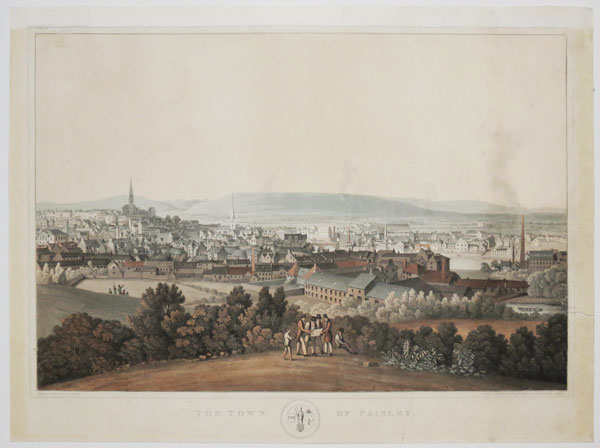
The Town of Paisley.
Drawn on the Spot by I. Clark.
London, Published by Smith, Elder & Co., 65 Cornhill, 1825.
Coloured aquatint. 510 x 665mm, 20 x 26¼". Trimmed to printed border at top, false margin added, two repaired tears.
Paisley in Renfrewshire, from the "Views in Scotland" series. Although it cannot be proved it is believed that 'I. Clark" is the Scottish painter John Heaviside Clark, famed as 'Waterloo Clark' for his early sketches of the Battle. He was also skilled in aquatinting, and certainly none of this series has a named engraver. Abbey No: 489.
[Ref: 27365] £260.00
(£312.00 incl.VAT)
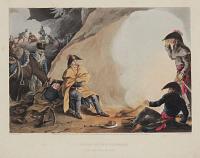
Bivouac in the Pyrennees. The night before the Battle.
J. A. Atkinson del. Fry & Sutherland sculp.t.
Published & Sold June 4th 1815 by Edw.d Orme, Publisher to his Majesty & H.R.H. the Prince Regent, Bond Street, corner of Brook St. London.
Coloured aquatint. 255 x 330mm (10 z 13"). Faint spotting.
Wellington and his officers around a fire, the night before the Battle of the Pyrenees, fought 25th-30th July 1813. A plate from Orme's 'Historic, Military, and Naval Anecdotes, Of Personal Valour, Bravery, and particular Incidents which occurred to the Armies of Great Britain and her Allies, in the last long-contested War, terminating with the Battle of Waterloo'. This was the first plate of the series, eventually published complete in 1819. It is interesting that this plate was published just over two months after the event shown. Abbey: Life 376.
[Ref: 33730] £130.00
(£156.00 incl.VAT)


![[Blücher] To his Royal Highness the Duke of Gloucester, Chancellor of the University of Cambridge](jpegs/34262.jpg)
![[Blucher. Copied from a Bust, Modeled at Paris, by M. Bosin.]](jpegs/33005.jpg)
![[Five portraits of Marshal Blücher]](jpegs/55845.jpg)


![[British cavalry.]](jpegs/41553.jpg)
![[Keyplate] Chelsea Pensioners reading the Gazette of the Battle of Waterloo.](jpegs/36975.jpg)
![[Keyplate] Chelsea Pensioners reading the Gazette of the Battle of Waterloo.](jpegs/58217.jpg)

![[Sir Augustus Frazer.]](jpegs/20169.jpg)

![[Lt Col John Gurwood] J.Gurwood [facsimile signature].](jpegs/63230.jpg)


![[The Right Hon.ble Viscount Hardinge, G.C.B., P.C.]](jpegs/65924.jpg)
![[The Right Hon.ble Viscount Hardinge, G.C.B., P.C.]](jpegs/65923.jpg)


![Edw.d Kerrison [facsimile signature].](jpegs/57854.jpg)

![[Siege of Kufstein] The Tyrolese Patriots,](jpegs/55802.jpg)


![[Leipzig] 'Brother the Lord is with us.'](jpegs/37118.jpg)


![[In pencil:] "Marengo". Buonaparte's... Charger at the battle of Waterloo.](jpegs/31227.jpg)


![[The Fall of Napoleon.]](jpegs/55754.jpg)
![[The Capture of French trophies during the Battle of Waterloo]](jpegs/37537.jpg)
![[Netherlands] General Chassé.](jpegs/31538.jpg)
![[Netherlands] Z.K.H. De Prins Van Oranje.](jpegs/9760.jpg)