Results 1-4 of 4
<<< Previous 1 Next >>>

Rencontre D'Anglaises a Paris. Le Suprême Bon Ton, No. 23.
AG [monogram of Adrien Godefroy].
A Paris chez Martinet, Libraire, Rue du Coq. No.15 [n.d., July 1814].
Coloured etching. Fine decorative interior design frame, sight size 205 x 270mm (8 x 10½").
Two British soldiers greet each other enthusiastically, one accompanied by his wife and daughter. From a series of 30 plates satirizing fashions observed in Paris by Aaron Martinet (1762 - 1841). BNF FRBNF41515493.
[Ref: 69570] £260.00
(£312.00 incl.VAT)
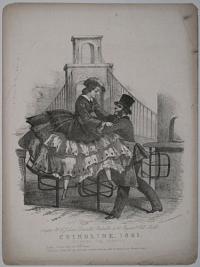
Crinoline 1861. Clearing the Barrier.
London W.H.J. Carter, Printseller, Bookseller, &c. 12, Regent St. Pall Mall. Printed at 22, Southampton St. Strand.
Lithograph, sheet 380 x 285mm. 15 x 11¼". Facsimile mss. publisher's price list to verso, for '...Prints, Illustrative of Crinoline...beautifully coloured'. Tatty extremities, creases through upper corners.
A satire on the mid 19th century fashion for crinolines, from an annual series on that theme by the same publisher. A lady is helped over turnstiles by a gentleman, a bridge, maybe Hammersmith Bridge, in the background. Crinoline was originally a stiff fabric with a weft of horse-hair and a warp of cotton or linen thread. The fabric first appeared around 1830, but by 1850 the word had come to mean a stiffened petticoat or rigid skirt-shaped structure of steel designed to support the skirts of a woman’s dress in the required shape. The crinoline was the subject of much ridicule and satire, particularly in Punch magazine. Dress reformers did not like it either — they seized upon the cage aspect of the crinoline and claimed that it effectively imprisoned women. Given that the crinoline did eventually have a maximum diameter of up to 180 centimetres (six feet), it is easy to imagine difficulties in getting through doors, in and out of carriages, and the general problems of moving in such a large structure. The second problem was the potential impropriety of the crinoline. Its lightness was a curse as well as a blessing, as a gust of wind or a knock could set it swinging and reveal the wearer's legs. Even worse, if a woman tripped or was knocked over, the crinoline would hold her skirts up.
[Ref: 15154] £180.00
(£216.00 incl.VAT)
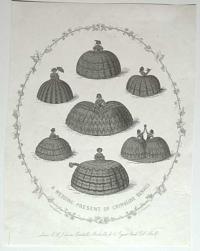
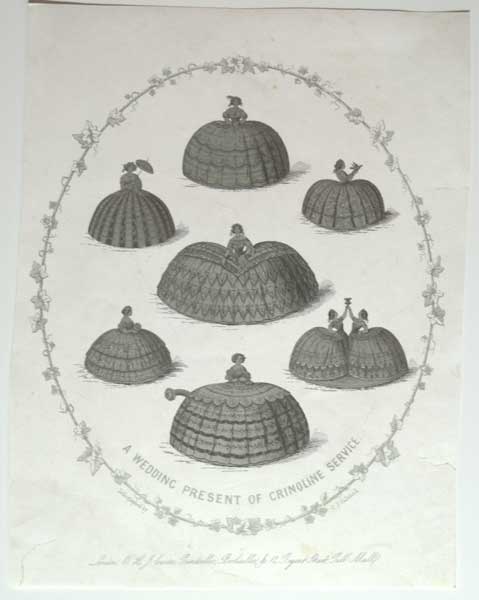
A Wedding Present Of Crinoline Service.
Lithographed by C.J. Culliford.
London, W. H. J. Carter, printseller, Bookseller, &c. 12, Regent Street, Pall Mall. [n.d. c.1850]
Very scarce lithograph, sheet 300 x 230mm (11¾ x 9"). Repaired tears.
A highly decorative satire on crinoline fashion, featuring 8 women in absolutely enormous skirts surrounded by an oval leaf border. W.H.J. Carter made a number of satires on crinoline publishing them annually. See also references 15161, 15159, 15153, 15154, 13109, 15160, 15165, 36835, 36836, 15352, 15353, 15354, 16831 & 42021.
[Ref: 61509] £180.00
(£216.00 incl.VAT)

The Little Unknown. The above gentleman turns round to express his gratitude to the Ladies of London on account of the very handsome and flattering manner in which his proposals have been received by them; at the same time he is happy to inform them that he is still open to treaty, no matrimonial arrangement having been determined on...
Published by S.W. Fores, 41 Piccadilly for the Proprietor 1832.
Very scarce lithograph with hand colour. Sheet 310 x 245mm (12¼ x 9¾"). Laid on scrapbook page.
A racist satire, the second in a series of three, taking the form of a man advertising his desire to find a wife. Although the illustration makes it clear he is black, the text, written in the third person, includes the line 'he has already expressly stated that he is by no means a [n-word]', and makes in plain that he is looking for a white wife, not a 'sable lady'. He writes he can be viewed in Hyde Park or the Burlington Arcade if it is raining. The third print in the series (BM Satires 15154) shows him as a very short man, engaged to a white woman who towers above him; an ink and watercolour sketch in the Lewis Walpole collection (lwlpr13368), apparently unpublished, shows him with a son. See BM 2006,0929.45 for very similar variant; Not in BM Satire, but see 15153 & 15154 for first and third plate.
[Ref: 53217] £390.00
<<< Previous 1 Next >>>