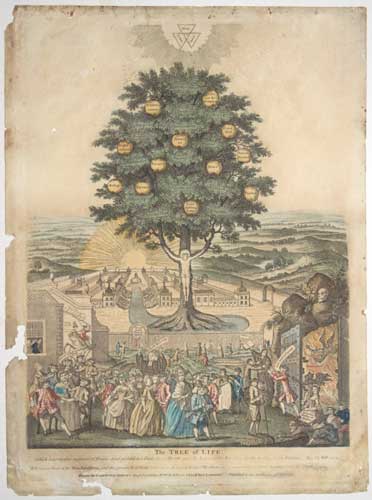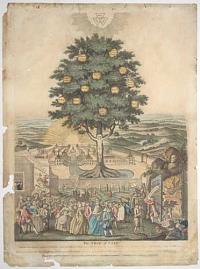
The Tree of Life, which bear twelve manner of Fruits...
Printed for Carington Bowles, Map & Printseller, N.º 69 in S.t Pauls Church Yard London. Published as the Act directs 25th Oct, 1772.
Scarce engraving with hand colour. 355 x 250mm (14 x 9¾"). Very damaged.
A satire on contemporary religiosity, with the traditional emblematic image of the Tree of Life bearing fruits carrying the names of virtues, with the symbol of the Trinity above and the 'New Jerusalem' behind. Bottom right is a door to the 'Bottomless Pit', with demons reaching to pull men into the flames. An early state: the two examples listed in the BM were both published by Bowles and Carver. BM Satires 4571.
[Ref: 70164] £120.00
(£144.00 incl.VAT)
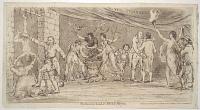
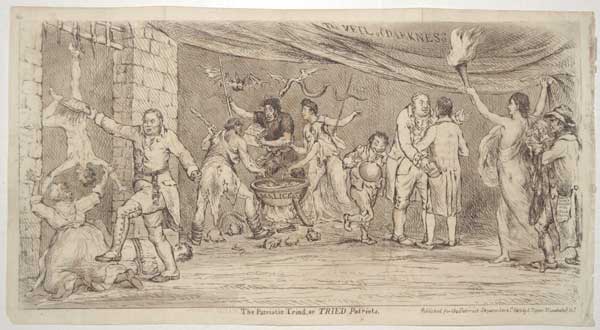
The patriotic triad, or tried patriots.
[Samuel De Wilde].
Published for the Satirist September 1st 1809. by S. Tipper. 37 Leadenhall St.t.
Etching with aquatint, sheet 205 x 375mm (8 x 15"). Trimmed within plate and folded as issued. Some transference.
Plate from the Satirist, v. 209. A satire on three recent trials: William Cobbett’s action for assault, which was grossly misrepresented; Wright v. Wardle; and a Chancery case involving Samuel Parkes’s A Chemical Catechism. Sir Richard Phillips had published a spurious version under the name ‘David Blair’, prompting an injunction against its sale. The print also refers to Dennis Hogan’s pamphlet, allegedly written by Peter Finnerty, which formed part of the attack on Frederick Duke of York. It exposes the character of these self-styled patriots. An attack on Cobbett, Wardle, and Sir Richard Phillips. Truth, holding a flaming torch, draws back a curtain inscribed ‘The Veil of Darkness’, revealing three scenes. Jack Ketch stands behind her holding papers naming Wright versus Wardle, Burgess ver Cobbett, and Park versus Phillips. In the first scene, Cobbett tortures a naked boy hanging from the bars of a prison cell, while an old woman tries to protect him and another boy lies bound nearby. In the centre, Wardle, dressed in goatskins and surrounded by serpents and reptiles, presides over a cauldron labelled ‘Malice’, stirring it with Peter Finnerty. Mary Anne Taylor adds an ingredient, while Mary Anne Clarke draws Wardle’s attention to the third scene. The fire beneath the cauldron burns copies of the Morning Chronicle, Political Register, Hogan’s Appeal, and Courier. On the right, Sir Richard Phillips slyly removes a book entitled Park’s Chemistry from his companion’s pocket, while a printer’s boy stands behind him. BM Satires 11359.
[Ref: 70098] £160.00
(£192.00 incl.VAT)
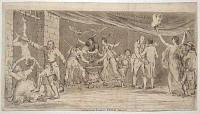
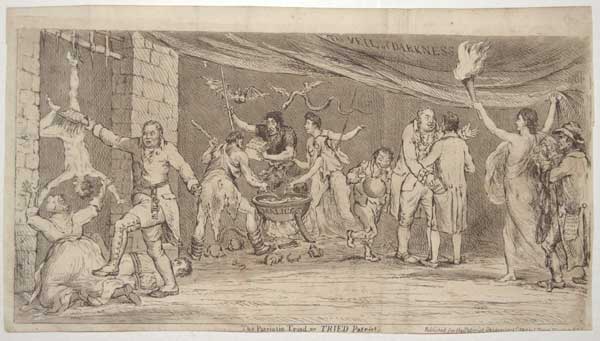
The patriotic triad, or tried patriots.
[Samuel De Wilde].
Published for the Satirist September 1st 1809. by S. Tipper. 37 Leadenhall St.t.
Etching with aquatint, sheet 205 x 370mm (8 x 14½"). Trimmed within plate losing some of the publication line at bottom. Top margin intact. Folded as issued.
Plate from the Satirist, v. 209. A satire on three recent trials: William Cobbett’s action for assault, which was grossly misrepresented; Wright v. Wardle; and a Chancery case involving Samuel Parkes’s A Chemical Catechism. Sir Richard Phillips had published a spurious version under the name ‘David Blair’, prompting an injunction against its sale. The print also refers to Dennis Hogan’s pamphlet, allegedly written by Peter Finnerty, which formed part of the attack on Frederick Duke of York. It exposes the character of these self-styled patriots. An attack on Cobbett, Wardle, and Sir Richard Phillips. Truth, holding a flaming torch, draws back a curtain inscribed ‘The Veil of Darkness’, revealing three scenes. Jack Ketch stands behind her holding papers naming Wright versus Wardle, Burgess ver Cobbett, and Park versus Phillips. In the first scene, Cobbett tortures a naked boy hanging from the bars of a prison cell, while an old woman tries to protect him and another boy lies bound nearby. In the centre, Wardle, dressed in goatskins and surrounded by serpents and reptiles, presides over a cauldron labelled ‘Malice’, stirring it with Peter Finnerty. Mary Anne Taylor adds an ingredient, while Mary Anne Clarke draws Wardle’s attention to the third scene. The fire beneath the cauldron burns copies of the Morning Chronicle, Political Register, Hogan’s Appeal, and Courier. On the right, Sir Richard Phillips slyly removes a book entitled Park’s Chemistry from his companion’s pocket, while a printer’s boy stands behind him. BM Satires 11359.
[Ref: 70099] £140.00
(£168.00 incl.VAT)

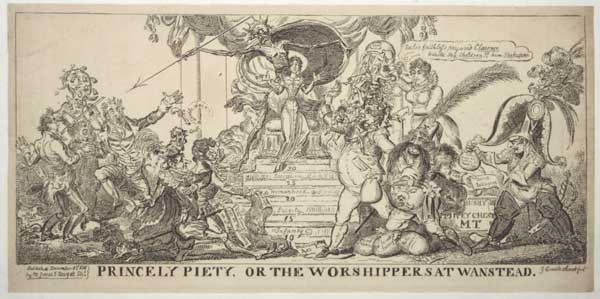
[The Wanstead Heiress] Princely piety, or the worshippers at Wanstead.
G. Cruikshank fec.t.
Published December 1st 1811 by M Jones 5 Newgate Str.t.
Etching. Sheet 200 x 410mm (8 x 16") Trimmed within plate, small hole in centre, laid on album paper at edges.
Catherine Tylney-Long (1789-1825), heiress to the 4th Earl of Plymouth with his estate at Wanstead, stands on a platform with steps inscripted with the stages of a woman's life. She and her wealth are protected by a skeletal Death, who uses his spear to ward off her suitors. On the right is the Duke of Clarence, who hoped to pay off his enormous debts with her money. His former mistress Mrs Jordan, empties a chamber pot (known as a 'Jordan') full of his children over his head. By his side is the Hungarian Baron Ferdinand de Geramb, show here as Napoleon's spy, exchanging 'Secret Intelligence' for gold. Provenance: Alfred Brewis, Newcastle ship owner, 1912.
[Ref: 70140] £220.00
(£264.00 incl.VAT)

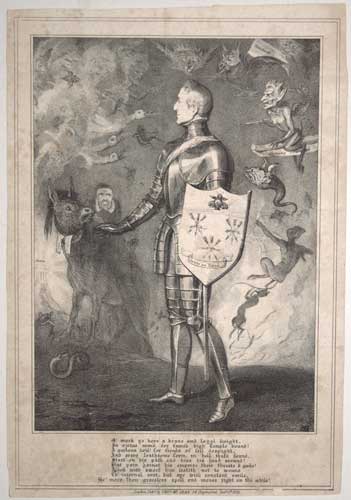
[Duke of Wellington as Don Quixote] O! mark ye here a brave and loyal knight, / In Virtue arm'd, from fame's high Temple bound!
HB [John Doyle].
London Pub.d by Tho.s M.cLean, 16 Haymarket Jan.y 1.st 1830.
Lithograph, folded to make envelope; Verso part G. Villiers Esq. Broad of ? Dubl ... postal stamp; Sheet 370 x 255mm (14½ x 10"). Tears, creases and stains.
A full-length caricature of the Duke of Wellington as Don Quixote, looking past Sancho Panza and his donkey towards the shining temple of Fame. Around his head swarm visions of demons and geese. Postal history interest.
[Ref: 70170] £130.00
(£156.00 incl.VAT)
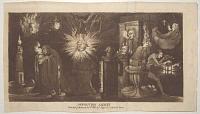
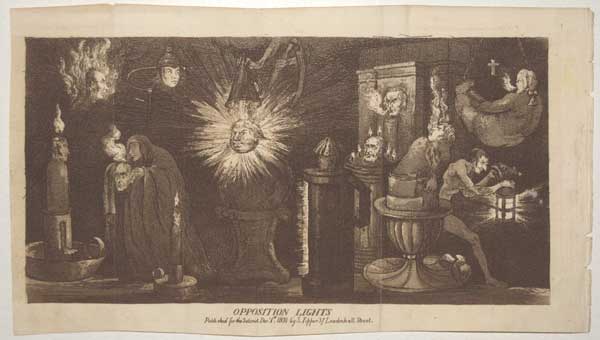
Opposition lights.
[Samuel De Wilde]
Published for the Satirist Decr 1st 1808. by S. Tipper 37 Leadenhall Street.
Etching with aquatint, sheet Trimmed within plate. Folded as issued.
Plate from the 'Satirist', iii. 449. Members of the Opposition are depicted as candles, lamps and other sources of light, each satirising their character or political role. From left to right: Lord Charles Kinnaird as a kitchen candle; Charles Grey as a flaming “firebrand”; Thomas Erskine as a vestal lamp; Samuel Whitbread II as a parish street lamp; Henry Petty-Fitzmaurice as a dim rush-light; Richard Brinsley Sheridan as a brilliant globe emitting rays, soon to be extinguished by Time; George Ponsonby as a dark lantern; Charles Howard Duke of Norfolk as a candle in tallow; William Windham as a gas light; Henry Temple, 2nd Viscount Palmerston as a collapsing candle; Burdett as a dim ignis fatuus carrying a lantern inscribed ‘Horne’; and William Wyndham Grenville, 1st Baron Grenville as a Roman lamp hanging from the ceiling. The remaining Opposition members are destined to become “simple tapers.” The satire chiefly refers to Whitbread’s educational scheme, introduced as part of his Poor Law Bill on 19 February 1807 and later made a separate bill. It proposed free parochial education for two years for children aged seven to fourteen whose families could not afford it. The measure passed its second reading but was rejected by the Lords and met considerable hostility in the country. BM Satires 11056.
[Ref: 70100] £180.00
(£216.00 incl.VAT)
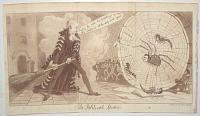
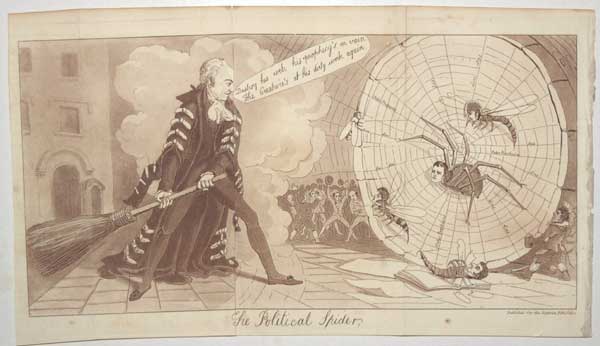
The Political Spider.
Published for the Satirist Feb.y 1st 1812.
Etching and aquatint, sheet 205 x 365mm (8¼ x 14¼"). Folds as issued. Trimmed left and right within plate.
Plate from the 'Satirist', x. 61. A satire on Samuel Whitbread’s speech of 8 January, in which he predicted disaster in the Peninsula and advocated peace. Spencer Perceval, in his gown as Chancellor of the Exchequer, stands with legs astride, holding a large broom as he prepares to sweep away an immense spider’s web. He declares, “Destroy his Web, his prophecy’s in vain. The Creature’s at his dirty work again,” adapting (or misquoting) Pope’s Epistle to Dr Arbuthnot (1734). The words ‘Lies’ appear eleven times across the web, alongside ‘False Prophesies’ three times. A large spider with Whitbread’s head advances towards Perceval, while three human-headed insects are trapped in the web and a fourth, resembling Wardle, has fallen with broken wings. The insects include figures with long, jointed or striped bodies and projecting stings, a fly, Sir Francis Burdett, and a figure in a cocked hat, probably Lord Cochrane. Papers and an open book lie beside the web. To the right, a countryman in tattered clothes holds a frothing tankard and looks up in alarm, while a cheering crowd gathers behind the web. The Treasury is represented by a building behind Perceval at the extreme left. BM Satires 11848.
[Ref: 70143] £180.00
(£216.00 incl.VAT)
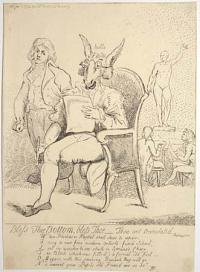
[Joseph Wilton] Bless Thee Bottom, bless Thee__Thou art translated. Shakespere. W - hen Phidias or Raph'el shall chuse to repair, / I - ncog to our fine modern Artists' fam'd School, / L - ost in wonder to see stuck in Genius's Chair / T - he Block which now fills it) a formal old Fool - / O - ff again with this sneering Remark they will go / N - o marvel your Pupils old Friend are so so''. JP.
[Isaac Cruikshank.]
Pub Jany 1 1794 by S W Fores No 3 Piccadilly.
Etching, 18th century watermark. Sheet 300 x 215mm (11¾ x 8½"). Trimmed close to image.
Joseph Wilton (1722–1803), Keeper of the Royal Academy, as Bottom, sitting in an arm-chair, wearing spectacles on his ass's forehead. In his right hand is a stick of charcoal, in his left is a paper, which he is studying. Above his head is etched 'Apollo'. The man looking over Bottom's shoulder, his fists clenched, is John Inigo Richards (1731–1810), secretary of the R.A. In the background two students draw a nude male statue on a pedestal. BM Satires 8519.
[Ref: 54456] £140.00
(£168.00 incl.VAT)
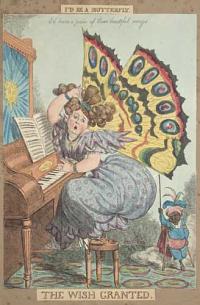
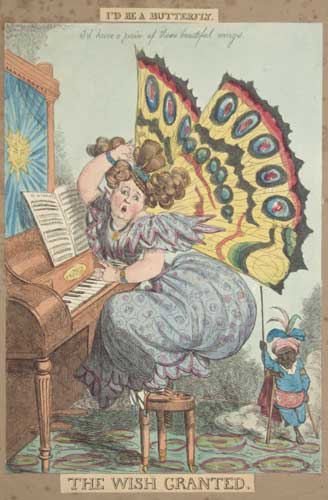
I'd Be a Butterfly. The Wish Granted.
[by William Heath.]
Published by Tho.s McLean 26. Haymarket [n.d., c.1929].
Etching with hand colour. Album sheet 365 x 245mm (14¼ x 9½''). Trimmed inside plate and laid on album paper..
A large woman seated at a piano sings 'I'd be a Butterfly' by Thomas Haynes Bayly. As she sings the words 'I'd have a pair of those beautiful wings', a cloven-hooved, dark-skinned, impish figure waves a wand and large butterfly wings sprout from her back, much to her surprise. Not in BM Satires.
[Ref: 70088] £70.00
(£84.00 incl.VAT)