Results 1-5 of 5
<<< Previous 1 Next >>>

"Jemmy's" Last New Pattern. The "Dodworth Nob!! Sheffield Borough Election, July 28th. 1837. John Parker Esquire 2 18 6. Henry George Ward Esquire 19 76. John Thornely Esquire 6 55.
G.E. Madeley lithog. 3, Wellington St. Strand, London.
[n.d. c.1838.]
Coloured lithograph, very rare. 443 x 305mm (17½ x 12"). Tears, folds, creasing and soiling. Bottom trimmed.
In the 1837 United Kingdom general election Viscount Melborne's Whigs won their fourth election of the decade. However in Sheffield, John Parker and Henry George Ward were the liberal representatives and John Thornely stood as a Conservative. Out of the duck's beak "Noa" !
[Ref: 29019] £160.00
(£192.00 incl.VAT)

Lander's Grave, at Fernando-Po. From a Sketch taken by Mr. S.L. Crofton, of H.M.S. Pelosus.
G.E. Madeley, lith. 3. Wellington St. Strand.
Pub. July 1834, by Ackermann & Co. 96, Strand.
Very scarce lithograph, sheet 185 x 215mm. 7¼ x 8½". Sheet trimmed.
Two European travellers visiting the tomb of Richard Lemon Lander (1804 - 1834), who explored the course of the Niger river, West Africa. The son of a Truro innkeeper, Lander's explorations began as an assistant to the Scottish explorer Hugh Clapperton, on an expedition to Western Africa in 1825. After Clapperton's death near Sokoto, Lander proceeded southeast to Kano and then returned to the coast through the country of the Yoruba people. He returned to Western Africa in 1830, accompanied by his brother John. They landed at Badagri and followed the lower Niger River from Bussa to the sea. After exploring about 160 kilometres of the Niger River upstream, they returned to explore the Benue River and Niger Delta before travelling back to England. On a trading expedition up the Niger in 1832, Lander was wounded by tribesmen attacking his canoe, and he died soon thereafter. Probably from ‘A Journal of the Niger Expedition...by Macgregor Laird and D. N. R. Oldfield,’ London, 1834, 2 vols. Laird and Oldfield are likely the two men here depicted. Not in Abbey Travel. From: Charborough House, residence to the Erle-Drax family.
[Ref: 14920] £160.00
(£192.00 incl.VAT)
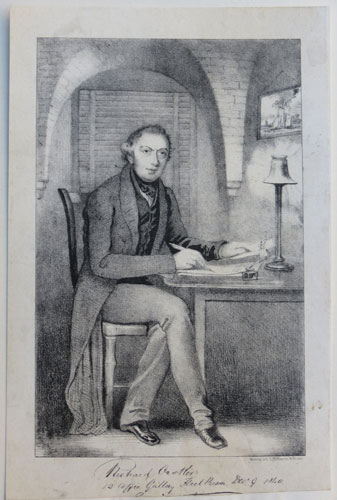
Richard Oastler, 12 Coffee Gallery, Fleet Prison Dec. 9 1840
Madeley lith. 5 Wellington St. Strand
Lithograph, rare, sheet 230 x 150mm (9 x 6"). Trimmed. Bit messy.
Richard Oastler (1789 - 1861), factory reformer. Oastler was famously 'awakened' in 1830 to the cruelties routinely practiced in English textile mills, and throughout the 1830s was an infuential advocate of factory reform, his oratorical skills earned him the sobriquet 'The factory king'. His paternalistic view of society meant that Oastler, the quintessential Tory radical, abhorred the idea of strikes, trade unions and universal suffrage. Eventually, in 1838, Thomas Thornhill, the squire of Fixby who employed Oastler as a steward on his estate, turned against Oastler, dismissing him and initiating legal proceedings against him. Unable to repay debts to Thornhill which he had accumulated, Oastler was committed to the Fleet prison for three and a half years (the date on this print is the date his sentence began). As this portrait suggests, Oastler kept busy in prison editing a weekly newspaper, and continued to edit a magazine after his release, but these had little influence. It was not as a writer but as a presence and speaker that Oastler was most influential.
[Ref: 41659] £140.00
(£168.00 incl.VAT)

Extraordinary Exploit On Tuesday the 17th of January 1826, Mr. Henry Hunt Jun.r for a bet of 100 Guineas made with a Noble Lord of sporting celebrity drove his Father's Matchless Blacking Van with four blood horses upon the Ice over the Serpentine at the broadest part[...]
Ingrey & Madeley Lithog. 310 Strand
J. Limbird 143 Strand [1826]
Scarce lithograph, sheet 255 x 350mm (10 x 13¾"). Glued to backing sheet at top corners. Bottom left corner made up.
Illustration of a man driving a van across the Serpentine river in London's Hyde Park for a bet. The text assures us that 'he accomplished the hazardous task in the grandest style without the smallest accident'.
[Ref: 39595] £480.00

The Two Chancellors. Oxford. Great Britain.
G.E. Madeley lith. 3. Wellington St. Strand.
Pub.d by T. Bird, 1. Wells St. Oxford St. [n.d. c.1834.]
Coloured lithograph with added gum arabic, original colour. 278 x 386mm. 11 x 15¼". Some staining; top left and right-hand side.
Two statuettes, with caricature features of the Duke of Wellington, Chancellor of the University of Oxford 1834-52 marked 'Oxford', the other of Henry Peter, 1st Baron Brougham and Vaux, Lord Chancellor 1830-34, marked "Great Britain". The highlights of Brougham's tenure was the passing of the 1832 Reform Act, of which he was a staunch supporter, and the Slavery Abolition Act of 1833, the cause to which he had been devoted to for so many years. He was offered the post by Grey following the defeat of Wellington's Government in 1830.
[Ref: 17816] £95.00
(£114.00 incl.VAT)
<<< Previous 1 Next >>>